Growing up with technology isn’t the same as knowing how to learn with it. As artificial intelligence reshapes higher education and the workplace, Denison is helping students build the digital habits, technical skills, and critical judgment they’ll need to succeed from the moment they arrive on campus.
Students arrive with tremendous experience using technology socially and creatively. College asks them to use technology differently: to organize complex work, collaborate across disciplines, manage information, and increasingly, partner thoughtfully with AI. Most critically, the vast majority arrive on campus having used only Chromebooks and Google platforms. They have little, if any, knowledge of the Microsoft products, including Excel, that are critical for college and careers.
Instructional technologist Sam Friedmann sees this disconnect firsthand. Professors seek her guidance to help their bright, highly motivated students learn fundamental digital skills. “It’s counterintuitive,” she explains. “They’re often incredibly fluent with phones and apps, but not always as practiced with storage and file organization — the building blocks that underpin everything we do in college.”
To close this gap, Denison has created two online courses to prepare every incoming student to use technology with confidence, curiosity, and purpose while, strengthening the critical thinking, ethical reasoning, and human relationships at the heart of a liberal arts education.
High School to The Hill: Digital Foundations (H2H)
Students in the H2H program familiarize themselves with commonly used University technology by participating in realistic scenarios. They learn the ins and outs of Denison’s learning platform, best practices for file storage and backup, Google Drive setups, cybersecurity tips, and how to access online library resources.
“They are using their own devices, working in their actual accounts, and practicing with the tools they will rely on throughout their time at Denison,” said Lori Kumler, associate director of educational technology.
“Denison is unique in preparing our students before they get to campus for the digital technology they’ll be using here. I don’t know of another liberal arts college that is doing this.”
Every incoming student completes their online H2H course as part of the admission process. The practice-based learning modules build muscle memory and confidence. The entire course takes less than an hour to complete, and students will be able to access optional modules on the Microsoft Office suite, troubleshooting, operating systems of Macs and PCs, and more.
There’s even a module for incoming students to record themselves saying their name. They can access the recordings over the summer and hear their roommates’ and classmates’ pronunciations, building early connections with their cohort — and hopefully helping to smooth over what can sometimes be a socially awkward situation: Asking people to repeat their names.
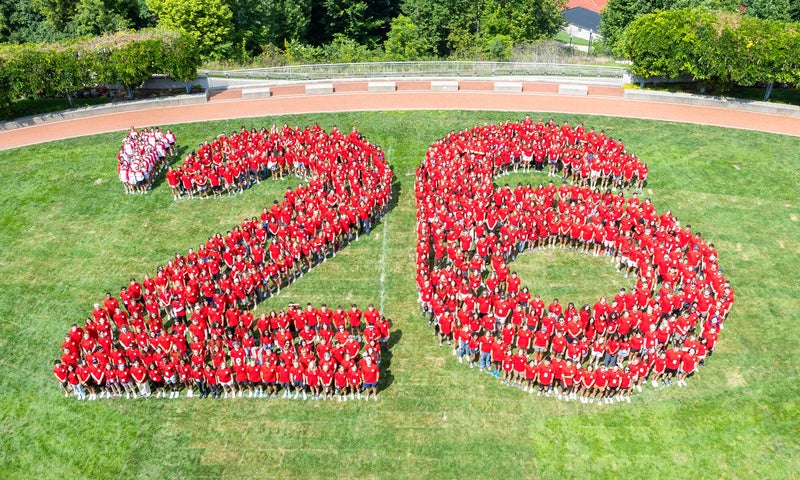
The Class of 2030 will be the first to reap the benefits of a full year of planning, testing, and iterating the course, including more than 600 student test-pilots. “We’re excited to help them hit the ground running,” said Friedmann.
Incoming transfer student Zoe Beauchamp ’29 is a fan of the modules. She said she hadn’t received tutorials about navigation or file storage in high school, and appreciates learning these new skills as well as tips for organizing her important documents and cyber security.
“Moving forward to Denison, I will be more vigilant in protecting my personal information by getting a password manager and being more mindful about where and how I store my files and documents,” she said. “Thanks for putting this course together; it was quite useful!”
Denison AI Essentials
AI works best when it supports — not supplants — student learning.
“The struggle of figuring out what you actually think about something, of finding the right words to express a complex idea, of sitting with a hard problem until it starts to make sense, that’s real learning,” said Lori Robbins, Denison’s head of AI strategy, and assistant director of the King Center for Data & Innovation. “We’re helping students to develop ways of using AI that don’t shortchange the very development that makes a liberal arts degree valuable.”
To aid incoming students level up their AI knowledge, Robbins’ AI student ambassadors have created Denison AI Essentials, an online course that covers AI limitations, ethics, and expectations at Denison.
“School isn’t just about getting assignments done, it’s about developing critical skills,” said AI student ambassador and computer science major Ethan Tecson ’26. “It’s important to be aware of where AI can help your learning instead of hindering it.”
Tecson and his fellow AI ambassadors fashioned a roadmap for Denison students to build foundational skills, develop a critical lens for the technology, and create personal AI philosophies. They learn about generative AI and what makes it different from other technologies, build their familiarity with AI productivity and chat tools, and practice creating effective prompts. Students are also informed about AI limitations, such as bias, hallucinations, and the “yes bot” effect.
Kelsey Sweetland ’29 has been using AI for years to help publish her children’s books and create her business, Authors for Nature.
“I’m comfortable having AI ask me questions so I can come up with answers, but I’m uncomfortable with AI coming up with ideas for me,” she says.
Sweetland creates class-specific AI mentors to quiz her and teach her concepts, but she says it’s fine for students who want to lean away from the tech. “It’s OK to not use AI at all,” she says.
“What we hope for is that even if you choose not to use the tools, you should understand what it is you are in opposition to.”
Students come to Denison to learn to think critically, communicate persuasively, engage with complex ideas, and develop a point of view that is uniquely their own, Robbins said.
“These are liberal arts values that align with our mission statement to help our students become ‘autonomous thinkers, discerning moral agents, and active citizens of a democratic society,’” said Robbins. “Students who know when and why to use AI, and what the trade-off is when they do, will thrive at Denison and after they graduate.”