
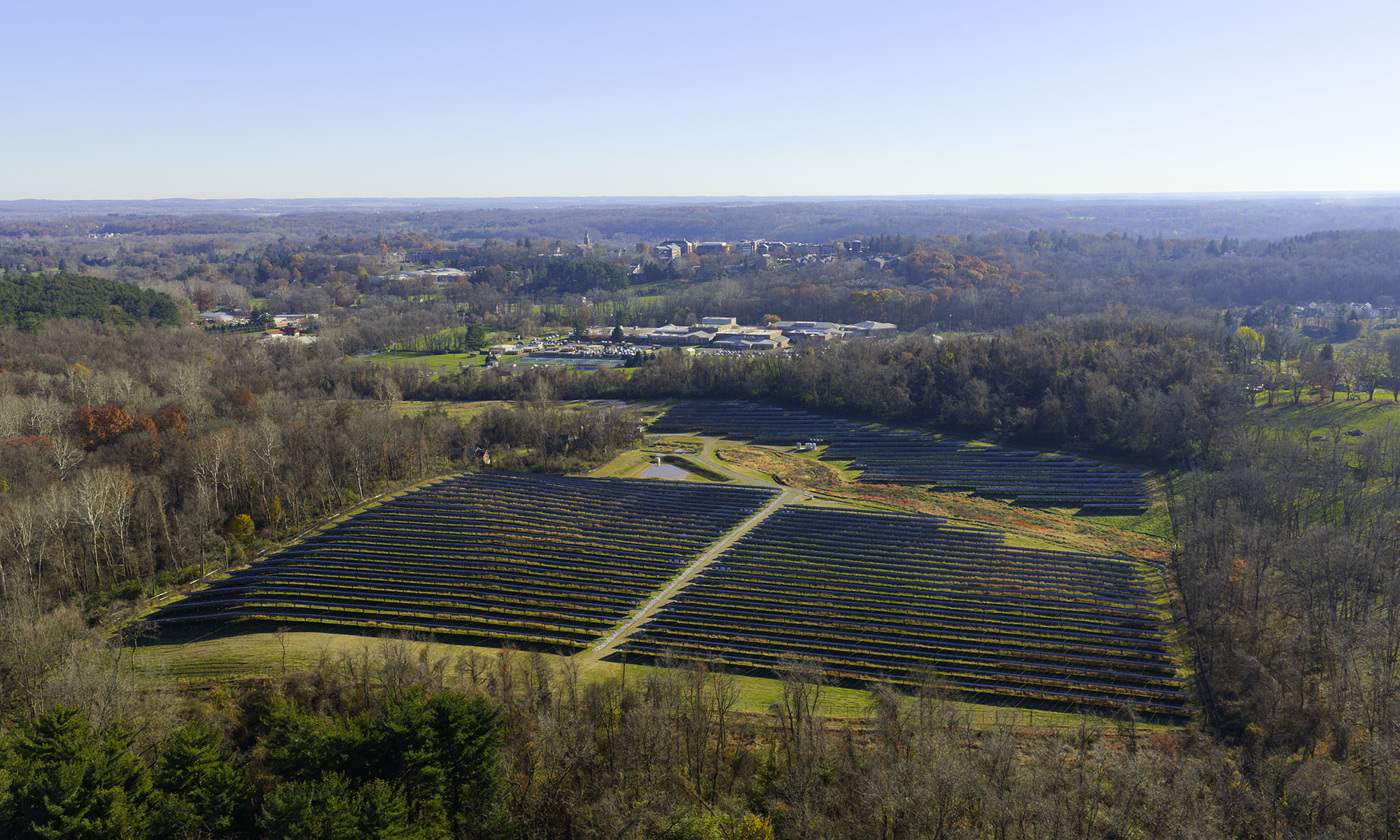
Continuing its commitment to sustainability — a core Denison value — the university powered up its largest solar array in June 2026.
The 10,800-panel unit, built on land north of campus, became the university’s 11th solar installation. Nearly 40% of Denison’s annual electricity now comes from renewable sources, at a time when demands on the electrical grid are escalating and energy costs are rising.
The new array will offset about 5.5 million pounds of carbon dioxide annually.
“This project marks a historic moment for the college,” said Jeremy King ’97, Denison’s director of sustainability. “This represents our largest single investment in sustainability to date and a significant milestone toward our goal of becoming carbon net zero by 2045.”
Denison has reduced its carbon footprint 50% since 2010, and King said the addition of the newest array — the largest solar installation at any Ohio university — could drive that total to 65%.
The solar arrays are just one way the university has lowered its greenhouse gas emissions. Other Denison initiatives to increase energy efficiency include:
- Committing to a “green revolving loan fund” that has invested in more than 150 energy efficiency and water conservation projects across campus. One example is Denison’s transition to more compact fluorescent and LED lighting.
- Hiring an energy consulting firm to create a master plan to reach its 2045 carbon net-zero goal. Denison has taken the firm’s report and turned it into an “energy road map.”
- Moving away from steam heating in new and renovated buildings. Hot-water heating is more efficient, King said.
- Electrifying more of the university’s heating systems, a process that allows Denison to use renewable energy as the source rather than fossil fuels.
- Installing EV chargers and transitioning to electric vehicles when it comes time to replace vehicles in Denison’s fleet.
The university is even employing sheep to graze beneath the solar panels rather than rely on diesel-powered mowers and chemical management to keep the vegetation down. The practice illustrates Denison’s determination to take no shortcuts toward sustainability.
King said the university doesn’t purchase carbon credits — tradeable certificates allowing buyers to achieve sustainability goals by having third parties reduce carbon emissions elsewhere. Each credit equals one metric ton of carbon dioxide or other greenhouse gases.
“Our approach at Denison has been, ‘We’re not going to lean into buying our way out of our emissions,’” King said. “We’re actually going to reduce our emissions on campus. That’s more meaningful.”
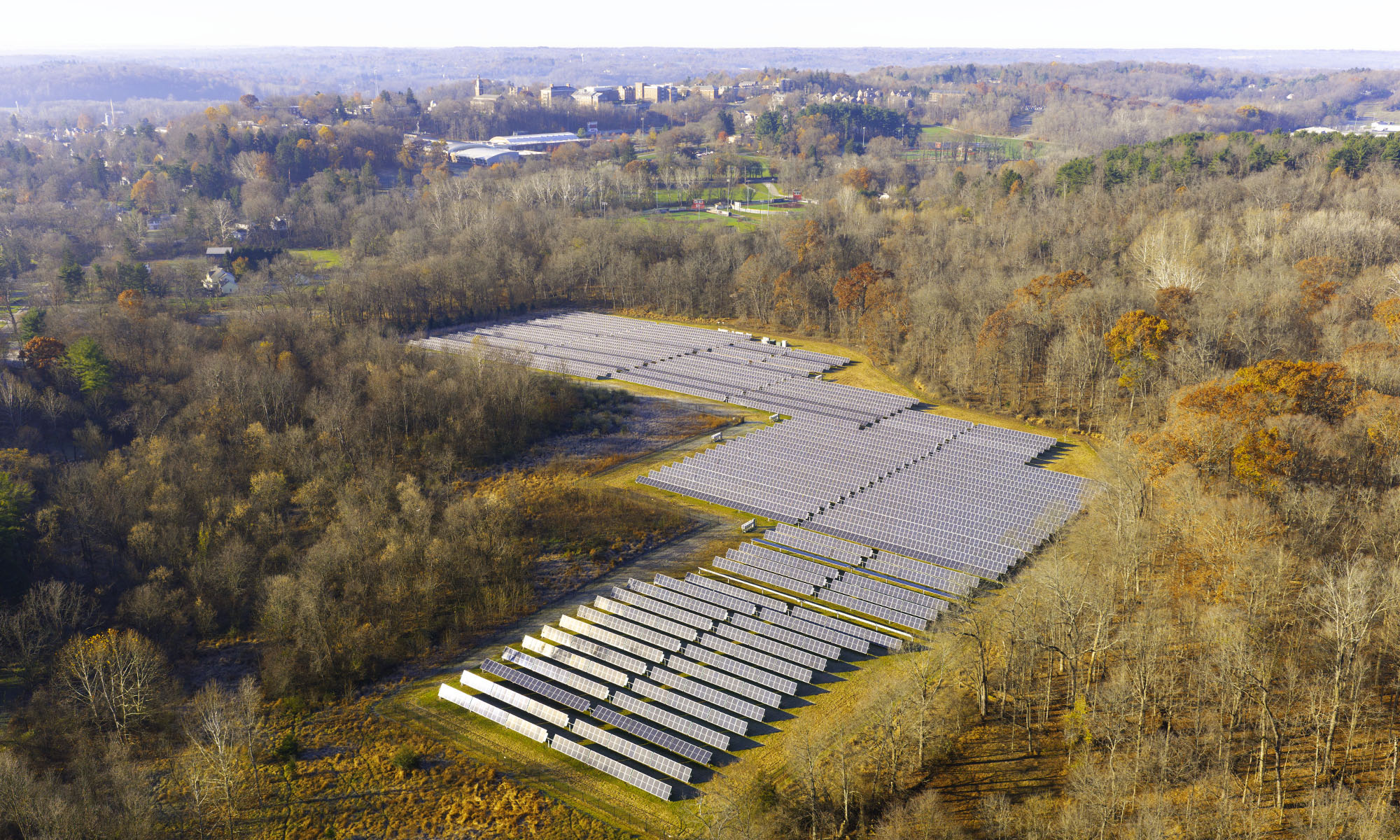
Denison’s first ground-mounted solar array was turned on in 2017.
The solar arrays have been a focal point in two Denison sustainability pledges. In 2010, Denison joined the American College and University Presidents’ Climate Commitment, pledging to become carbon neutral by 2030. Coming out of the pandemic, President Adam Weinberg and the campus sustainability committee decided carbon neutrality was not going to “move the needle,” King said, and “upped the ante” with its net carbon-zero goal for 2045.
Plans for the university’s latest and most ambitious solar array began in 2023, when campus partner Kokosing Solar authored a study illustrating the economic benefits.
Jake Preston, director of physical plant and capital projects, credits much of the project’s early development to James Gallick, Denison’s senior automation engineer. What started with Gallick sketching ideas “on a napkin” evolved through his technical analysis and collaboration with the project team into a 5.4-megawatt solar array.
Preston said it’s a worthy investment on multiple levels.
“There’s much more to the story than just producing solar volume,” he said. “This project helps us manage how much impact we have on the grid throughout the summer months. That’s not just a benefit to Denison, it’s a benefit to the whole grid. The fact that it is reducing our impact during the times when people need power the most pays dividends to everybody in the surrounding community.”
Preston said the demand for electricity in Licking County in the past three years has reached unprecedented levels. With soaring costs, Denison is reaping the benefits of a campus that runs on 40% renewable energy.
“There’s a real business case to be made for these projects,” he said.