
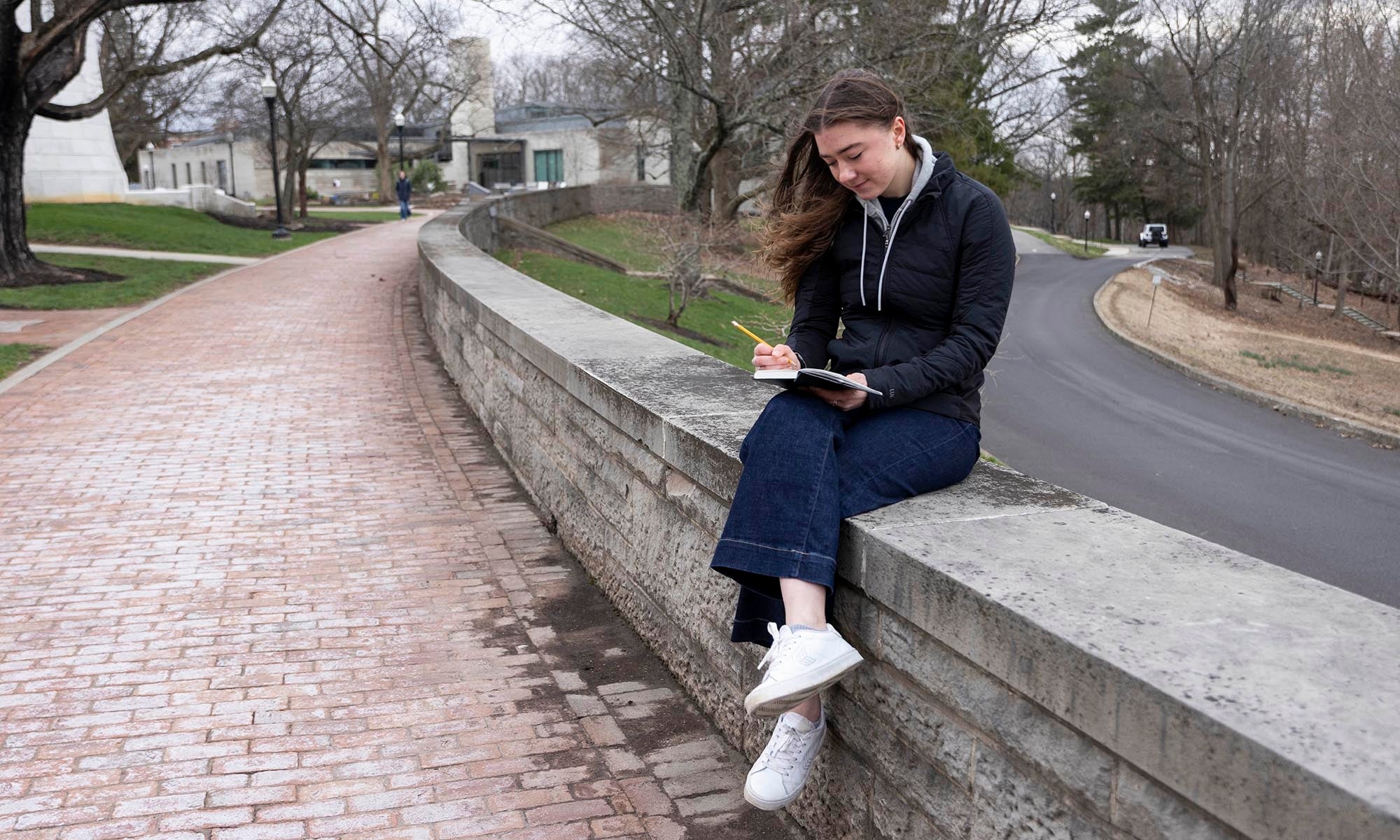
Kelsey Sweetland ’29 stands before her first Denison class, buzzing with energy as she guides peers through a three-week course on using AI to reach their goals.
Dreams spill out, and questions follow. How do I build an online mentorship for athletes? Create a travel guide that serves international students? Start a late-night Denison DoorDash for classmates?
With years of experience already under her belt, Sweetland handles it all with ease. She leads her peers from self-discovery to concrete action plans, all powered by AI tools — and a guidebook she wrote herself.
A self-taught entrepreneur
At 19, Sweetland has taught herself to write, illustrate, and publish four children’s books about nature. She’s forged partnerships with international nonprofits, explored the ins and outs of marketing, and founded Authors for Nature, a creative program publishing house that helps other young writers publish and bring awareness to environmental issues.
Obsessively watching The Blue Planet as a toddler may have sparked her environmental advocacy, but Sweetland credits middle school teachers for turning talk into action with a single question: “What are you doing about it?”
A week-long immersion in The Bahamas’ damaged ecology sharpened her resolve to spotlight endangered fish and the ocean — eventually leading to her first children’s book: Natalie the Narwhal, whose net proceeds benefit nonprofit Mission Blue.
It wasn’t all smooth sailing. “It took a lot of grit,” Sweetland says. Instead of sleeping in on weekend mornings, she was up early to write and illustrate her book. Then Sweetland planted herself at the computer for hours of trial-and-error, learning Adobe Illustrator, mastering the IngramSpark self-publishing platform, and publishing her first children’s book at the age of 13.
Three more books followed, and as she began interacting with customers at local stores to showcase her titles, Sweetland realized that a number of people were asking her how to publish their own books.
Recognizing her knowledge base was a viable product that could also advance her environmental aims, Sweetland’s next step was to create a website and video. Using ChatGPT, which had just matured into a practical toolset for budding entrepreneurs, she launched into building the business online — with little parental hand-holding beyond her software engineer father’s guidance.
Today, Authors for Nature is a publishing house with a live community chat and weekly meetings, all supported by a video course for aspiring authors that uplift environmental issues. Sweetland continues to innovate; now she is building AI chatbots to augment her services and launching a podcast series to help market her clients’ books.
Bringing hard-earned knowledge to The Hill
Her journey from the foothills outside San Francisco Bay to The Hill at Denison began with a simple wish: a place to study what she loved and a robust entrepreneurship lab.
She did her research, traveling across the country on campus visits. “You wouldn’t believe how hard it was to find a good entrepreneurship lab that cared about what I wanted to do,” she says.
Sweetland got a whole different vibe from the Red Frame Lab, Denison’s consulting and entrepreneurship program. When she walked into an interview her website was prominently featured on a large screen. Then she and Director Steve Krak had “one of my favorite conversations.”
“I talked with Steve about sustainability and publishing and coding,” she says. “Then I walked around the campus and just knew I wanted to go here. When I received my acceptance letter from Denison, I withdrew all my other applications.”
In her first semester, she joined Denison’s AI Student Ambassador Program, led by Lori Robbins, head of AI strategy. She’s part of a student coterie who explore AI tactics, study the tech, and teach their peers.
“I love this job,” says Sweetland, who was named “Overall Student Employee of the Year” for her work in the program. “I’ve learned so much about AI and the tools behind it.”
Working with Robbins, Sweetland developed a three-part AI Innovation Studio to help students, faculty, and staff turn ideas into reality — and she teaches it in the Red Frame Lab.
“I haven’t been surprised, but I am amazed at the level of creativity and ability Kelsey applies to her academics and her work as an AI ambassador and entrepreneur,” says Red Frame’s Associate Director Rick Coplin ’85. “Everything she does, she does well. Plus, it’s so much fun to work with her.”
Keeping a finger on the pulse of AI
Sweetland believes humans and AI can coexist — and thrive — if people guide the tech rather than letting it steer them.
“AI is not going away, so we need to think about the best way to guide it,” she says. “Dreamers, thinkers, and artists are in the best position to steer AI, because they can delegate and automate technical portions of their work, and make their visions a reality.”
The technology evolves by the day. “It’s changing monthly, weekly, or daily,” Sweetland notes.
With guidance from Robbins, as well as an unexpected advisor from Harvard, Tony Wagner, she’s shaping her ideas into a new book on the student perspective amidst the generative AI revolution, covering AI literacy, ethics to protect human voice, creativity, responsibility, and critical thinking.
Wagner, expert in residence at the Harvard Innovation Lab and founder and co-director of the Change Leadership Group at the Harvard Graduate School of Education, is the author of Creating Innovators, which Sweetland’s parents referenced as a pivotal book in shaping their approach to their daughter’s childhood education.
As Wagner learned more about Sweetland’s accomplishments and their mutual interests in underwater photography, writing and education, their correspondence grew.
“Tony is an amazing writer, educator, and mentor,” says Sweetland. “I’m so lucky to have his input and guidance while writing this book.” Sweetland is eager to share her expertise in generative AI with the Denison community.
She sees a range of engagement with AI among students. Some adapt, others are concerned about environmental impact, and still others worry about losing creativity and a hard-won education.
“Everyone is waiting for someone to help them with it,” she says.
But this force of nature is not waiting. She’s learning, building, innovating, and teaching. Her philosophy is simple: do your research, roll up your sleeves, and learn by doing. Then follow the impulse to share your abundance. Naturally.
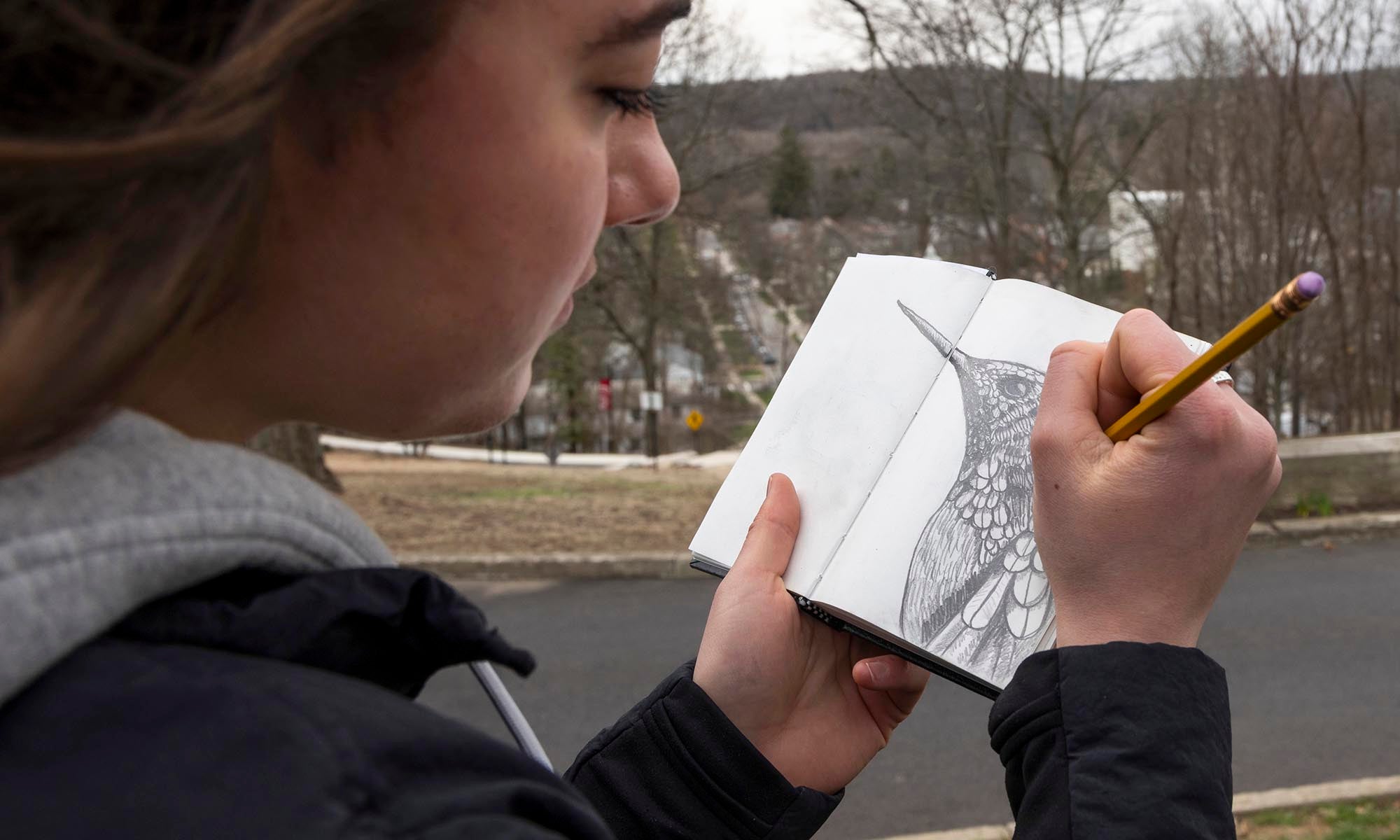
Kelsey Sweetland ’29 puts the finishing touches on a sketch that could end up as an illustration in her next book.