Denison Magazine
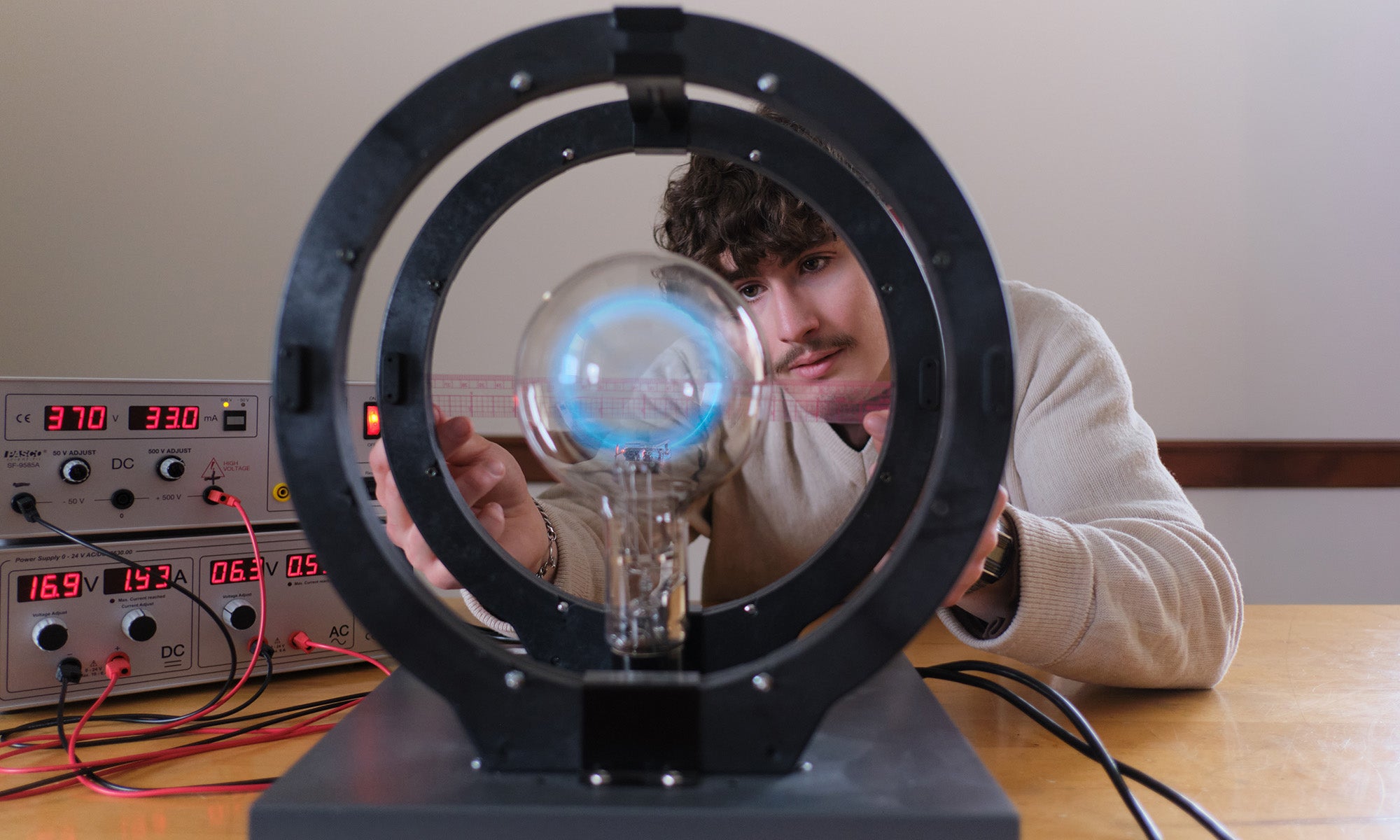
Unlock the mysteries of the universe. Peer into the physical world and learn the mechanics behind the evolution of the cosmos and the smallest structures in quantum physics.
Prepare for careers in astrophysics, biophysics, engineering, research, and more.
 Melanie Lott ’04
,Associate Professor, Chair of Physics & Astronomy
Melanie Lott ’04
,Associate Professor, Chair of Physics & Astronomy
 Cathy Geho
,Academic Administrative Assistant
Cathy Geho
,Academic Administrative Assistant
Master fundamental knowledge through rigorous coursework on motion, fluids, heat, electricity, magnetism, waves, and optics. Learn classical mechanics, electrodynamics, quantum mechanics, thermodynamics, electronics, and data analysis.
Study special relativity, quantum behavior, nuclear structure, and cosmology, alongside hands-on laboratory work. Deepen your understanding of Newtonian mechanics, dynamics, vibrations, fluids, thermal physics, electricity, magnetism, waves, and optics.
Build analytical and mathematical tools to explore relativity, quantum mechanics, and atomic structure. Learn how light interacts with matter and deepen your mathematical computational skills through work with operators, vectors, complex numbers, differential equations, and linear algebra.
Gain a broad understanding of quantum theory, classical mechanics, electromagnetism, thermodynamics, and statistical mechanics. Explore concepts such as the Schrödinger equation, atomic structure, entropy, and the dynamics of motion and fields.
Apply your theoretical knowledge to digital and analog electronics projects and strengthen your experimental abilities through advanced lab work focused on data analysis, design, and scientific communication.
Denison’s 45-seat planetarium features the latest display and immersive software technology. You can visualize the sky from the Earth’s surface and across the cosmos — and even span time into the ancient past.
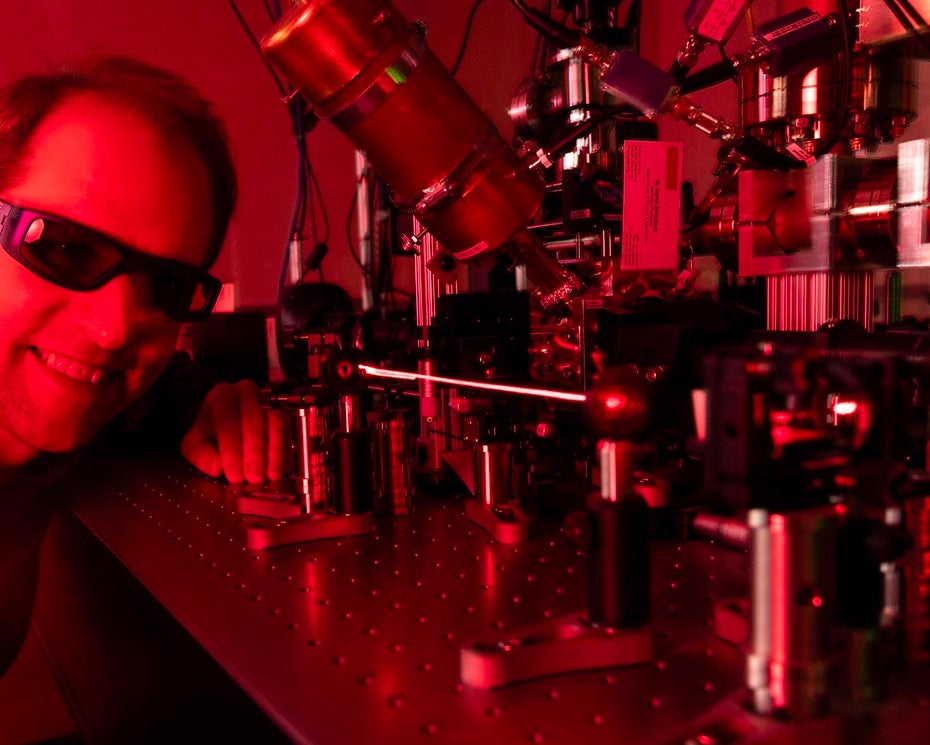
Our state-of-the-art research facilities feature tunable lasers, advanced spectrometers, ultra-high-vacuum systems, and powerful computers for modeling and data analysis. An on-site machine shop can give you hands-on experience with cutting-edge equipment when working on a research project.
Earn an engineering degree through our Dual Degree Program. Complete three years at Denison studying physics or another science, then transfer to a partner engineering school (like Washington University, Columbia, or RPI), ultimately receiving degrees from both institutions.
A physics and astronomy degree will prepare you for careers in mechanical and electrical engineering, biophysics, architecture, astrophysics, and more. See where our grads have landed.
Physics and astronomy majors often join one or more of our career communities, like our Technology, Data, & Science career community.
Through the Knowlton Center for Career Exploration and its training center, Denison Edge, career coaches help you prepare for the next step after college, and industry experts help you acquire specialized skills and certifications.




Explore career paths through an internship (or two!). Denison physics and astronomy majors have interned with Brigham Young University, The Ohio State University, American Energy Society, Michigan Aerospace Corp, and more.
Study physics and astronomy in your chosen region to enhance your language skills and build your career network. Conduct research on a traditional semester abroad or take a summer internship in another country.
Delve into independent research through our Summer Scholars program. All Summer Scholars receive a stipend and a housing allowance plus supplemental funds for research expenses.