Courses
Global Commerce majors are required to take courses in economics; including Introductory Macroeconomics, Introductory Microeconomics and Elements of Statistics; develop proficiency in a language; take part in an off-campus study or internship; complete a senior capstone experience.
2026 - 2027
For this academic year's course catalog, please visit our Academic Catalog site. For courses currently offered, please refer to the Schedule of Classes.
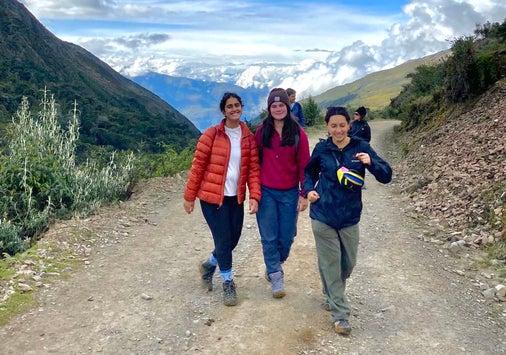
An off-campus experience is required of Global Commerce majors. Ideally, the off-campus experience occurs in the geographical region of the Global Focus or is tied to the Global Focus in terms of topics of study. In the GC 200 - Global Focus Proposal for Global Commerce proposal assignment, students are required to indicate and explain the rationale supporting their choice of an off-campus experience.
This course provides a thematic introduction to global commerce, emphasizing the interrelationship of commerce and society. The particular topic and approach of the course will vary dependent upon the instructors’ choice, but students in all sections will explore the relationship of commerce and society from an interdisciplinary perspective, emphasizing the ways in which the economy and trade are connected to culture, social movements, and other global factors. Broad topics addressed include economic systems & institutions, money & value, markets, labor, commodities, and ethics & equity. GC 101 is required for all Global Commerce majors and is a prerequisite for Global Commerce 201.
This one-credit, sat-unsat course is intended to complement your liberal arts education with the addition of some technical skills. In the course, you’ll learn the fundamentals of analytics and how to use these technologies to support an organization’s business strategy. Participants will gain a better understanding of analytics applications, governance, and ethics/risks using real-world examples and case studies. By the end of this program, you will have a foundational understanding of analytics and how to leverage these methods to drive business value. Participants will learn how to identify and communicate around use cases and opportunities and understand how to incorporate these capabilities into an organization’s business strategy. You will also be asked to reflect upon the way in which the course fits into your Denison education and plans for life after Denison.
This course explores how artificial intelligence is transforming businesses', universities', and other organizations' strategies and operations. Through guest speakers and in-class activities, students see how AI can impact efficiency and reshape industries. They also learn how AI in business is shaped by technical realities, customer reactions, government regulation and ethical questions. Perspectives from business leaders, the university's information technology services, and liberal arts disciplines, like psychology and philosophy, give students good AI examples and key critical questions for their careers.
This sophomore-level course is required for all Global Commerce majors. In this half-credit course, students create their individually designed Global Focus. Steps in this process include classroom discussion, peer review, oral presentations, and consultation with the program director and assistant director. At the end of the course students submit the Global Focus proposal essay, in which they explain their goals as a GC major and propose a synthesis of coursework, an off campus experience (off-campus study and/or an internship), and language training that will allow them to develop a coherent area of focus within Global Commerce. The Global Focus must be approved by the GC Director, in consultation with the Global Commerce Program Committee as necessary, in order for a student to proceed in the major.
Prerequisite(s): GC 101.
For GC majors only. This sophomore-level course provides an introduction to the elements of global commerce approached through an examination of the roles and structures of corporations. Students gain an intellectual foundation to help them make sense of business issues in the present and think carefully about business ethics, which includes examining the wisdom, stakes, and consequences of managerial decision-making. The course also builds students' applied skills by introducing them to business vocabulary, accounting practices, and financial reports. Throughout the course, students will gain significant facility in spreadsheet manipulation to learn how to present data effectively. Coursework may require attending co-curricular events. GC 201 is a prerequisite for GC 301 and GC 401. GC 201 is also required for all Global Commerce majors.
Prerequisite(s): GC 101.
The modern business environment requires the ability to analyze and summarize data, and to use statistical analysis for decision-making and problem-solving. This course introduces Global Commerce majors to the fundamentals of statistics and to the methods of collecting and analyzing data to solve practical problems in global commerce and social contexts. The primary objective of this course is to enable students to perform and understand statistical analysis of data, with the view of being able to interpret the limitations of statistical findings and to think critically about how statistics is used by others. Topics such as descriptive statistics, basic probability, data visualization, sampling methods, distributions of sample statistics, hypothesis testing, confidence intervals, and statistical inference will be discussed in the commercial, business, and social contexts. Throughout the course, students will gain significant facility in spreadsheet manipulation to learn how to present and analyze data effectively. Coursework may require attending co-curricular events. Students who complete QC 202 are not eligible to receive MATH 120 credit.
This course explores the relationship among sex, gender, and labor from the Industrial Revolution to the present. Drawing on history, anthropology, and feminist theory, the course examines various kinds of labor—emotional labor, care work, bureaucratic white-collar work, and sex work, among others—to examine how sex and gender have shaped the perceived value, as well as the legal and social status, or different kinds of work.
Crosslisting: WGST 210.
This course will allow students to interrogate the historical connections between commerce and a variety of forms of war. Students will learn about the relationship between war and commerce through specific case studies in a historical context and will learn to identify turning points when disagreements over commerce turn into war. Students will also consider the perspective of companies and countries as they use commerce to influence other military, political, diplomatic, or economic outcomes.
This course will explore how profit is created, consumed, and distributed in global professional sports. We will examine soccer and tennis in-depth, weaving discussion of other global sports in with guest speakers and activities. The global sports analyzed in this class generate significant financial gain in public and private forms. Specifically, students will look at the relationship between organizational structures, leagues, community partnerships, and personal investment to interrogate how sports contribute to the economic, social, political, and cultural aspects of nations and peoples.
A well-functioning financial sector is key in improving economic efficiency and producing high economic growth, but in the 21st-century, those goals cannot be achieved without considering both environmental and social sustainability issues. This course gives students a foundation in how sustainability issues (ESG: Environmental, Social and Governance) create challenges to businesses, economies and society, and the role of the financial sector in addressing environmental and social challenges. The course explores questions such as: what is sustainability and why does it matter, what are the challenges to corporations and the economy posed by sustainability, how to value financial assets and how integrated reporting can facilitate valuation and improve transparency. Applications on sustainable investment products such as green bonds, climate financing, and social impact bonds will also be discussed.
Prerequisite(s): ECON 101 and ECON 102.
Crosslisting: SES 220.
This class provides a space to engage in regular, sustained language and culture exchange with native speakers of Chinese and English in a “language partner” format. Students learning Chinese will practice basic oral Chinese, and native Chinese speakers will practice advanced colloquial English. Over the course of the semester, students will improve their ability to speak, listen, and build social relationships in their target language. We will meet every week for regular class, but twice during the semester, we will cancel the regular class for an enrichment activity, such as Game Night, Karaoke Night, or Restaurant Night, to practice language in social contexts. During all class times and class activities, there will be a language pledge - for half of the time, we will speak only Chinese, and for half of the time, we will speak only English. In this class, students develop their language skills and also practice leadership in building a cross-cultural community on campus.
Crosslisting: EAST 222.
In this age of job loss caused by automation, the emphasis on building human capital is more important than ever. Content can be generated immediately with advances in generative AI, and facts and data can be recalled by search engines faster than humans. Yet one essentially human activity that resists replication by technology is leadership. Although the scientific study of leadership remains elusive, this course focuses on the evidence-based findings on leadership that exist and the related topic areas such as communication, persuasion, power and influence, perception and biases, and team dynamics.
This class will explore the history of the present. More specifically, we will examine the historical roots of some of the pressing issues facing American society today, such as economic equality, residential politics, corporate power, and the implications of twenty-first-century technology on society. Through the work of journalists, documentarians, and creative writers, as well as historians, we will gain a more nuanced understanding of the historical origins of our own time. And we will see how the tools of history can help us think critically about the issues around us.
This reading-intensive discussion course examines selected topics in the history of US capitalism. It explores various historical developments including mass incarceration and the New Jim Crow; presidential power and partisan politics; sex, gender, and bodily autonomy. Engaging with journalists and public intellectuals—but mostly historians—we will see how thinking historically can help us understand the political and societal transformations taking place in our own time.
This course is designed for Global Commerce majors to introduce them to the complexities and fundamentals of global financial markets and international trade. The course begins with the basic principles of global trade, covering determinants of comparative advantage, welfare analysis of trade restrictions such as tariffs and quotas, and the movement of capital across nations. As the course progresses, we will investigate the relationship between interest rates and exchange rates, and how they impact national monetary policy, as well as the balance of payments. Additionally, we will discuss what determines the choice of exchange rate systems and how to hedge against exchange rate risk.
Prerequisite(s): ECON 101 and ECON 102 and GC 101 and GC 201.
A student in good standing may work intensively in areas of special interest under the Directed Study plan. A Directed Study is appropriate when, under the guidance of a faculty member, a student wants to explore a subject more fully than is possible in a regular course or to study a subject not covered in the regular curriculum. A Directed Study should not normally duplicate a course that is regularly offered. Directed Studies are normally taken for 3 or 4 credits. A one-semester Directed Study is limited to a maximum of 4 credit hours. Note: Directed Studies may not be used to fulfill General Education requirements.
Independent Study engages a student in the pursuit of clearly defined goals. In this effort, a student may employ skills and information developed in previous course experiences or may develop some mastery of new knowledge or skills. A proposal for an Independent Study project must be approved in advance by the faculty member who agrees to serve as the project advisor. Note: Independent Studies may not be used to fulfill General Education requirements.
This course serves as the culminating experience of the Global Commerce major. Students will combine their research, writing, teamwork, and presentation skills with interactions with professionals from the business and non-profits sectors to produce their final senior project. In addition to significant teamwork, semester project will include a sophisticated reflective component that requires students to articulate the connections among the curricular and co-curricular elements of their major experiences. Final projects will incorporate students’ foreign language and spreadsheet skills, knowledge related to their global focus, and understanding of organizational strategies and cultures as developed through the GC core courses, co-curricular opportunities and off-campus experience. Coursework may require attending co-curricular events.
Prerequisite(s): GC 101, GC 201 and GC 202 or MATH 120 and GC 301.
Students may enroll in Senior Research in their final year at Denison. Normally, Senior Research requires a major thesis, report, or project in the student's field of concentration and carries eight semester-hours of credit for the year. Typically, a final grade for a year-long Senior Research will not be assigned until the completion of the year-long Senior Research at the end of the second semester. Each semester of Senior Research is limited to a maximum of 4 credit hours. Note: Senior Research may not be used to fulfill General Education requirements.