
Denison has remained at the forefront of academic innovation by developing new curricular pathways for students while staying true to its liberal arts mission and values.
Now the college is set to add a finance major, minors in machine learning and artificial intelligence and organizational strategy and leadership, and a sports analytics domain within its popular data analytics program.
In developing the finance major, faculty in the economics department sought to continue Denison’s tradition of tailoring courses of study in ways that appeal to today’s students and make them stand out to potential employers.
The plan to add the major has drawn widespread support from alumni in the business world, who are thrilled about the program and eager to help in any way they can.
“The alums are coming out of the woodwork with excitement for what we’re doing here,” said Associate Professor Jessica Bean, chair of the economics department. “I’m getting random emails from people asking, ‘What can I do?’ or, ‘Can I come visit your class?’ The engagement has been terrific. I have never had as many meetings with alumni.”
Approved in September 2025, students can begin taking the newly designed finance curriculum in spring 2026.
“This will give us the opportunity to be a leader in the finance space at liberal arts institutions,” said Emily Marshall ’10, director of quantitative initiatives and an associate professor of economics. “The finance major will have the technical aspects students need to succeed in a highly quantitative field — but taught in our own innovative way.”
Denison previously offered a financial concentration within economics but elevated it to major status after more than a year of research and curriculum building. Feedback from students, alumni, and employers supported the move, and the college saw significant opportunities to boost career placements and internships in a growing and diverse field.
“Finance is what makes the economy grow and work and operate,” said Hyun Woong Park, an associate professor of economics. “It’s a significant, indispensable part of the economy. The skills that you learn in these finance courses can be very flexible and used elsewhere — not just in finance.”
Finance involves money management in areas such as investing, saving, borrowing, and budgeting to achieve financial goals. Its popularity as a major is driven by an increased demand for financial expertise, high earning potential, and the industry’s rapid evolution with new technology.
“Finance has become a bigger part of the macroeconomy; it’s become a bigger part of economic institutions,” Marshall said. “Students realize this, and more of them are interested in it. We’re responding to what the students want, what they want to do, and evolving opportunities in the workplace.”
Denison is now one of only three universities in the top-50 liberal arts colleges, as ranked by U.S. News & World Report, to offer finance as a major. The publication recently ranked Denison 34th among liberal arts institutions — rising 21 places since 2016 — and first in Ohio. Denison is also listed as the fourth most innovative national liberal arts college for the second year in a row.
Bean said finance will incorporate broad-based learning from across the college curriculum.
“Finance students will be taught historical backgrounds, social context, critical thinking, and the ethical consideration for applying what they learn,” she said.
Julie Zhao ’24, now a private wealth management analyst, believes finance is a perfect fit for Denison.
“I can’t say enough good things about how liberal arts impacted me in a positive way,” Zhao said. “I continue to grow, my world continues to expand, and the education never ends. Finance as a major at Denison will give students who are curious and explorative an opportunity to ready themselves for a good career.”
A new minor in machine learning and AI
A faculty decision in December 2025 to approve a minor in machine learning and artificial intelligence is just a recent piece of Denison’s ongoing mission to ensure all students, regardless of their majors, enter the workforce fluent in data and versed in the technological advances they will need to succeed in a rapidly changing world.
While the minor is open to all students, it likely will draw the most interest from computer science, mathematics, and data analytics majors, Professor Matt Kretchmar said. Other possible matches include physics, neuroscience, cognitive psychology, and the engineering track.
Understanding the appeal and importance of the burgeoning AI field, Provost Kim Coplin ’85 met in the summer of 2025 with Kretchmar, who teaches math and computer science, and Professor Ashwin Lall, chair of the computer science department.
Coplin asked if they could construct a technical degree in AI.
“We were like ‘heck ya,’” Kretchmar said. “Kim asked how long it might take, and I said ‘by Christmas.’”
A 12-person committee assembled the necessary curriculum and earned faculty approval in 138 days. The minor features seven courses overall, including four new ones.
Kretchmar anticipates current sophomores could fulfill the minor requirements by the time they graduate.
“This is a very attractive supplement for students who are entering these kinds of technical fields that will provide them a foundation to grow in the changing world that they’re entering,” he said.
If the interest is strong enough, Kretchmar said machine learning and artificial intelligence could be elevated to a major within a year or two.
“New AI programs are popping up all over the place,” he said. “We need to remain relevant and viable and visible to students who are looking for education in these fields.”
A new minor in organizational strategy and leadership
The corporate world is transforming at breakneck speed — and Denison graduates are about to get a serious competitive edge. Faculty approved a new minor in Organizational Strategy & Leadership in November, which promises to prepare students to be adaptable leaders of tomorrow’s workplace.
“Today’s world is hungry for graduates who can decode organizational dynamics and step confidently into leadership roles,” said Associate Professor of Psychology Sarah Hutson-Comeaux, director of the new program.
Building on the popular Organizational Studies certification, the enhanced program packs more punch while keeping its crown jewel: an immersive summer experience that takes students behind the scenes at cutting-edge businesses and nonprofits in cities like Chicago, San Francisco, and New York.
The seven-course minor weaves insights from psychology and global commerce, culminating in new courses: one in organizational decision-making that teaches students how corporate and nonprofit leaders think, and a capstone course that navigates the complexities of organizations and leadership. In the capstone course, students will serve as members of a team-based consulting project, working with a local client to address a pressing organizational or leadership issue.
“Don’t mistake this for just another business program,” Hutson-Comeaux said. “This approach transforms Denison’s world-class liberal arts foundation into a leadership launchpad. Pair it with any major, for our students to gain the critical thinking, analytical firepower, and communication skills that make great leaders unforgettable.”
A new domain in data analytics
Sports analytics, now the eighth domain within the data analytics major, was approved by the general faculty at its October 2025 meeting.
Students in the sports analytics domain can follow one of three tracks: health and human movement, performance analytics, and sports economics and society. The domain will collaborate with several departments, including mathematics, economics, computer science, and health, exercise and sports studies (HESS).
“It shows you how wide the scope for sports analytics is,” said Professor Dan Homan, director of the data analytics program. “It is focused on many different areas that sports intersect with our lives. ”
The domain was created in answer to the many students who sought to tailor their studies to the field.
“The new domain gives students a concrete path to something they already were working toward,” Homan said. “It’s now a well-defined path without re-inventing the wheel. I think students who are considering it may now be more willing to make it their domain.”
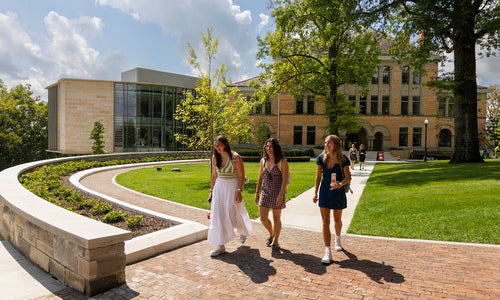
Denison introduced data analytics as a major in 2016 and is nearing completion of a major building project that positions it to be the first liberal arts college with a hub devoted to integrating data across the curriculum.
Knobel Hall, housing the King Center for Data and Innovation, is set to open in fall 2026.