A liberal arts education is built on curiosity.
Denison challenges students to ask better questions, explore new ideas, and see connections others might miss. Investments in faculty, academic programs, research, mentorship, and learning spaces help create an environment where students are inspired to think deeply, engage broadly, and prepare for a world that rarely fits neatly into a single discipline.
From vision to reality
Donor support brings a dynamic campus hub to life
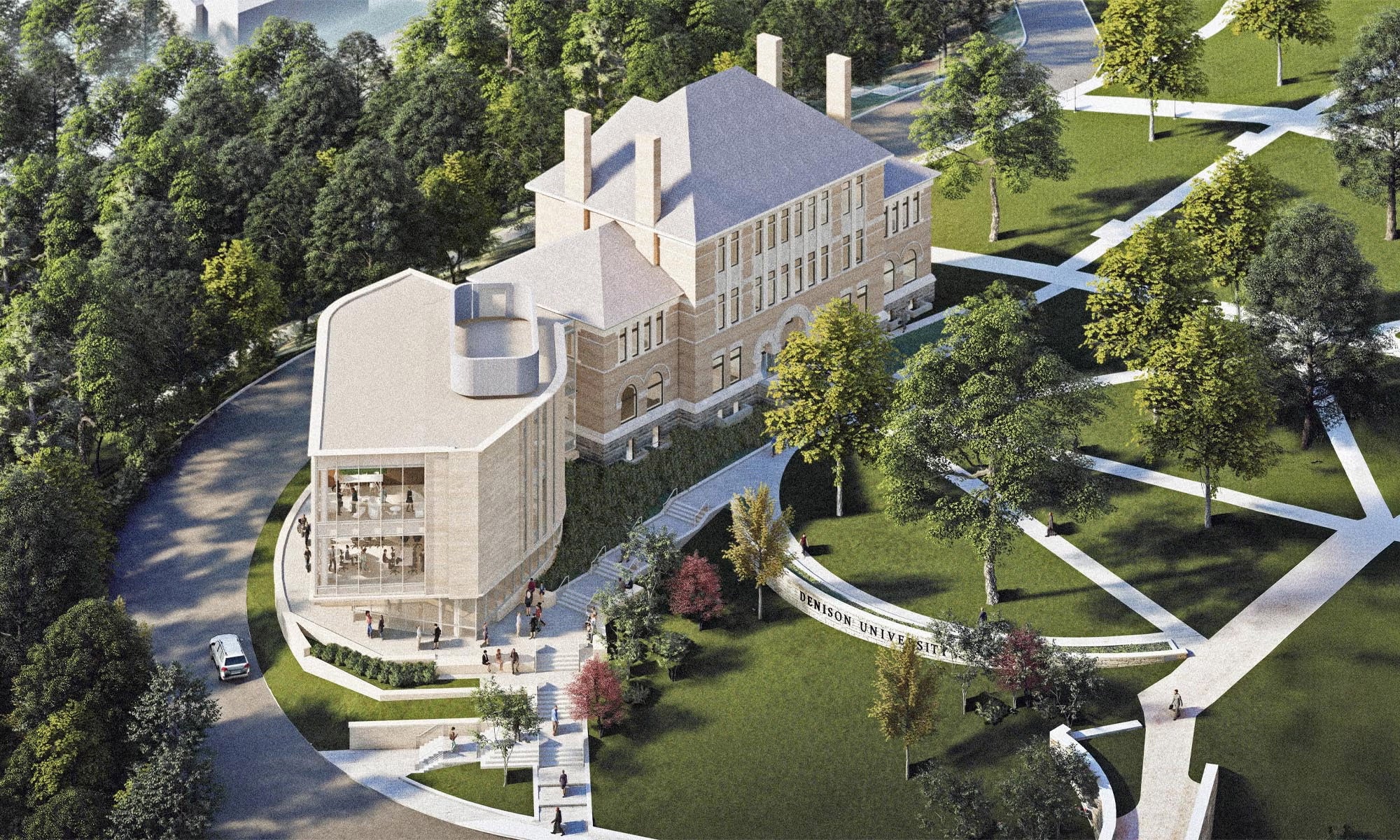
This fall, students will stream into Knobel Hall and the King Center for Data & Innovation for the first time, stepping into a space designed to prepare them for a world increasingly shaped by technological advances, AI, and data-based problem-solving.
As they explore labs dedicated to virtual reality, data visualization, and robotics and machine learning — and enjoy expansive views of President’s Drive through floor-to-ceiling windows — their experiences will be made possible by the generosity of Denison alums and friends.
What began as an ambitious vision is now a stone, glass, and steel reality. Through the renovation of historic Doane Hall (now Knobel Hall) and the sweeping addition of the new King Center for Data & Innovation, Denison has created an energy-infused, cutting-edge campus hub where students and faculty from across disciplines can come together to explore the crossroads of data, technology, and the liberal arts.
“Denison is a leader in data analytics at liberal arts colleges, and this building showcases that,” said Associate Professor Emily Marshall ʼ10, the King Center’s inaugural director.
The opening of the facility marks a significant milestone in Denison’s commitment to academic excellence and innovation in teaching and learning. It also represents the culmination of remarkable philanthropic support, totaling more than $30.5 million, including transformational gifts announced this year from the Sherman Fairchild Foundation and from Emily Hauser King ’63 and Robert E. King, whose generosity established the King Center for Data & Innovation.
Thanks to the Sherman Fairchild Foundation’s investment, Doane Hall was renamed Knobel Hall in honor of President Emeritus Dale Knobel and his wife, Tina. Together, the naming of Knobel Hall and the King Center reflects the commitment of donors who believe deeply in the future of the liberal arts and in the life-shaping power of a Denison education.
“Faculty have come together, devising applied learning experiences for student success, enriched research environments for faculty development, and projects that connect campus and community partners,” said Kim Specht, senior associate provost.
With the building now complete, attention is turning to what will happen inside its walls. As Marshall helps shape the center’s first chapter, she’s focused on pairing academic learning with hands-on experiences that prepare students for careers and leadership in a rapidly changing world.
“A major goal of the King Center is to connect career-relevant experiences to business, data, and technology through partnerships with the Knowlton Center,” she said, citing the ongoing success of the No. 2 best career services in the U.S. “We want to bridge the gap between our curricular offerings and the great work we’re already doing around careers.” From internships and corporate partnerships to leveraging Denison’s network of alums who are working at the forefront of their fields, the possibilities for meaningful collaborations are boundless.
Another key focus for Marshall is the intersectional nature of a campus nexus focused on an aspect of academia — data and technology — that is infused across curricula. She sees the King Center as a place for everyone.
“We really want it to be a space for any student who’s interested in figuring out how data, technology, and business-oriented initiatives can work in what they are doing,” Marshall said. “We’ve been talking a lot about how we can connect with the arts and bring students who are art or music theatre majors into our space to complement their education.” From finance and economics to athletics and the humanities, students visiting the King Center can explore their own interests while gaining practical experience with emerging tools and ideas.
As Knobel Hall and the King Center opens its doors, it stands as a testament to the foresight and generosity of the Denisonians who made this milestone possible. Donor support has created new opportunities that will shape the Denison experience for generations of students to come.
The ribbon cutting may mark the completion of a project. The impact, however, is only beginning.
Emily Marshall ’10
Director of the Emily Hauser King and Robert E. King Center for Data & Innovation
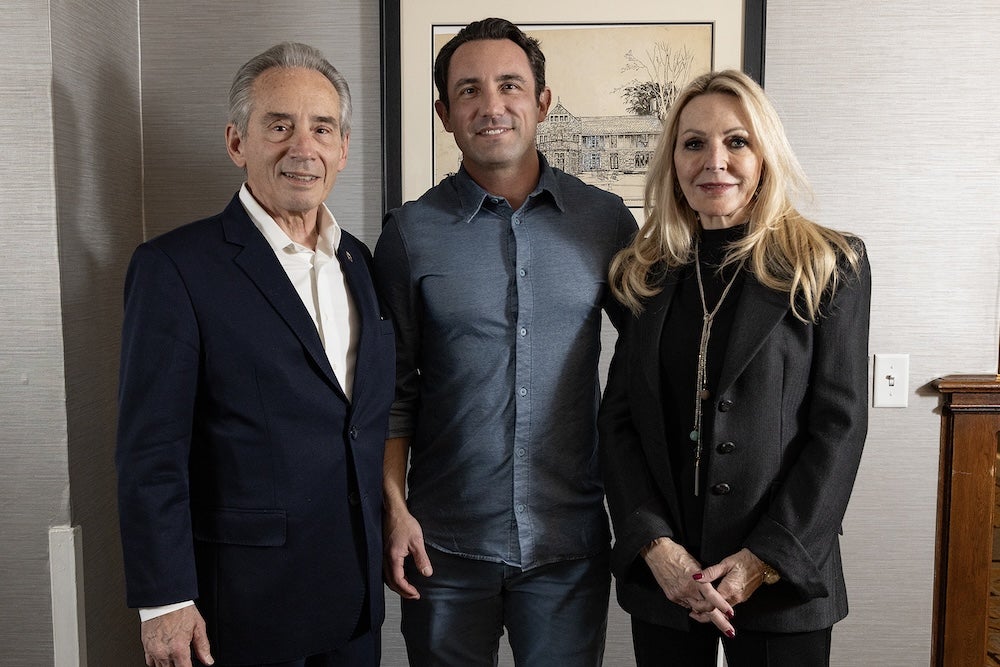
Paul Dimitruk ’71 Pʼ00, Michael Dimitruk ʼ00, and Ingrid Dimitruk Pʼ00
Seeing the whole board
A game-changing gift for Grand Strategy
For Denison Life Trustee Paul ʼ71 and Ingrid Dimitruk Pʼ00, supporting Denison has always been about strategy — intentional investing in people, programs, and priorities that have guided the university they love toward a position of strength and resilience.
Over decades of service and philanthropy, the Dimitruks have demonstrated deep care for Denison, including Paul’s years as a trustee and member of the Investment Committee. Their family established two presidential discretionary funds in honor of President Weinberg and they have been staunch supporters of the Annual Fund. Giving is indeed a Dimitruk family tradition, with son Michael Dimitruk ʼ00 and his wife, Corrine Brenner Dimitruk ʼ01, contributing a leadership gift toward the creation of the King Center for Data & Innovation.
Paul and Ingrid’s latest gift reflects both that commitment and their belief in the importance of preparing students to navigate an increasingly complex world, where the answers aren’t always apparent and require a wide, well-informed view.
Through their Dimitruk Family Endowed Fund in Support of the Grand Strategy Program, the Dimitruks have made an investment that will provide lasting support for one of Denison’s most distinctive academic initiatives. The fund will help sustain the Grand Strategy program by supporting travel opportunities, guest speakers, staffing, student experiences, and programming that bring learning to life.
For Paul, whose professional and civic leadership has long centered on issues of strategic intelligence, national security, global affairs, and investments, Grand Strategy represents a powerful expression of the liberal arts in action.
“Throughout my career, I’ve seen how important it is to understand the connections between history, economics, politics, technology, and human behavior,” Paul Dimitruk said. “The challenges facing our world don’t fit neatly into a single discipline. What excites me about Grand Strategy is that it teaches students to think broadly, ask difficult questions, and approach complex problems with intellectual rigor and curiosity. Those are skills that matter in any profession and in any form of leadership.”
Grand Strategy challenges students to examine the forces that shape our world and understand how complex issues intersect — from diplomacy to deterrence, from energy to public health, and from assessing adversaries to identifying allies. Students engage with classic texts alongside contemporary case studies while gaining firsthand exposure to the institutions, leaders, and decision-makers shaping policy around the globe.
“Grand Strategy offers students a big-picture view of the world,” says former military strategist and retired Army Colonel Scott Smitson, professor of practice of Grand Strategy and the program’s director. “Preparing our graduates to not only succeed in such a world, but also to lead it, provides life-altering experiences and a critical service to the global community.”
That combination of intellectual rigor and experiential learning is what makes the program unique. “What we’re envisioning for Denison would be something that no other liberal arts school is doing,” said Smitson.
Students participate in immersive opportunities that connect classroom learning to real-world application, from policy-focused experiences in Washington, D.C., to conferences, research projects, internships, and conversations with leaders in government, military, business, and international affairs. Many times, their applied learning intersects with Denison alums who are working in national security-related fields. Along the way, students learn to think across disciplines, analyze competing priorities, and approach complex challenges with curiosity and confidence.
The Dimitruks’ gift for Grand Strategy ensures that future generations of Denison students will have a true edge in developing the essential skills they need to not only understand a rapidly changing world, but also how to shape it.