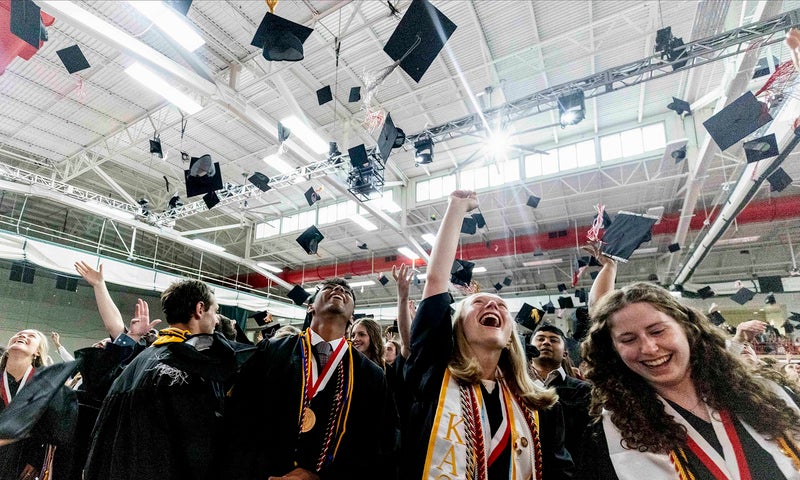
Each year, graduating seniors are invited to submit essays for the honor of being chosen as the student speaker at Commencement.
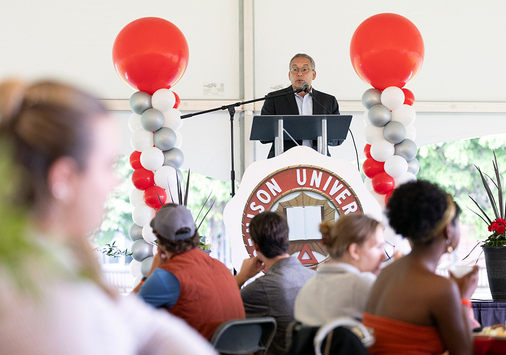
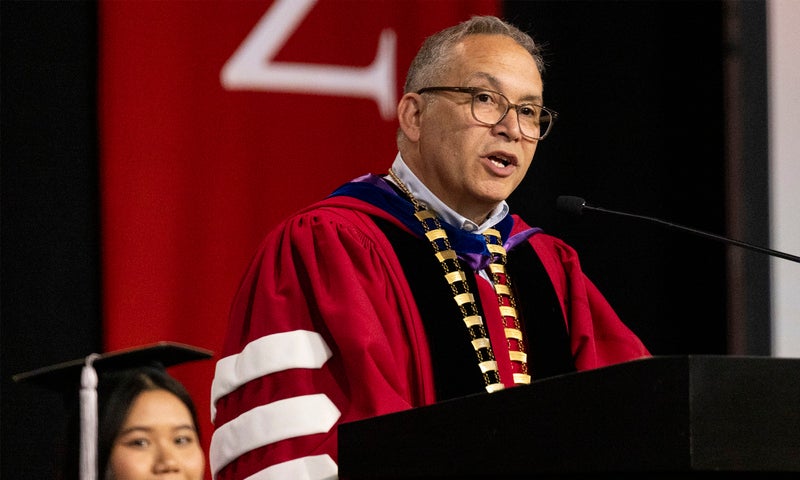
Every submission is excellent, and choosing one is difficult. This year, Denison University selected Nancy Tran as the student commencement speaker for the Class of 2026. Tran delivered her address on behalf of her class on Saturday, May 16, at Denison’s 2026 Commencement Ceremony. You can read her speech below.

Good morning, honored faculty, staff, family, and friends of the Class of 2026.
Before we talk about endings, I want to start somewhere far from Granville.
In my sophomore year, I invited friends from Denison to visit my home in Vietnam. For some of them, it was their first time out of the US. We flew halfway around the world, across oceans, time zones, and what I can only describe as a mix of excitement and nerves. When we arrived, my family welcomed them, not as guests, but as kin. They learned to eat with chopsticks, to greet elders, and to navigate roads full of motorbikes.
The cultural differences, the surprises, and the discoveries my friends experienced as they saw my home took me back to my very first time arriving in the United States for college.
One evening, as we sat outside listening to cicadas and motorcycles pass by, my friend told me something simple yet unforgettable: “I see you better now.”
That moment captures what Denison has meant to me, and I believe, to all of us.
Denison friendships are not only formed in classrooms, labs, or club meetings. They are formed across real differences, between athletes and artists, international and domestic students, first-generation students and those whose families have walked these paths before, across languages, identities, faiths, and ways of moving through the world. They are formed when we are willing to carry one another’s worlds, when we celebrate each other’s cultures not as curiosities, but as homes.
That spirit is not new here. From its earliest days, Denison has asked students to look outward, to engage difference seriously, and to understand education not as insulation from the world, but as preparation for participation in it.
That outward-facing commitment is also what defines a liberal arts education at its best.
At Denison, we were not trained to memorize answers; we were trained to live inside questions. We learned how to sit with uncertainty, how to connect ideas across disciplines, and how to argue and listen in ways that sharpened rather than closed our minds. Many of us struggled, not because we were unprepared, but because real learning is uncomfortable and humbling.
In those moments, our professors did more than teach. They pushed us when we resisted, supported us when we doubted ourselves, and reminded us that intellectual growth is rarely linear. And I know that as I say these words, a name, or maybe several names, just came to mind, and that is exactly what makes Denison so special.
What Denison gave us is a way of approaching the world. And the world we are entering now will test that approach.
We are graduating into a future defined by paradox. Never before have we been so digitally connected, and yet so fragmented. Innovation moves faster than wisdom. Data travels instantly, while trust erodes slowly. We face overlapping crises: climate change, political polarization, and economic inequality. These challenges cannot be solved by technical expertise alone. They require judgment. Ethics. Imagination. And above all, human connection.
Denison prepared us for this moment precisely because it refused to give us simple answers.
Our education trained us to ask better questions: Who benefits from progress? Who bears its costs? What does responsibility look like when our actions ripple across borders and generations? We learned that solutions must be grounded in reality but guided by values, that innovation without accountability is incomplete, and idealism without pragmatism is unsustainable.
As we move forward, we will enter many spaces: boardrooms, classrooms, communities, laboratories, and fields where efficiency is prized more than reflection. In those moments, our task is to carry the Denison habits with us. To pause when speed is rewarded. To listen when certainty is loud. To remember that knowledge is most powerful when it serves people and the planet we share.
The friendships we formed here, across identities, disciplines, and continents, are not incidental to that mission. They are practice. They taught us how to live with difference without fear, how to disagree without dehumanizing, and how to belong without erasing who we are.
That is why a moment in my home country, Vietnam, matters just as much as a moment in a seminar room. Both remind us that education is ultimately relational.
May we build futures that are innovative and grounded, ambitious and humane. May we stay connected to our communities, and to the Earth we call home. And may we carry the Denison spirit wherever we go.
Congratulations, Class of 2026. May we leave Denison not trying to be the smartest voices in the room, even though I know you are, but the ones willing to listen, to act, and to take responsibility for the world we are stepping into.
Thank you!
Below, we share submitted speeches from other members of the Class of 2026. They indicate the breadth of experiences a Denison education encompasses.
Good morning esteemed faculty, family, and friends. For the last three and a half years, I have had the privilege of working as a docent in our Office of Admission. Day after day, I walked prospective students across campus and answered questions about classes, dorms, and dining halls. My main job as a docent is to accurately showcase what Denison can offer prospective students, and to help them understand how they might fit into our life on the Hill. Each tour concludes with the big, inevitable, question: “Why Denison?”
At first, my answer felt rehearsed. But, over time explaining Denison forced me to move beyond slogans and reflect more deeply on what this place actually stands for, and what it means to me. Admissions work became an exercise in synthesis. I had to connect my lived experience to Denison’s broader mission. In doing so, I realized something important: we don’t fully understand the value of our education until we are being asked to represent it to others.
As I crafted my explanation of the Denison experience on tour, one thing became clear to me: this education is not something we earn alone. I would tell stories that weren’t always my own, but stories my professors, friends, and teammates had shared with me, that exemplified the spirit of Denison.
My Denison story is the culmination of the collective efforts of those who I surrounded myself with. I experienced the power of collectivism firsthand on the rugby pitch, as my teammates and I persevered through the challenge of learning a sport none of us had played before, and in my sorority, where sisterhood was cultivated through small acts of kindness and a shared commitment to our values. But I also saw it in the musicals I watched and the various sporting events I attended.
While each of us is in pursuit of our own individual goals, the Denison community has never faltered to come together to help each other succeed. From offering one another rides up and down the hill, to reading over senior research projects, no task is too large for those who have the privilege of calling themselves a Denisonian. In a world that values individual achievement, Denison has shown us the importance of collaboration.
But collaboration doesn’t automatically indicate success, and meaningful answers rarely arrive fully formed. Instead, Denison gave us the tools to ask questions and engage thoughtfully with the unknown. I saw this skill echoed in the classroom, where our confidence didn’t come from certainty but from trust in our ability to figure things out.
As an aspiring healthcare professional, conducting ecological research on snail embryos felt abstract. I stumbled through experimental procedures and often the only honest idea I had to record in my notebook was what I didn’t know. Learning to sit with that unknown became as much of a lesson as any result I recorded. At a seemingly uncertain moment in our lives, remember that uncertainty is not failure, but a starting point to creating something wonderful. Instead of teaching us to avoid uncertainty, Denison taught us how to sit in it.
Denison asked us to actively learn to adapt, as we discovered the plethora of possibilities held within the unknown. From navigating new living situations to taking a class outside of your comfort zone, the Denison experience encourages us to let go of rigid expectations and allows us to find belonging in unexpected places.
As a biology major, I never thought I’d spend Wednesday nights straying as far from science as practicing improv in the Slayter Auditorium as a member of the Burpees. My time in the Burpees taught me how to adapt and respond thoughtfully in unscripted situations. Adaptability has shown up in small moments; when a group meeting fell through, when we didn’t get into the class we wanted, or when the career we imagined for ourselves as freshmen no longer fit the people we are now. Denison taught us how to adjust without losing ourselves.
In learning to adapt, I also learned how to name what mattered most to me. I began to speak about my education not as a credential but as a formative experience. Which brings me back to the question I am so often asked on tours: “Why Denison?” The answer to which now lies in how we choose to show up in the world beyond The Hill.
Our learned ability to collaborate, sit in uncertainty, and adapt will remain invaluable as we navigate our future passions and careers. It is inevitable that our perspectives regarding our four years here will change as time goes on. Our Why Denison answer may sound radically different in five, 10, or 15 years. But, our Denison education will remain unchanged and always be demonstrated through our actions. As you leave The Hill behind, carry Denison forward, not as an answer you recite but as a way that you live.
Good afternoon, I’m honored to be here today to celebrate the graduating class of 2026. When we first came to Denison, President Weinberg promised us, in so many words, “That for all the restrictions we had during COVID we would experience all the freedoms of living on a residential campus.” He made good on that promise, and these past four years have been full of exploration and discovery.
Yet, now we are looking ahead to challenges we will most certainly face. We are the generation graduating into one of the most difficult job markets in recent memory. We are the generation living in a time of unprecedented political polarization. We are the generation that has had to tackle utilizing AI in an academic setting, and face a future where it is inevitable and uncertain in our workplaces.
In the years to come, it will be more important than ever to rely on what we have learned during our time at Denison. With that in mind, I offer this: WWADD? What would a Denisonian do? As we move forward, how can we leverage what makes us uniquely Denison?
The first month of college is hard for everyone, but for some it is especially hard. Parents drive back home, and all of a sudden you’re in a strange place with strange people. In September of my freshman year my grandfather passed away, and already feeling homesick, this was an enormous loss. I remember learning the news outside of Talbot Hall and running into the bathroom to cry. I thought everyone had left, but when I emerged from the stall a girl was standing there, startled to see me so distraught. I told her, “I’m sorry, my grandfather just passed away.”
This stranger, who I had never met, took me in her arms and held me while I cried. “It’s going to be okay,” she told me, and we walked out together. I have no idea her name, her year, if she’s in the audience today or somewhere beyond Denison, but to me, she represents everything Denison is. Compassion makes us Denisonians.
Last semester I hosted a “bald party” for Halloween, which is precisely what it sounds like. I originally had the idea freshman year, as a joke, but the question then became: could I make such an event happen? Would people really want to come?
In the end, they did come, and the imagination of the class of 2026 was boundless. Attendees included a gaggle of Shreks, Mr. Clean, Charlie Brown, the Blue Man group, the Lorax (who spoke for the trees), a beautifully feathered Bald Eagle, and, what’s a party without singer-songwriter Pitbull?
Upwards of 100 people came together on Silverstein lawn to walk the red carpet and participate in a costume contest, which rewarded celebrities like the Mucinex Man and the Green M&M. The event ended up being featured in the school’s publication, The Bullsheet, with three writers on the scene reporting. It symbolizes the creativity and humour that Denisonians have captured during their time here. Creativity makes us Denisonians.
I have experienced profound growth during my time at Denison. I have learned to thrive on failure, a lesson that has been hard-learned. During the first month of college there were days where I would drink six Diet Cokes from Slayter Market, and then have Nest mac and cheese for dinner. As I would quickly learn, this did not make for a very healthy diet. I would learn that staying up until 2 a.m. when you have an 8:30 a.m. class is, in the end, also not a journey towards health.
I would learn how to rely on my friends after a bad day, how to approach my professors with questions, and how to hide how out-of-breath I am when someone passes me on the Eisner steps. Denison pushes its students out of their comfort zones while giving them the freedom to explore. As my Red Frame Lab mentor, Steve Krak, often says, it’s important to “stretch yourself,” because that’s how you know you’re growing. Growth makes us Denisonians.
Denison was once described to me as the “place for busy people.” Being on the precipice of graduation, I would make an amendment to that statement: “Denison is a place for people who seek to be better than they were yesterday.”
James Clear, Denison graduate and author of the New York Times bestseller, Atomic Habits, suggests focusing on becoming just 1% better every day. Denisonians are, at their heart, generous people. We are emerging into one of the most tumultuous times for young people in history, and yet when you walk across A Quad you can always encounter someone you know with a kind word — in fact, you can hardly walk across this campus without seeing someone you know, greeting a professor, sharing an inside joke.
This is what will guide us through the years beyond Denison. Paying forward the gift we’ve been given over the last four years. Bringing the sort of compassion, creativity, growth, and generosity that we have experienced everywhere we go. Trying to be just 1% better every day by asking ourselves: what would a Denisonian do?
Dear Class of 2026,
I was born and raised in Georgia for half of my life, taught to value debate but to cloak it in a particular brand of civility that centers politeness and tact. The other half of my life I spent in Peru, learning a new language and culture, a way of life. There, I realized that silence can be a form of respect and that blending into the background is a form of survival.
These differing cultural values and the way they reflect in civil discourse didn’t always align. Moreover, they often collided. And it wasn’t until I arrived at Denison University that I finally learned to bring them together, a sentiment I know many of us share as we’ve tried to mesh the different parts of who we are during our college journey.
It was here that I built the foundation of what I now call the art of disagreement. When I matched to Denison as a QuestBridge Scholar, I had never heard of Ohio, nor did I know what a liberal arts education even meant.
I came with a blank slate and two goals: to pursue learning wholeheartedly and to take the steps toward the career that has always grounded me: medicine. I expected nothing more than biology labs and anatomy flashcards. Instead, I found myself crying over the definitions of love and consciousness in a philosophy class, and completely lost in a music class as I tried to transcribe music, something I had never done before.
And in those moments, I began to understand the real purpose of a liberal arts education: not to teach us what to think, but to expand how we think, how we speak to one another, how to build a community, and ultimately, how to disagree.
Denison’s small, interconnected community, where you recognize almost every face on campus and thus feel accountable to each one, taught me something more invaluable than any single discipline could. It taught me that disagreement, when practiced with sincerity and integrity, is an art form.
This campus fosters honest intellectual discourse, genuine debate, and the courage to speak up without fear of retaliation. And for us, the Class of 2026, learning how to navigate disagreement has been a part of our everyday education.
I remember one particular moment in class when a passionate conversation slowly tipped past debate and into argument. After forty minutes of the in-class discussion, my classmate and I were both frustrated, and later learning I would work with this person on a semester-long project, I walked out questioning whether I just ruined a group project that hasn’t even started? I replayed the conversation in my head all afternoon.
Thankfully, given the nature of the course and the community we are all part of, we had to face that discomfort. And so we talked again, and more importantly, we listened. We learned that disagreement is not a failure or a breakdown of communication; It is an opportunity to practice the very skills the liberal arts promise: curiosity, humility, and the pursuit of truth over ego.
For me, the art of disagreement is not about winning, or speaking the loudest, or getting the last word in. It is about seeking truth, speaking with purpose, and understanding that conflict is a chance to learn and grow — as thinkers, as citizens, and as people who care about the world we are stepping into.
And Denison teaches this not just through its curriculum, but also through the relationships we build with each other, with faculty who challenge us, and with peers who live, work, argue, and grow alongside us.
The art of disagreement is also standing up for what is right and acknowledging when silence is no longer enough. It is recognizing that our voices carry weight.
As the eldest daughter of immigrant parents, no matter how they got here, it is because of their sacrifices that I am here, and this acts as a reminder of the responsibility that we all carry with us: presence itself is an act of courage. For that reason, it is my civic duty to say that speaking up matters, speaking out matters.
And to the Class of 2026: as we leave this campus, we are walking into a world that desperately needs people who can disagree and speak out with integrity. A world that needs people who can hold complexity, honor differences, and challenge injustice without dehumanizing those on the other side.
We carry that responsibility with us now. We carry the art of disagreement through our education that we have received on the Hill, not just for ourselves, but for the communities, professions, and futures we are about to enter.
And when we disagree with truth, courage, and purpose, it is not divisive. It is revolutionary. Denison taught us that. Thank you.
Graduates, faculty, families, and everyone else celebrating the Denison community today: This is a very big and exciting moment. I’d like to talk about what has made it so fun and so important.
This speech was generated to meet a set of predefined expectations. It is approximately five minutes in length, includes a central theme, and reflects the intellectual mission of a liberal arts institution. It avoids excessive nostalgia and instead looks ahead toward the future. It addresses the graduating class as a collective, just as a commencement speech is intended to do. The world is becoming increasingly complex. Now more than ever, a liberal arts education matters.
To begin, I would like to thank ChatGPT for writing that introduction. I’m sure the language sounded familiar to many of us. It is efficient. It is structured. It says the right things in the right order. Tools like ChatGPT can write essays, summarize readings, and produce speeches like this one in mere seconds.
Yet here we are — at a liberal arts university — celebrating an education that insists those things are not enough. Why spend four years reading slowly, arguing carefully, and thinking deeply when an algorithm can produce something polished on demand? Why struggle through ambiguity when coherence can be automated?
Believe it or not, this is a relatively easy question to answer. Denison has never claimed to train its students to be the most efficient or streamlined. From the very beginning, Denison has focused on preparing students to be “effective leaders and active citizens.” Today, its mission emphasizes the development of “autonomous thinkers” and “discerning moral agents.”
These are traits that cannot be generated by algorithms alone, no matter how advanced the training process becomes. A liberal arts education is not designed to make us faster producers of content, or even quicker learners. It is designed to make us better judges of meaning.
Here, we were taught that a strong argument is not defined solely by how convincing it sounds, but by how responsibly it is constructed and presented. We learned to ask where ideas come from, whose voices are included, and what assumptions are doing the hidden work. Rather than ignoring or banning emerging technologies, Denison has chosen to engage with them thoughtfully.
The university has taken steps to integrate artificial intelligence into classrooms and research not as a shortcut, but as an object of inquiry — asking not only what these tools can do, but what they should do. In doing so, Denison has positioned itself not merely as a user of new technology, but as an ethical leader.
That is why our students are prepared for the world — not only because they have access to powerful tools, but because they have been trained to use them with proper judgment.
Across disciplines, we were asked to sit with complexity: to read texts that contradicted one another, to analyze data that resisted simple conclusions, and to confront histories that were uncomfortable rather than reassuring. We learned that understanding often requires humility, and that certainty is not the same thing as wisdom.
This is a defining moment of our time. We are entering a world shaped by systems that scale quickly — technological, economic, and political — but rarely ask who or what they leave behind.
In such a world, the most important skill may not be the ability to generate an answer, but the courage to question one.
As a graduating class, we are not defined by identical experiences or shared ambitions. What unites us is something more subtle: a shared way of thinking that values context over convenience and responsibility over speed.
Denison did not train us to be passive consumers of information. It trained us to be accountable participants in its shaping and use. A tool can imitate the surface of intellectual work, but it cannot replace the judgment required to use knowledge well.
Only humans decide what deserves attention. Only humans decide when efficiency becomes harm. Only humans are responsible for the consequences of the ideas they deploy.
Graduation does not mark the completion of that responsibility. It marks its expansion. As we leave this university, we will enter fields where automation is powerful, shortcuts are tempting, and the pressure to move quickly is constant.
The value of a Denison education is not that it shields us from those forces, but that it equips us to engage them. The habits of mind we practiced here — critical inquiry, ethical reflection, and intellectual humility — are not outdated in an age of artificial intelligence. They are essential.
As we move forward, the question will not be what technology can do for us, but what we choose to do with it. That responsibility belongs to us now.
Congratulations, Class of 2026.