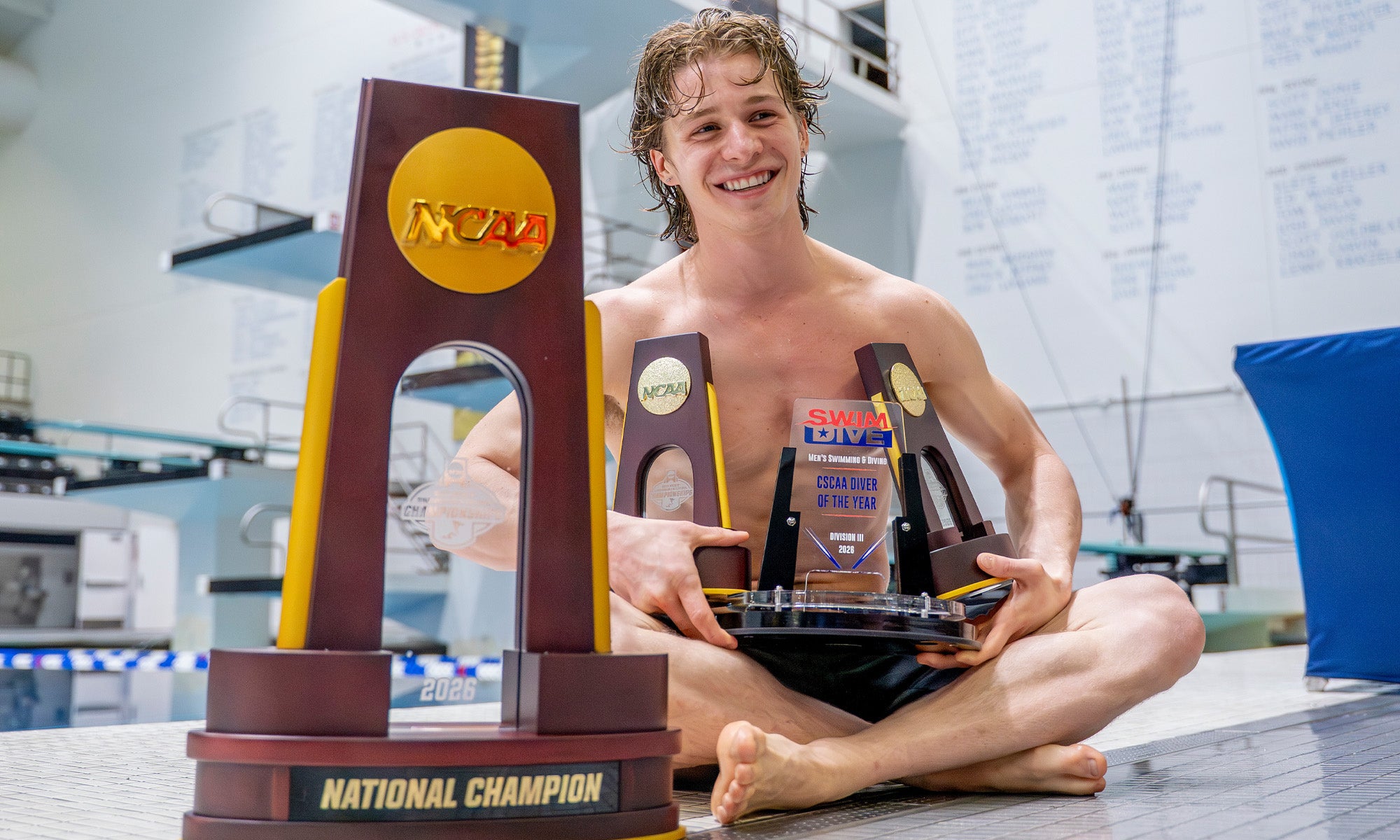
Weeks after helping Denison win an NCAA men’s swimming and diving championship, Nick Fogle ’26 plunged headfirst into unfamiliar waters.
The psychology major, who wants to counsel young people with executive functioning challenges, entered the seventh annual pitch competition hosted by Red Frame Lab, the university’s consulting and entrepreneurship hub. Fogle was initially reluctant to participate, but he impressed mentors and judges alike with his April presentation.
As someone diagnosed with Attention Deficit/Hyperactivity Disorder (ADHD) at age 7, Fogle was a hyperactive, impulsive kid who struggled to focus. He was unable to sit through 50-minute classes as a teenager — telling his mother, “I’m smarter when I stand.” He eventually transferred to a high school that allowed him to stand in the back of classrooms.
“I struggled to do well in school early on,” Fogle says. “I didn’t know how to study, and I wasn’t organized. I had trouble completing assignments. The counseling I received felt very cookie cutter. It might have worked for some people, but others have highly specific needs.”
Fogle’s desire to start his own practice, Wildly Capable Coaching, led him to Red Frame Lab and the Red StartUp program. With the help of mentors Tracy Brandenburg and Lisa Armitage, he delivered a dynamic presentation, earning him a $1,000 first-place prize that he’ll put toward the private practice he’s opening in his native Minnesota after graduation.
“I was a kid who dealt with similar experiences, and Nick’s story really resonated with me,” says local fitness entrepreneur Cory Gregory, who served as a pitch-competition judge. “I think he has a massive opportunity to impact the lives of young people — and there’s a real need for it.”
Fogle, named Division III Diver of the Year as a senior, said the pitch competition is the latest way Denison helped accelerate his growth as a student and a person.
“When I look at where I started versus where I am today, it’s clear how Denison has given me the opportunity to mature,” Fogle says. “It gave me the opportunity to prove myself academically. It also challenged me and showed me I’m capable of juggling many interests in my life.”
‘I can do this’
The story of Fogle’s first leap into a pool remains a family legend. He was a toddler, preparing for his first swim lesson with his father, and sprinted toward the deep end.
“I apparently got this grin on my face, ran down the side of the pool, and jumped in,” Fogle says. “My dad had to swim over and rescue me.”
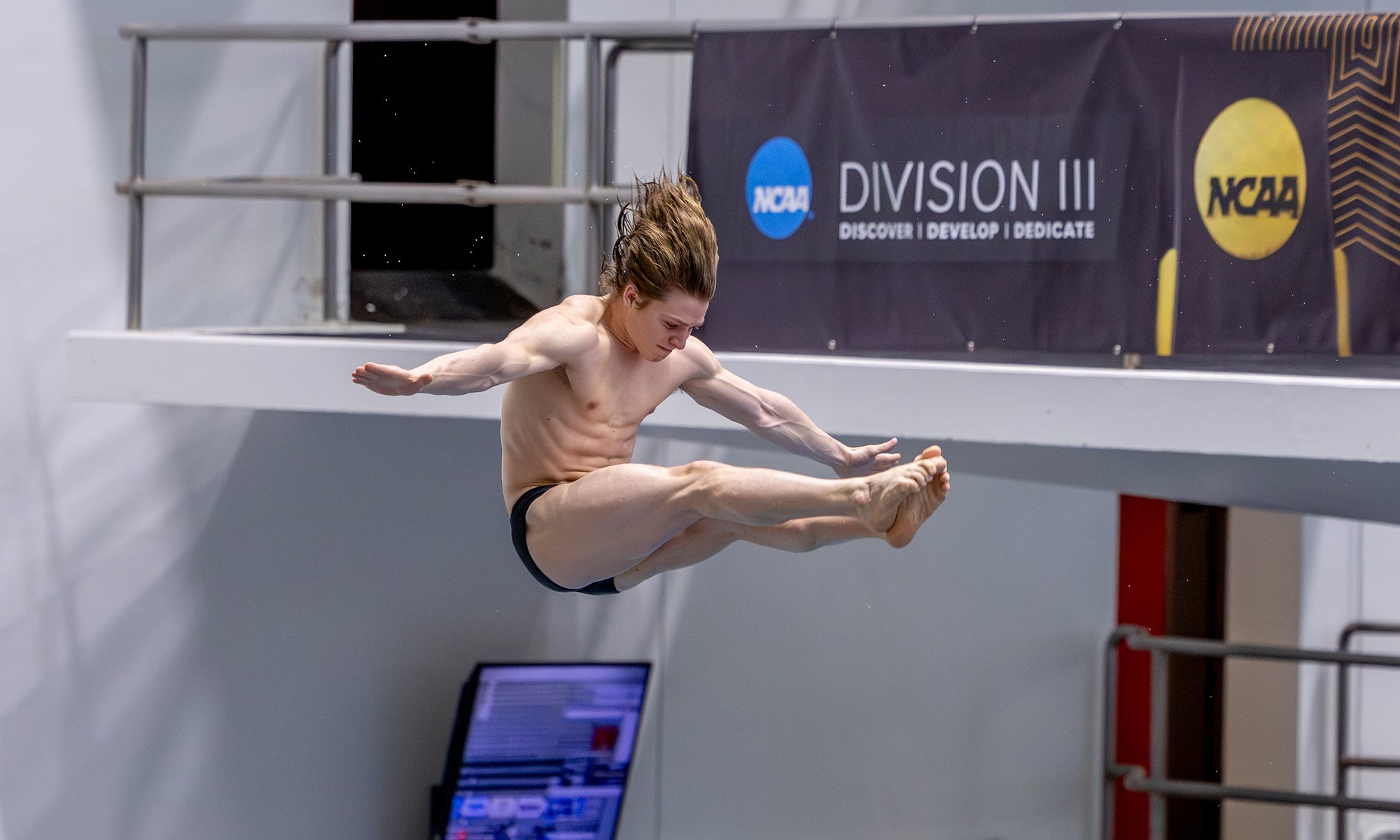
Nick Fogle ’26 is a six-time all-American in diving.
ADHD is a common neurodevelopmental disorder affecting the brain’s executive functions, causing persistent patterns of inattention, hyperactivity, and/or impulsivity. The Centers for Disease Control and Prevention reports that an estimated 7 million U.S. children, ages 3 to 17, have been diagnosed with ADHD, according to data from a national survey of parents using data from 2022.
The Fogles tried medication and occupational therapy to help their son reach his potential.
Fogle recalls a lot of “trial and error” and growing frustrated with what he perceived was a lack of individual attention to his issues. His mother cited the efforts of several school teachers in developing study skills that enabled Fogle to thrive in the proper environment.
They found movement was a key to his success. During the pandemic, when schools and universities shifted to virtual learning, Fogle blurred his background and listened to his instructors while riding a skateboard.
The family also discovered he had a talent that involved rapid movement and spinning.
“Diving was a big part of this,” says his mother, Rachel Fogle, a learning specialist and cross country coach at a Minnesota prep school. “Nick was a risk taker. He loved doing these flips off the neighbor’s diving board. I was like, ‘No, if you’re going to do this, you’re going to learn to do it the right way.’
“We’ve looked up articles that talk about — not just spinning — but that kids with ADHD have a much better success rate if they get lots of exercise and movement.”
Fogle credits his youth diving coach, John Dailey, for transforming him into a championship-level athlete. As his diving improved, so did his academics and quality of life.
“I remember when he got his ACT score back,” his mother says. “Nick looked at it and said, ‘Wait, I’m smart? I can do this.’”
Finding his fit
When Fogle began his college search, Denison wasn’t immediately on his radar despite long-ago family connections. His great-grandparents, Richard ’46 and Margaret ’48 Fogle, were alums, as were his grandfather, Steven Fogle ’73, and uncle, David Fogle ’71.
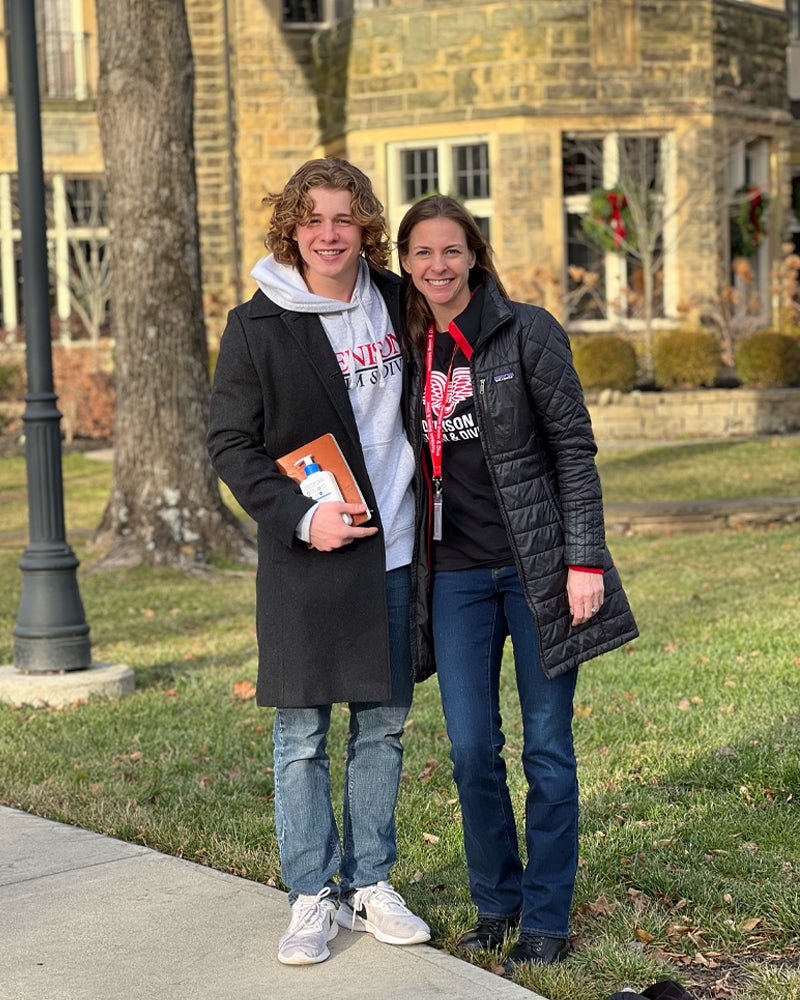
Nick Fogle ’26 with his mother, Rachel.
The family toured the campus and met members of the athletic department. But it wasn’t until Fogle later spoke with the Big Red swimming and diving coaches that he thought Denison would be a good fit.
The program’s reputation as a national powerhouse was appealing, and so were the small class sizes and individual attention students receive on The Hill.
“Nick said he needed somebody to help hold him accountable, and he found that with the coaches at Denison,” his mother says. “After talking with the coaches, he told us, ‘this is a good place for me.’”
Decorated diving career
Fogle qualified for the national meet in all four years at Denison and blossomed into a six-time All-American, culminating with individual NCAA titles on the 1- and 3-meter boards as a senior.
He was one of three multi-event winners — swimmers Jack Hill ’27 and George Goins ’28 were the others — to power the Big Red men’s program to a second consecutive national title and a seventh overall.
“Nick Fogle is incredibly hardworking,” first-year Denison diving coach Kai Robinson says. “And, with his work ethic and talent and experience, he’s seen a natural progression. He also was receptive to a new coach in terms of changing some of his fundamentals, board work, and technique.”
Fogle served as a team leader and speaks highly of teammates who helped him work through his challenges. One example was his reluctance to dive when songs playing during practice were about to have a beat drop — where a rhythmic build up breaks into an intense bassline or percussion.
“They were totally understanding,” Fogle says. “They knew exactly what was going on. When they saw me waiting a long time on a board, they were like, ‘oh, it’s the music,’ and one of the other divers would step up and dive.”
Master juggler
Fogle has been more than just an NCAA champion at Denison. He’s earned multiple scholar-athlete awards and in 2025 was inducted into Chi Alpha Sigma, a national nonprofit honor society specifically recognizing college student-athletes who excel in both academics and athletics.
As a young person, Fogle had difficulty remaining focused on any single task. At Denison, he juggled many.
- He was the university’s vice president of Mortar Board, a national honor society recognizing college juniors and seniors for their exemplary scholarship, leadership, and service.
- He founded the Denison Book Recycling Program.
- He contributed to ongoing research projects and conducted independent research under the direction of Sydney Green, assistant professor of psychology.
“I’ve really enjoyed working with Nick,” Green says. “Hearing more about his experience with ADHD makes sense, as his self-awareness and discipline are things that definitely set him apart. It’s not surprising to me that he wants to support others as an executive functioning coach. That feels like a really natural next step for him.”
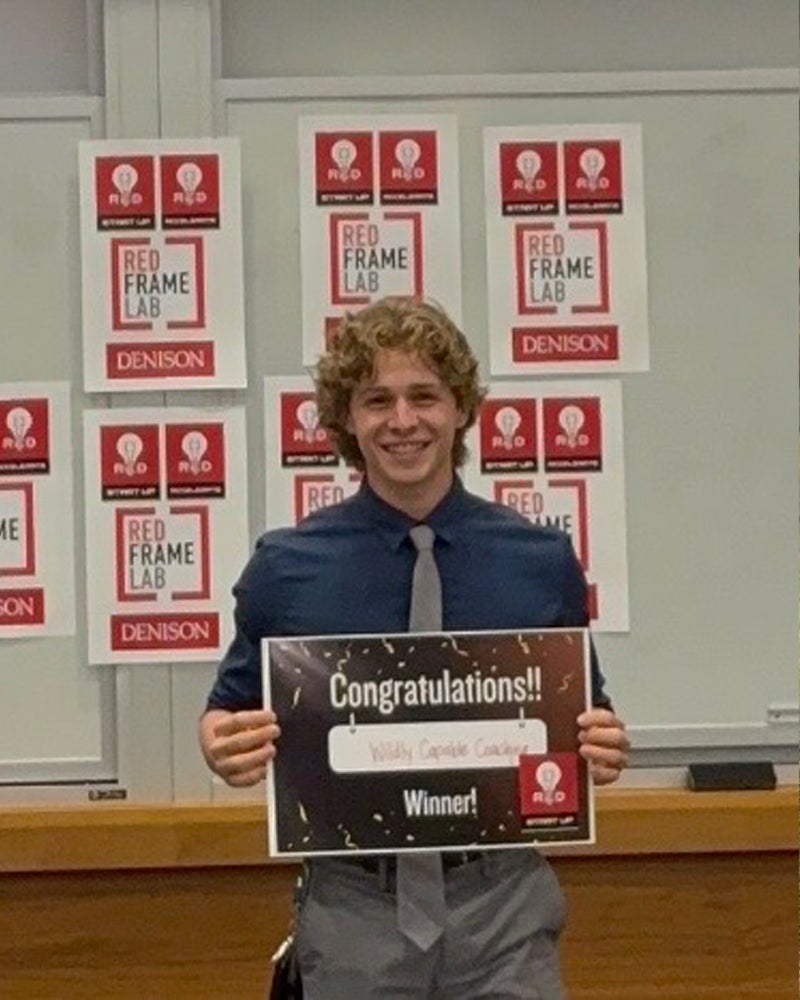
Nick Fogle won a $1,000 first-place prize at a Red Frame pitch competition in April.
Fogle landed on the idea of starting a private practice in January, with his mother’s help. He’s spent the last few months developing a business plan, working with mentors, earning the necessary certifications, and reaching out to Minnesota school districts that might partner with him.
His father helped Fogle come up with the name Wildly Capable Coaching.
“I wanted to find something memorable, simple, and most importantly, to show that the practice isn’t just about getting kids good grades, it’s about showing kids how capable they are,” Fogle says.
His Red StartUp mentors were impressed with his level of preparation and organization.
“Nick was already far down the path when I started working with him,” says Armitage, a marketing and sales executive in Dublin, Ohio. “He had the vision for the actual business, and the passion to make it work. I helped him with several things, but he did the work.”
Fogle’s mother is thrilled with her son’s experience at Denison. She has seen him mature, grow in confidence, and evolve into a national champion. His work with the Red StartUp program and his decision to pursue a career as an executive functioning coach represent a full-circle moment in his development.
“I told some of his teachers that this is what he’s planning to do, and I had one teacher who just started crying,” Rachel says. “She was like, ‘With everything he’s gone through, he’ll make an excellent coach.’
“I’ve always told my four kids that they needed to leave the world better than when they came into it,” his mother adds, “and Nick has taken that to heart.”