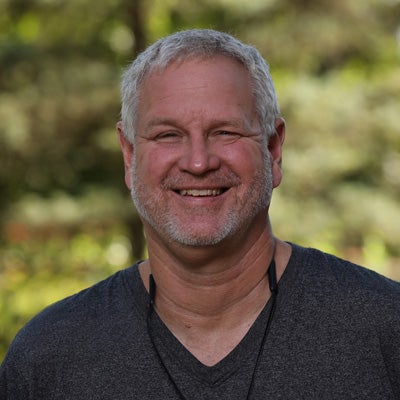
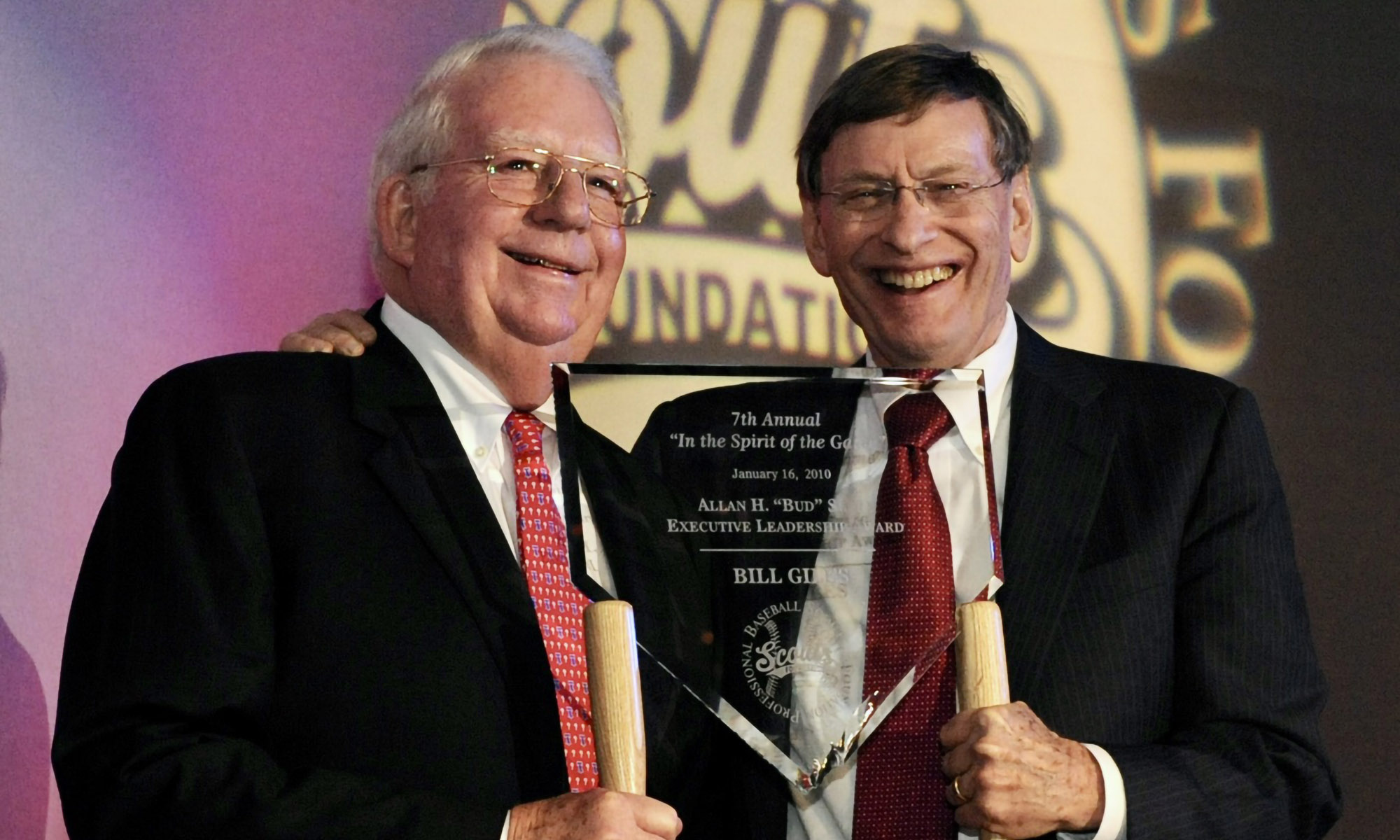
Bill Giles ’56 lived to put smiles on the faces of baseball fans.
Opening new stadiums and delivering National League titles certainly did that. So did an ostrich race in a Philadelphia ballpark — even as the flightless birds veered off script.
“If you put a cart behind an ostrich, I was told, they would race around the warning track,” Giles, a longtime baseball team executive, told Denison Magazine in 1990. “Our announcers were on the carts behind the ostriches. The ostriches went wild. They dumped the announcers, and ran into the stands.”
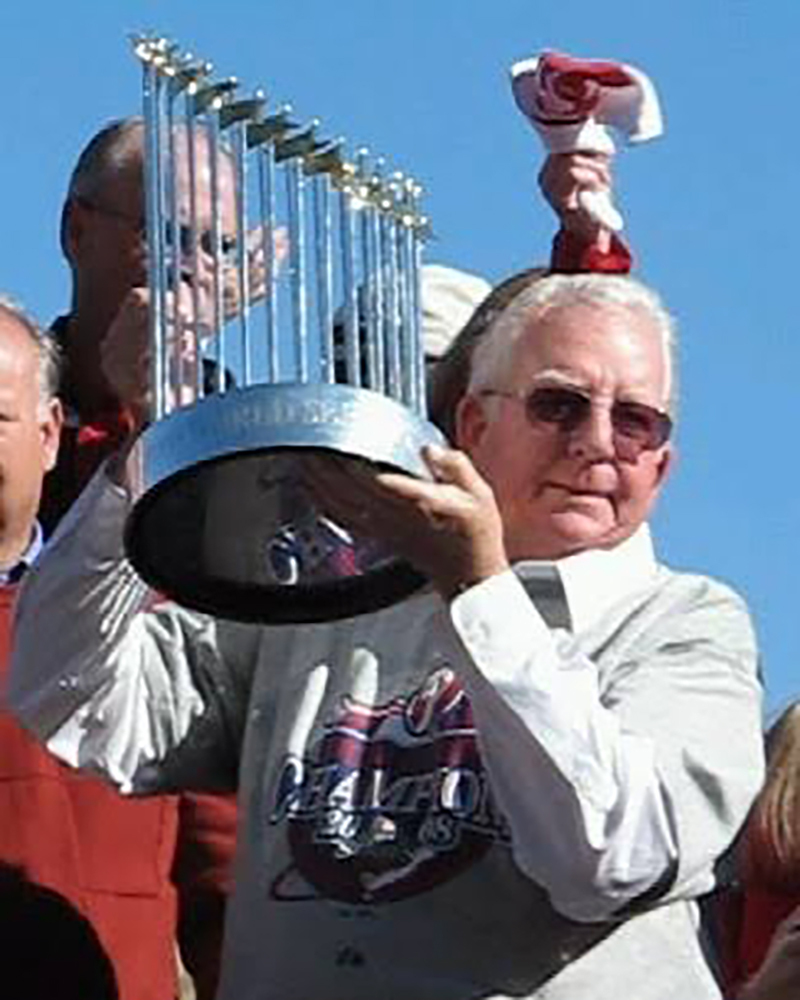
Bill Giles ’56 with the Phillies World Series trophy in 2008.
It didn’t matter to Giles that some stunts failed to go as planned, as long as paying customers enjoyed themselves. Giles, who died Sept. 25, 2026, at 92, was a visionary in the realm of the fan experience.
Decades before the introduction of T-shirt cannons, Jumbotrons, and arena pyrotechnics, Giles was the P.T. Barnum of game-day promotions. He recognized the importance of showing people a good time at the ballpark whether the home team won or lost.
His mission took many innovative forms after graduating from Denison with a degree in economics and working for the Cincinnati Reds, Houston Colts (now the Astros), and Philadelphia Phillies.
In Philadelphia, he convinced one of the Flying Wallendas to walk a wire across the top of Veterans Stadium between doubleheaders. He had an opening day ball dropped by helicopter to a Phillies bullpen coach, and employed a series of daredevils, all named “Kiteman,” to float into the stadium and — with varying degrees of success — deliver a first-pitch ball.
“Throughout his life, his main focus was to create enjoyable experiences for his family, friends, and fans,” his son Chris Giles ’88 said. “That’s what he was all about — it was always first and foremost in his mind.”
The weekend of Oct. 17-18, 2026, will be a poignant and memorable one for the family. The former Phillies executive and minority owner is being buried Saturday, and his family will host a memorial service the following day. In between, family members will attend the premiere of Big Phan, a documentary about the Phillie Phanatic, the iconic green mascot that Giles helped conceive.
“I want something undefinable, fat, green, with a big nose, with his tongue hanging out,” Giles said in an interview prior to the mascot’s 1980 unveiling. “When I think of baseball, the first thing I think of is the green grass.
It’s always such a beautiful picture. And that’s why I wanted it green. To go along with the field.”
Famous father
Giles was the son of National Baseball Hall of Fame inductee Warren Giles, a Cincinnati Reds executive (1937-1951) and National League president (1951-69). An only child whose mother died when he was eight, Bill Giles dreamed of a career in baseball. Working for his father, there was no odd job he wouldn’t perform to achieve his goal.
As a 12-year-old, he served as the “sound effects” technician for Reds broadcasts in an era before franchises routinely sent radio announcers to away games. Using real-time information from Western Union ticker tapes, the announcers recreated games in a Cincinnati studio. When the batter hit the ball, Giles would strike a two-by-four with a mallet next to the microphone.
“I was far better at hitting that block of wood than I was hitting a baseball,” Giles said.
Denison days
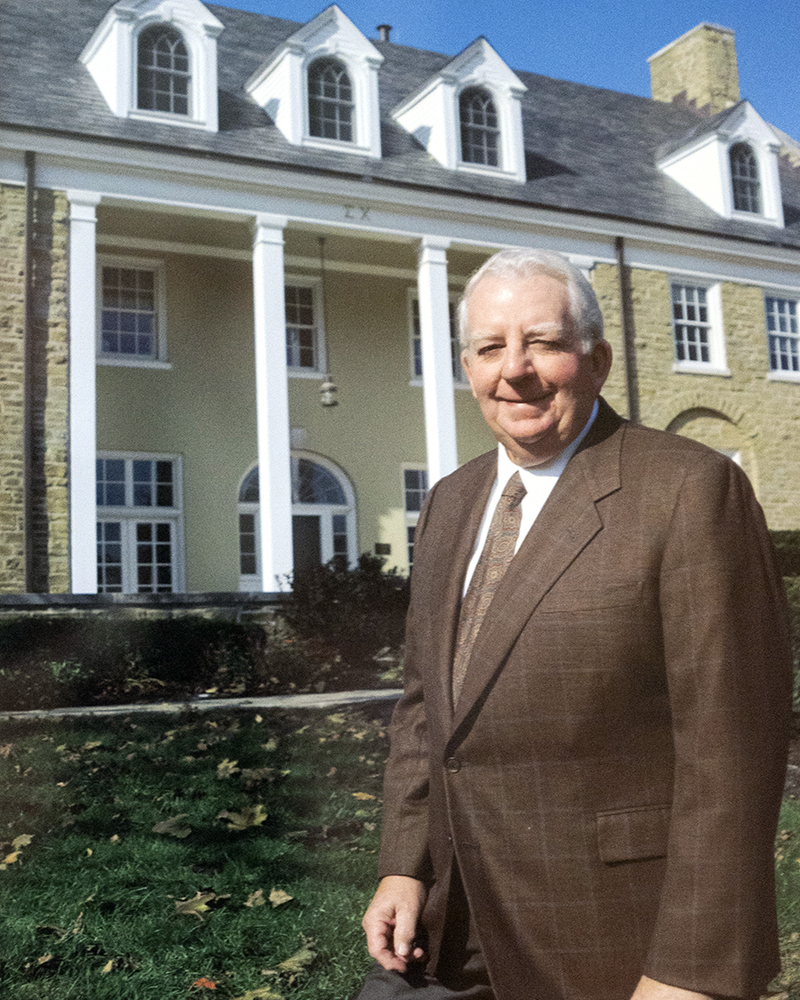
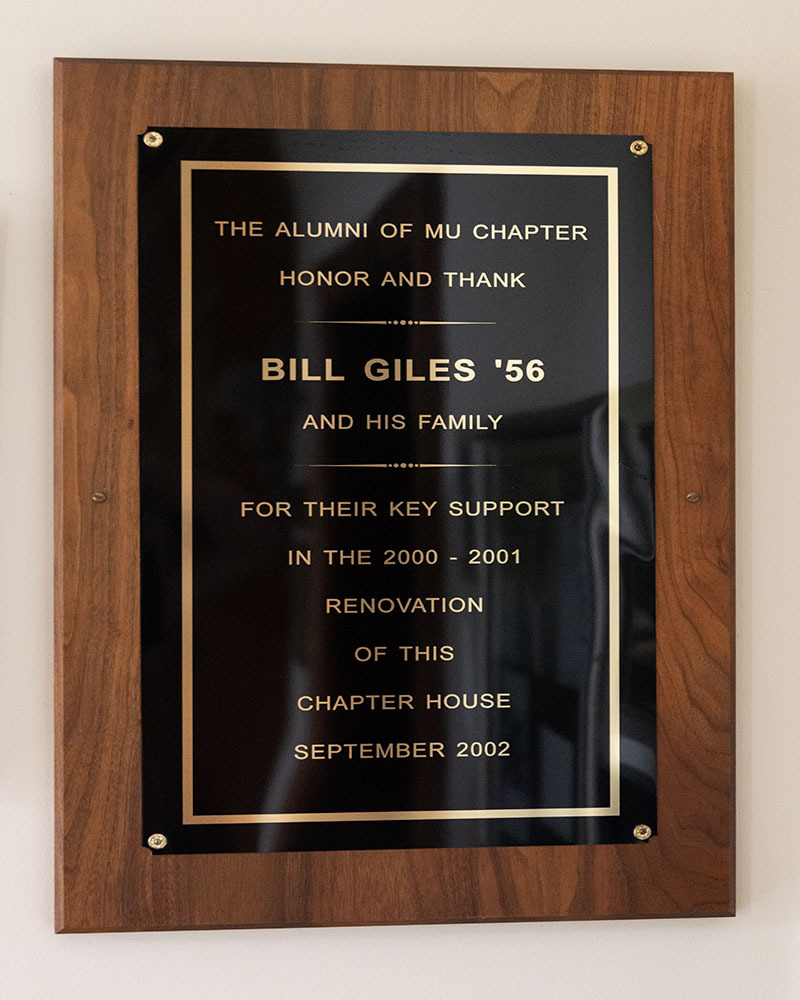
Bill Giles ’56, standing in front of the Sigma Chi House (above), and a plaque honoring Giles and his family for their support of renovations to Sigma Chi.
Several of Giles’ older high school friends attended Denison and, after visiting the campus, he joined them on The Hill. He dabbled in varsity football and baseball but excelled in tennis, where he was a three-year letter winner and a key member of two conference champions.
It was at Denison he also met his future wife, Nancy Kirwin Giles ’55.
“My dad loved his time at Denison,” said Chris, who like his father met his wife, Amy Eichhold Giles ’88, on campus. “He went back a number of times to reunite with old friends.”
Giles roomed with tennis teammate and Sigma Chi president Bill Bowen ’55. His fraternity brother challenged Giles to buckle down academically and he responded, earning straight A’s and the Leland Gordon Alumni Prize in Economics.
Decades later, when he learned the Sigma Chi fraternity house needed significant repairs, Giles wrote a check for $400,000. His generosity inspired others to raise an additional $900,000 for the 2000 renovation. A photo of Giles and a commemorative plaque hang in Sigma Chi, honoring his commitment to the fraternity.
“Bill was one of the most kind and humble men you would ever want to meet,” Bill Mason ’57 said. “He never bragged about his background, but it was always a thrill for us when his father came to campus.”
During a one-week span in 1956, Giles graduated from Denison, married Nancy, and was commissioned in the U.S. Air Force as a flight navigator. But everyone knew where his future lay.
“His goal was to own a team,” Christopher said. “He would tell that to anyone who asked.”
Coming up Rose(s)
After three years in the Air Force, Giles went to work fulltime for the Reds. In 1962, he joined the expansion Houston Colts, where he ran afoul with his father for using the Astrodome’s scoreboard to pan an umpire for ejecting a Houston player.
When the umpire complained to the National League office, Giles received a call from its president, demanding to know who was responsible.
“Gee, Dad I’m not sure who it was, but I’ll tell him not to do it again,” Giles recalled saying. “My dad answered, ‘When you find out, tell him his allowance is cut off, will you?’ The next day, when the umpires came out, I put on the scoreboard 50 times, ‘I shall not write messages about the umpires.’”
The moribund Phillies, playing in front of mostly empty seats, hired Giles in 1969. He oversaw marketing, sales, public relations, and promotions. Like in Houston, he opened a new ballpark, Veterans Stadium. Giles helped transform the franchise, drawing fans to the multi-purpose stadium with an endless stream of promotions to create family fun. He was among the first to realize teams could use the scoreboard as a means of entertainment.
As the on-field product improved, Giles worked behind the scenes to secure one of the team’s biggest free-agent signings, Pete Rose, in 1979.
Using lessons learned from his Denison economics classes, he convinced the club’s flagship television station to pay more for its broadcast rights, reasoning it could charge higher advertising rates with Rose in the lineup. In 1980, the Phillies won their first World Series title.
Two years later, Giles organized a group of investors to purchase the Phillies for $30 million, realizing his childhood dream. As a minority owner, he became even more influential as the franchise’s president. In 1984, he assumed control of baseball operations and served as the team’s general manager from 1984-87.
Giles was the public face of a silent ownership group for a decade after that. A progressive thinker, he pushed for interleague play and an expanded postseason.
The Phillies won National League pennants in 1983 and 1993 with Giles as team president. The club’s current stadium, Citizens Bank Park, might never have existed if he hadn’t led the years-long campaign to build it. Between his duties with the Phillies and his civic-minded endeavors, Giles found time to write several books, including his memoir, Pouring Six Beers at a Time: And Other Stories from a Lifetime in Baseball.
He never stopped looking for ways to make people smile.
For years, friends told Giles he resembled Dave Thomas, founder of Wendy’s. When the restaurant chain sponsored a “Calling All Daves,” look-a-like contest in 1996, Giles entered. He was one of five finalists from a list of 1,700 applicants.
Although he finished runner-up, Giles said: “I did win the bathing suit division.”