
George Wang ’26 was a first-year at Denison when OpenAI released ChatGPT to the public in November 2022.
Unlike many forms of modern technology, Wang and his classmates did not grow up using generative AI. It meant they needed to quickly educate themselves before entering a workforce in which 66% of business leaders said they would not hire someone without AI skills, according to a 2024 World Trend Index Annual Report survey.
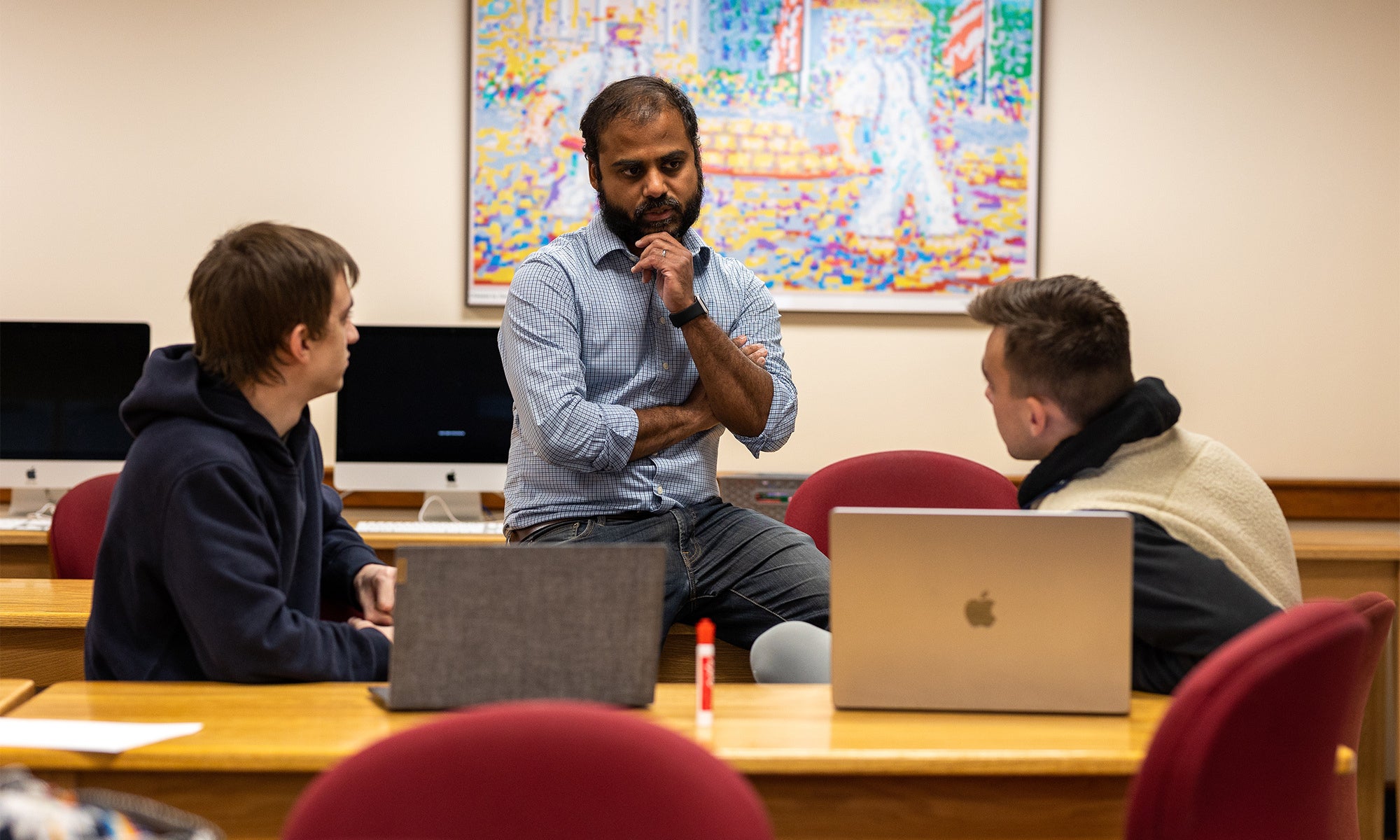
Wang was among 18 seniors to take AI Basics and Big Questions taught by Professor of Computer Science Ashwin Lall in Spring 2026. The interdisciplinary course was designed for seniors across the academic spectrum to learn how a disruptive technology is changing society and examine the ethical and environmental questions surrounding it.
“It’s important for people to learn about AI because it’s becoming increasingly prevalent in our world,” says Wang, a physics major. “I found the course really useful. It focused on the many impacts of AI and why it’s important to understand them.”
The class members, representing 13 majors, took a course first taught by Professor Matt Kretchmar, chair of computer science, and Associate Professor Mark Moller, chair of philosophy, in Fall 2024. Lall worked with a different group of students, and made changes to the curriculum.
Lall focused on how AI works, its impact on many fields, and the importance of developing generative AI skills. The course also featured about a dozen guest speakers.
“One of my goals was to create a true liberal arts experience for our seniors in their last semester,” Lall says. “AI is a topic that’s impacting many different disciplines.”
Denison is committed to academic innovation and workplace readiness, creating a new model for artificial intelligence in higher education.
The university has opened the Emily Hauser King and Robert E. King Center for Data and Innovation, which houses new courses and collaborative projects involving AI, data, technology, and the liberal arts. The center is the latest example of why Denison ranks as the fourth-most innovative national liberal arts college, according to U.S. News & World Report, and is No. 2 in career services, according to Princeton Review’s 2026 Best College rankings.
Associate Professor of Economics Emily Marshall, the inaugural director of the King Center, says Lall’s artificial intelligence course reflects Denison’s dedication to “innovation with intentionality.”
“As Gen AI is rapidly transforming the workplace, we are creating opportunities for students to engage with these technologies by learning to use them effectively while considering the ethical and societal implications,” Marshall says. “The King Center for Data and Innovation will continue to build on existing initiatives by expanding Gen AI learning opportunities for all students in collaboration with academic departments.”
Denison offers an AI machine learning minor, but Lall tailored his course to seniors pursuing other disciplines. Students don’t need a strong math or computer science background, Lall says, to gain a general understanding of how artificial neural networks work.
“On a macro level, I’ve learned how AI is built, how it functions, and the history behind it,” says Colin Dowling ’26, a global commerce major. “I’ve also learned about AI’s environmental and economic impacts.”
Dowling enjoyed the array of guest speakers, who included Denison faculty members and off-campus experts. Lall cast a wide net, inviting Grammy-award winning composer Nathan Schram — a member of Attacca Quartet, which performed at Denison as part of the Vail Series — to discuss AI’s impact on the arts.
Students teamed up to write papers on AI-related topics and make final presentations.
“I wanted to get a leg up post-grad in understanding how AI systems work,” Dowling says. “I already use AI in my daily life, but this class definitely helped me learn how to use it more effectively. It also gave me a deeper understanding of the ethical concerns around AI.”