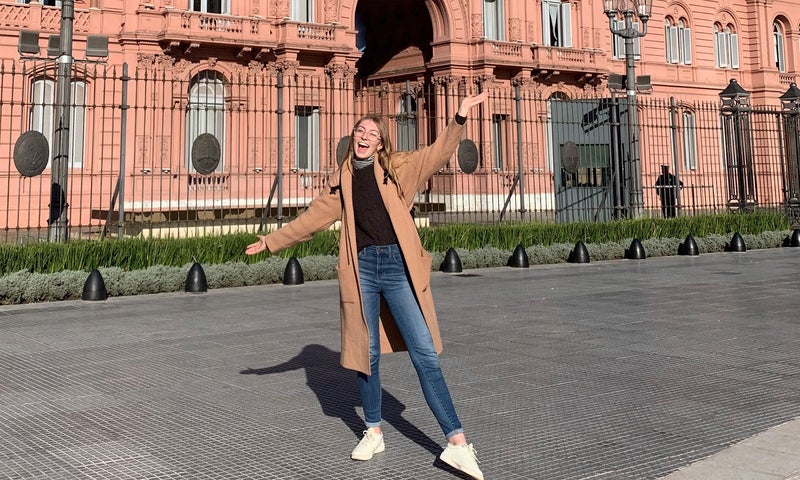
Nancy Tran ’26 describes herself as “passionate about sustainability and solving real-world problems.”
The data analytics and sustainability and environmental studies double major put that passion to work in summer 2025 at the PSEG Institute for Sustainability Studies in Montclair, New Jersey. As part of a team supporting a pharmaceutical company, she conducted market research on sustainable industry practices, analyzing emissions data and helping develop a reduction roadmap under California’s SB219 regulation.
While swapping resources with fellow interns, Tran learned about the Boston University Questrom School of Business $50K Sustainability Case Competition, one of the largest student sustainability prizes in the world. Open to undergraduates through doctoral students, the competition draws dozens of teams, many from major business schools.
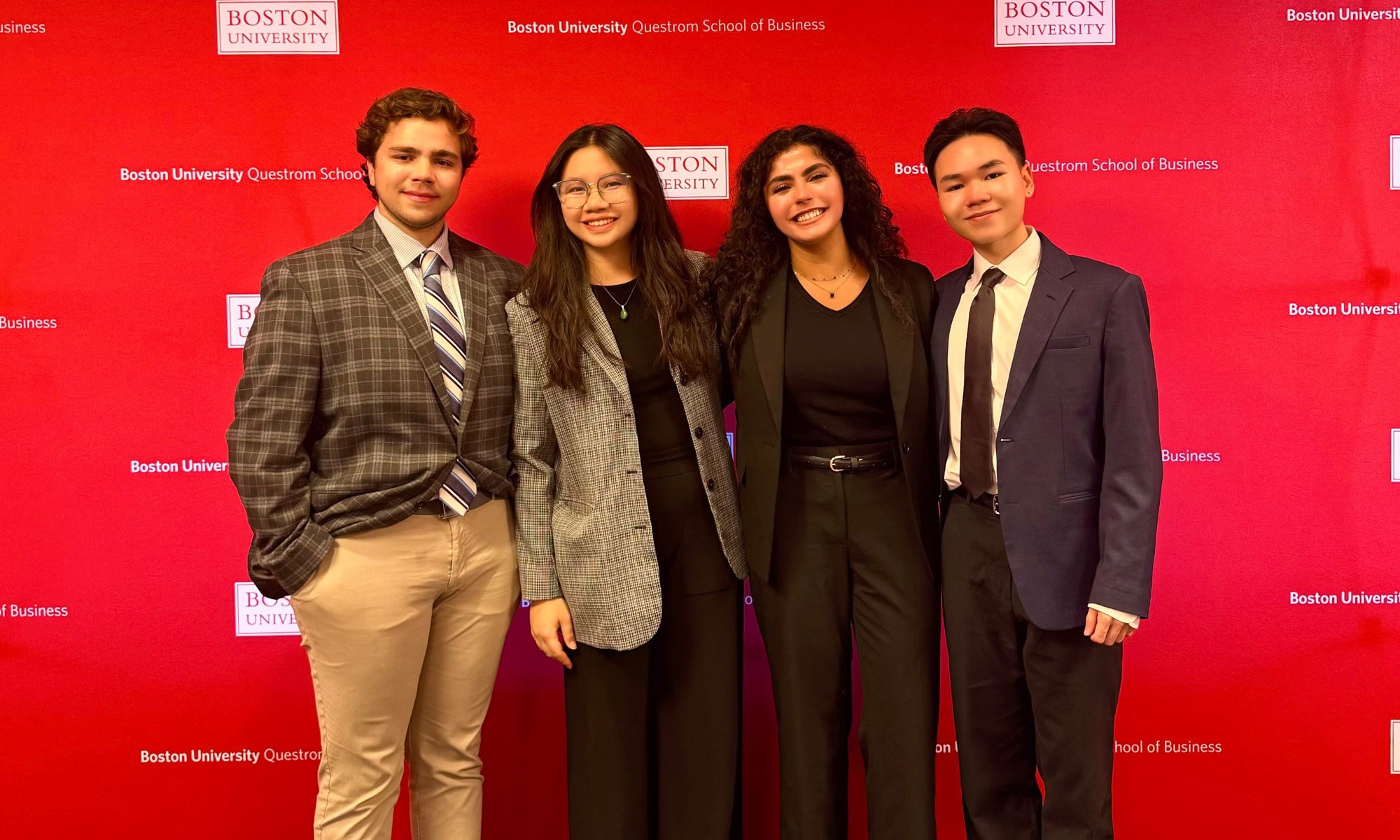
Tran was ready to test herself against the best in the nation. Back on The Hill, she recruited a formidable team from a range of majors, including data analytics, economics, financial economics, and sustainability and environmental studies. Ola Abdullhady ’26, Tri Ngo ’27, and Cole Shegan Siniawski ’26 joined her in the quest to build a prizewinning entry.
Their project began with a simple but ambitious question: How can we make cryptocurrency storage safer, more affordable, and more accessible for everyone?
Their solution, Unichain, takes aim at the high cost, complexity, and corporate control of existing hardware wallets. “Digital currencies are becoming everyday tools,” Ngo said. “We saw a need for a beginner-friendly, open-source wallet — something universities are uniquely positioned to create.”
For two months, the team worked at an all-out sprint. They researched licensing and security, designed both hardware and software, drafted a budget, built a prototype, and refined their pitch. Faculty offered crucial guidance and resources, Tran said.
“Dr. Park and Dr. Duroy gave us insight into economics, and Dr. Spieles in SES supported logistics,” she said. With funding from the Lisska Center, the team traveled to Boston, ready to compete.
Or almost ready.
After dinner the night before the competition, their rehearsal revealed mismatched ideas and an uneven flow, followed by a realization that they needed to practice individually before coming together as a team. Confidence grew. The chance for sleep shrank. Four hours later, with a few early-morning run-throughs, they were as ready as they’d get.
The next morning’s competition moved fast. Teams faced two surprise twists that forced them to adapt their pitch under intense time pressure. Denison rose to the challenge. Out of 86 teams, they reached the semifinal round, finishing sixth overall. The top three spots went to powerhouse business schools from Canada, UConn, and UC Berkeley.
Shegan Siniawski believes their project stood out because it combined accessibility with an immediately usable idea. “We didn’t just emphasize technical features,” he said. “We showed how our open-source, affordable wallet solved real problems — cost, complexity, and access.” Confident responses during Q&A on security, scalability, and budgeting reinforced their command of the concept.
Back on campus, each teammate reflected on what the experience taught them.
Ngo found that his teamwork skills grew exponentially.
“I understood the power of working together with a shared passion, goal, and purpose,” he said. “As we pushed through it, I could feel a sense of shared commitment that helped us move forward. Making everyone feel included and energized is crucial to success.”
Going into the competition, Shegan Siniawski had only a little knowledge about cryptocurrency, yet he enjoyed the opportunity to apply his critical thinking skills to an area where he had little expertise.
He also realized how important “staying on our toes” is to success. “We had to think quickly, efficiently, and creatively,” he said. “The ability to think quickly and apply critical thinking to any situation are skills I will use in any career.”
Tran came to see that competing against top business schools wasn’t as intimidating as it might seem. “We didn’t have as much experience as some of the other schools, but we believed in our vision, and our passion brought us far.” The experience was more than a competition. It was a chance to test themselves, build something meaningful, and step boldly into a field they’d only just begun to explore — proving that innovation isn’t limited to any major, department, or school.