
Varsity golfer Natalia Fanucchi ’27 was interested in doing on-campus consulting work, but her course load and athletic commitments didn’t leave much time for long-term projects.
“I’d love to do some kind of campaign management after I graduate,” says Fanucchi, a communication and politics & public affairs double major. “Consulting work is appealing, but my schedule is very challenging. I’ve done the math, and I’ve calculated I devote about 30 hours a week to playing and practicing golf.”
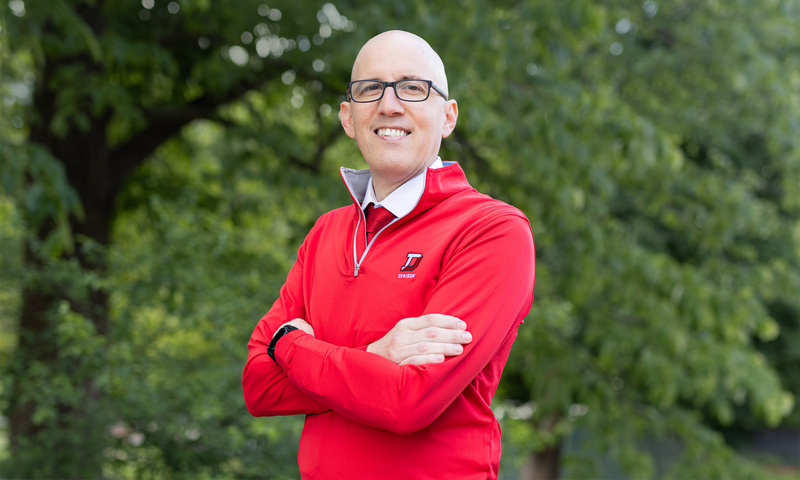
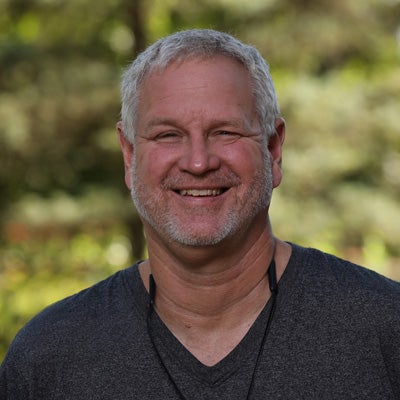
Steve Krak, director of Red Frame Lab, knew of the scheduling conflicts student-athletes sometimes face. It’s why he designed RED Corps for Athletes, a paid, selective student-consulting program within the Big Red athletics department.
The pilot program launched in the 2025-26 academic year.
It’s modeled on the existing RED Corps program in which teams of student employees consult with campus clients on projects important to Denison. The students examine challenges and provide solutions through research methodology, data analysis, and design thinking.
RED Corps was founded in 2018 but over the years has included few varsity athletes because of scheduling overlaps.
“When I was thinking about it from an athletics’ perspective, I thought, ‘What would it look like to create this opportunity within their universe?’” Krak says.
Big Red athletics administrators and coaches encouraged Krak to develop his idea. He designed a program that included more scheduling flexibility without sacrificing components that make consulting so challenging and rewarding. While RED Corps is a year-long fellowship, RED Corps for Athletes is a modified, six-week “sprint model.”
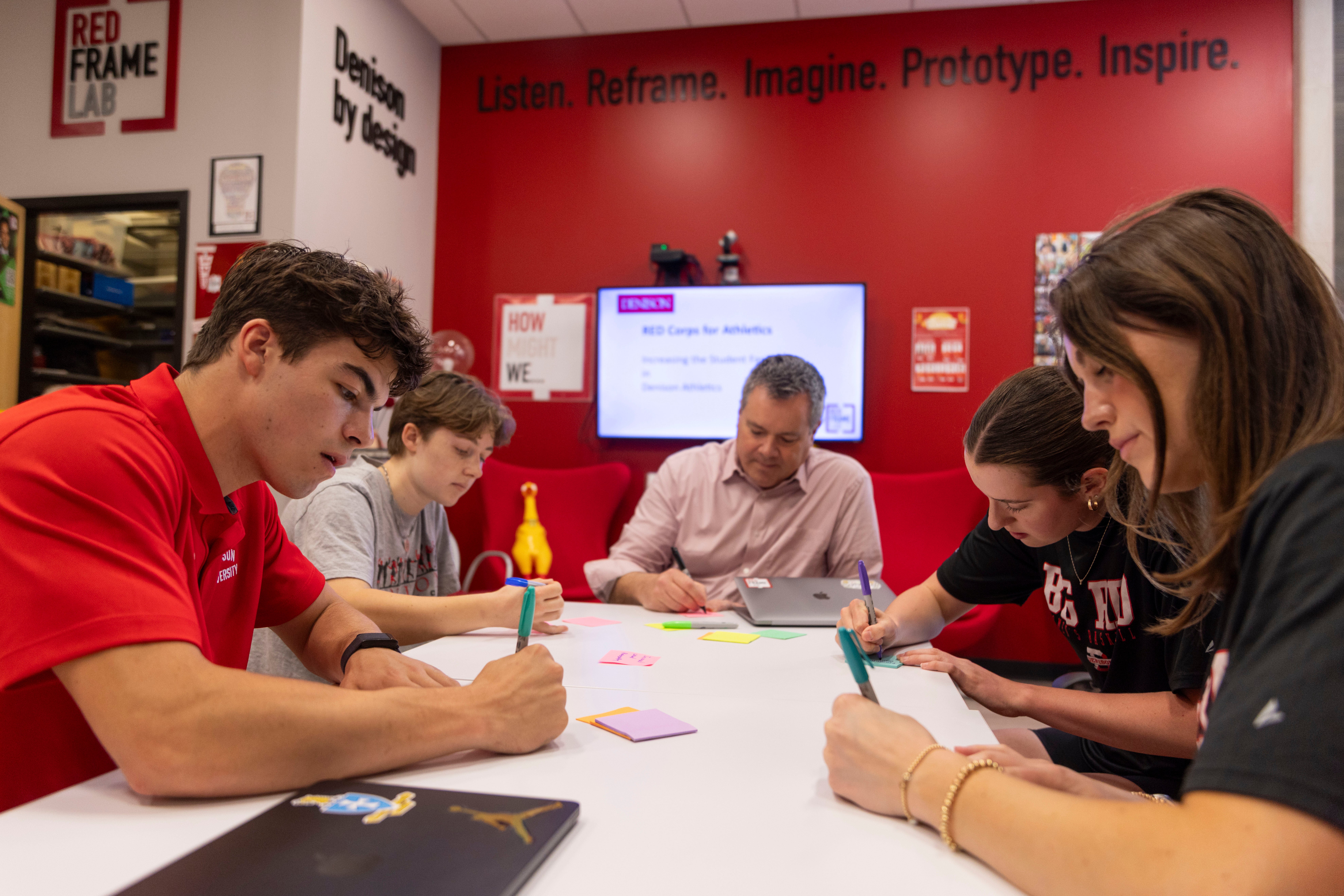
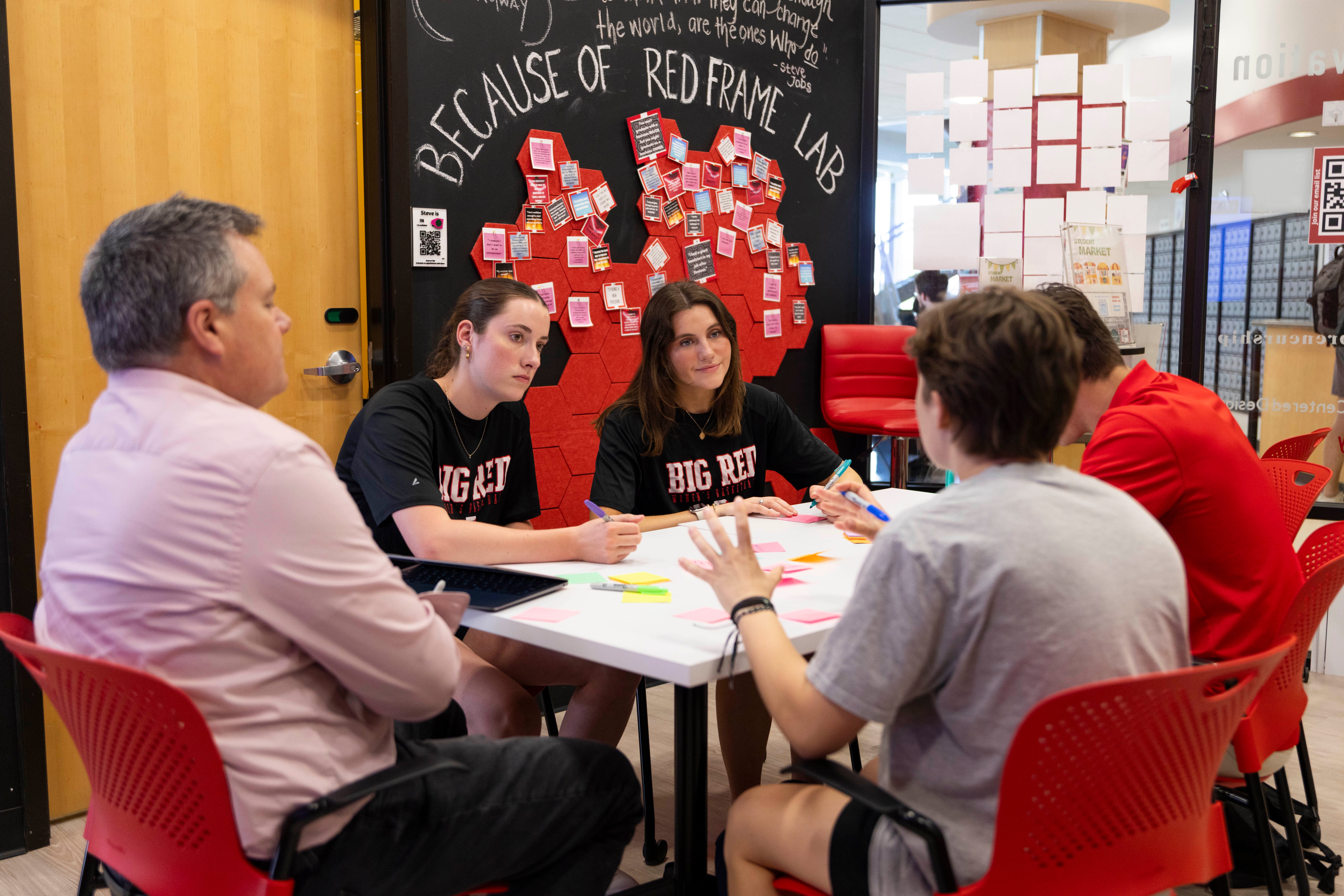
Athletes met with Steve Krak, director of Red Frame Lab, twice a week.
Fannuchi, who led the women’s golf team to a 19th-place finish at the NCAA tournament, learned of Krak’s proposal a year ago. After hearing the scope of the program and the time commitment necessary, Fanucchi thought: “I want to be involved.”
She interviewed for a position and was one of 12 students chosen for the inaugural RED Corps for Athletes cohort. Each of three teams worked on a project selected by the athletics department. The projects included developing a new nutrition plan for athletes, improving fan engagement at games, and increasing awareness of Denison’s Knetzer Family Institute.
Fanucchi worked on the nutrition plan.
“In my interview, I told Steve, ‘I’d love to fix some issues — I’m in the athletes’ world, and I hear a lot,’” she says. “It ended up unfolding exactly the way I would have imagined, and it was perfect for me.”
The student-athletes met twice a week with Krak, and the three consulting groups set their own schedules to work on their projects before making a final presentation to their clients.
The student groups met with clients and coaches. They conducted student interviews and created surveys. In some cases, they examined how other colleges tackle the issues.
“I thought it was a great idea,” says Sara Lee, deputy director of athletics and the client for fan engagement. “It gives the student-athletes opportunities to develop their consulting skills, but it also helps us identify areas where we could improve. It’s a win-win. It’s a win for the department, and it’s a win for the student-athletes because they have a stake in the game. They’re in this world year-round, and they deal with these concerns. Now, they’re working to find solutions.”
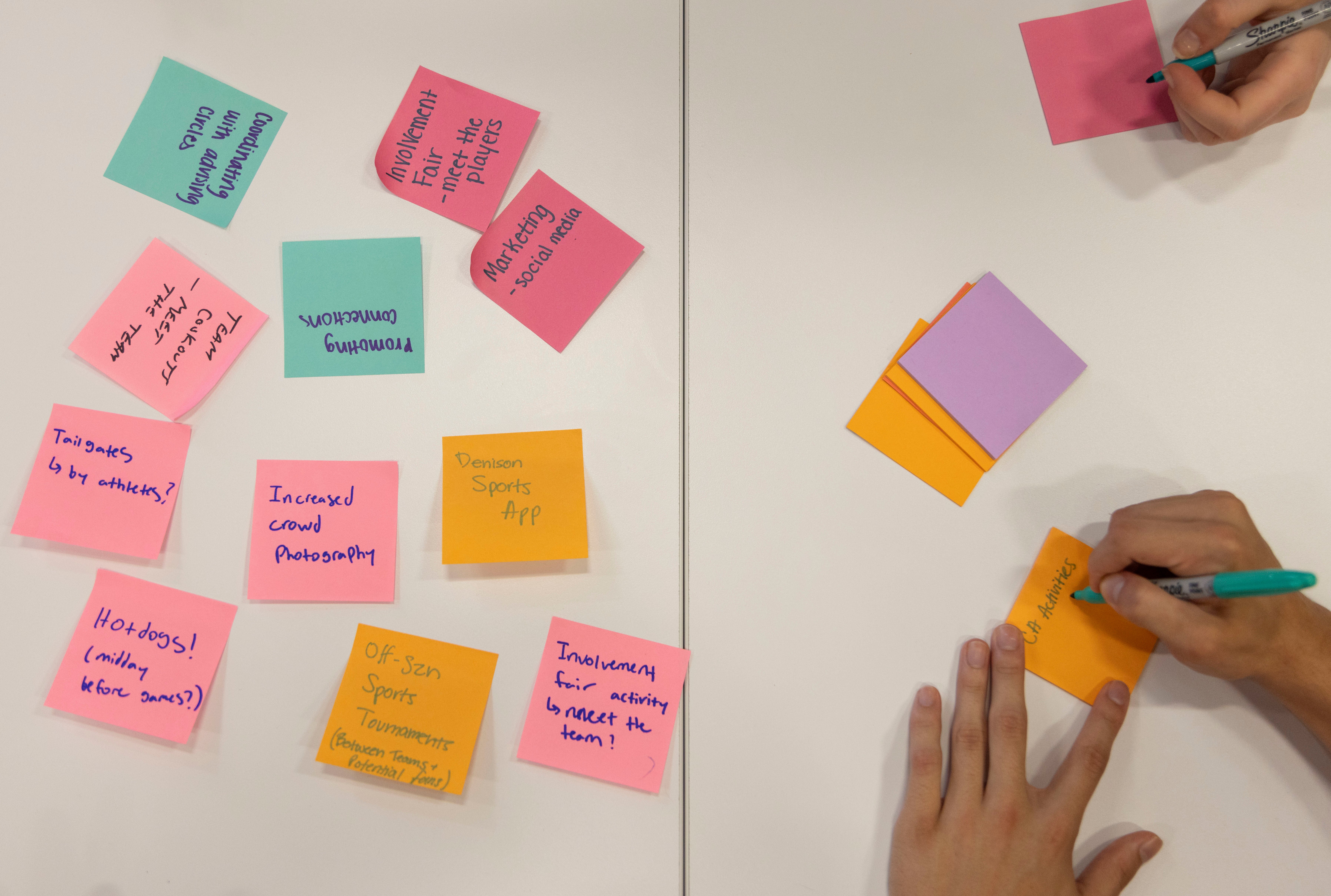
Athletes brainstorm ideas and jot them down on Post-It notes.
Chase Daniel ’27, a football player, enjoyed preparing questions that helped unlock solutions. He was part of the team looking to raise awareness of the Knetzer Family Institute, which integrates the liberal arts with athletic development at Denison.
Daniel spent the summer of 2026 working as an athletics department intern and helping implement some of his group’s recommendations.
“One of my biggest takeaways is you have to ask the right questions to get to the heart of what interests your clients,” Daniel said.
Owen Giannoulias ’28, a men’s basketball player, learned quickly he had to shed his personal opinions and allow data collection to inform his insights.
“When we first got our project assignments, I immediately was thinking about solutions,” he said. “You can’t do it that way. You have to trust the information you’re getting from the data collection.”
Krak challenged the groups to dig deep for answers. For instance, winning alone is not going to draw more fans. It’s about creating a game-day experience and forming a personal connection with the student body.
The group recommended that athletes should meet up with students at events like cookouts, allowing them to get to know the players. They also advised targeting fraternities, sororities, and the first-year office to create “theme nights” or competitions.
“Steve was an excellent mentor,” Giannoulias said. “He gave us a lot of the skills that we needed to dive deep into our projects.”
While developed specifically to accommodate varsity athletes, Krak emphasized there are similar programs open to all students. Moving forward, Lee expects the success of the first cohort of student-athletes to drive higher interest and expand the applicant pool.
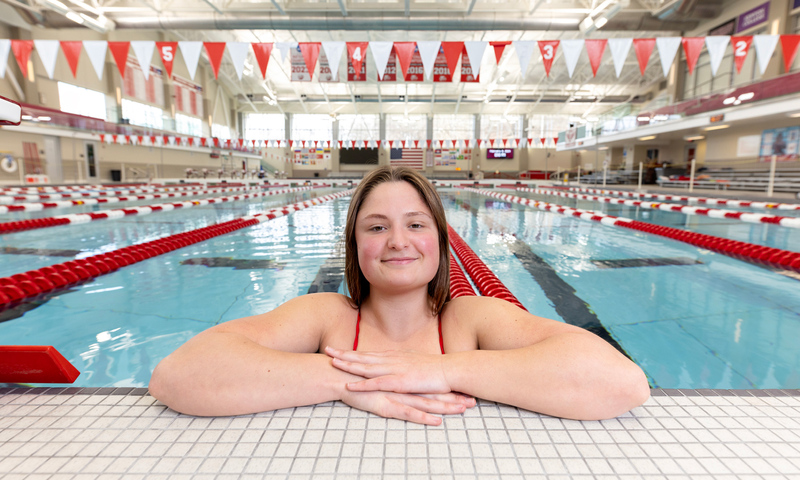
Ada Taute ’27, a member of the NCAA champion women’s basketball team, found the RED Corps for Athletes experience rewarding.
“As athletes, these are issues we care about,” she said. “The projects kind of put the power in our hands to help find solutions.”
Clients from all three groups already have begun searching for ways to implement recommendations.
“We’ve always been about experimentation, and this experiment to build a consulting program within the student-athlete world went very well,” Krak said. “These student-athletes, recommended by their coaches, were passionate about learning consulting processes and having an impact on Denison athletics. I’m expecting this to be just the beginning for this program.”