Three Denison students participated in Summer Scholars research thanks to sponsorship from the Laura C. Harris Foundation. Harris (1916) was a pioneer in the medical profession and embodied the value of a liberal arts and sciences education.
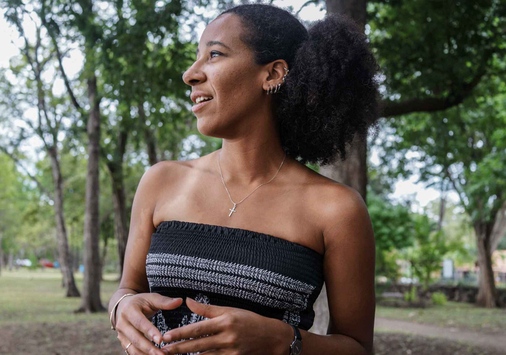
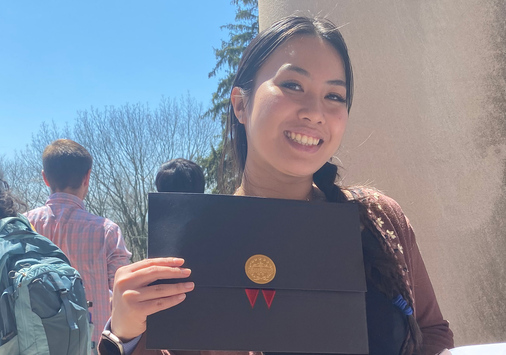
Nemi Kapur ’27, Violet Mitchell ’27, and Luccile Zhu ’28 gave presentations on their summer research projects on Sept. 10, 2026, inside the Mitchell Center Fieldhouse.
Weight-loss research
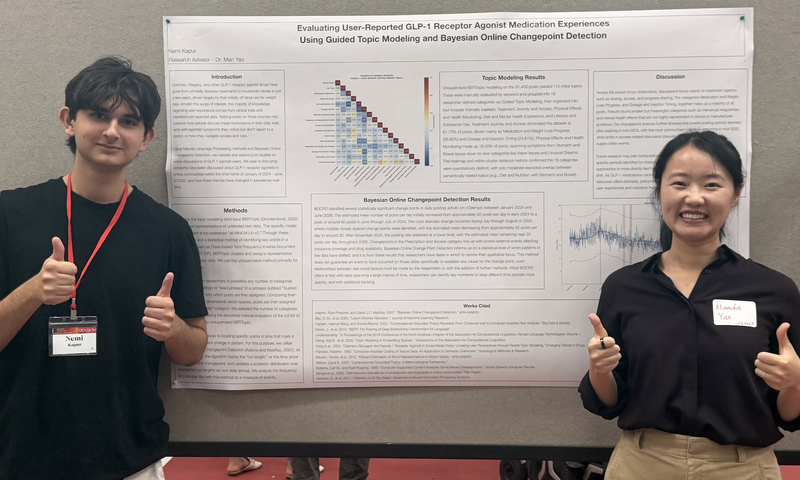
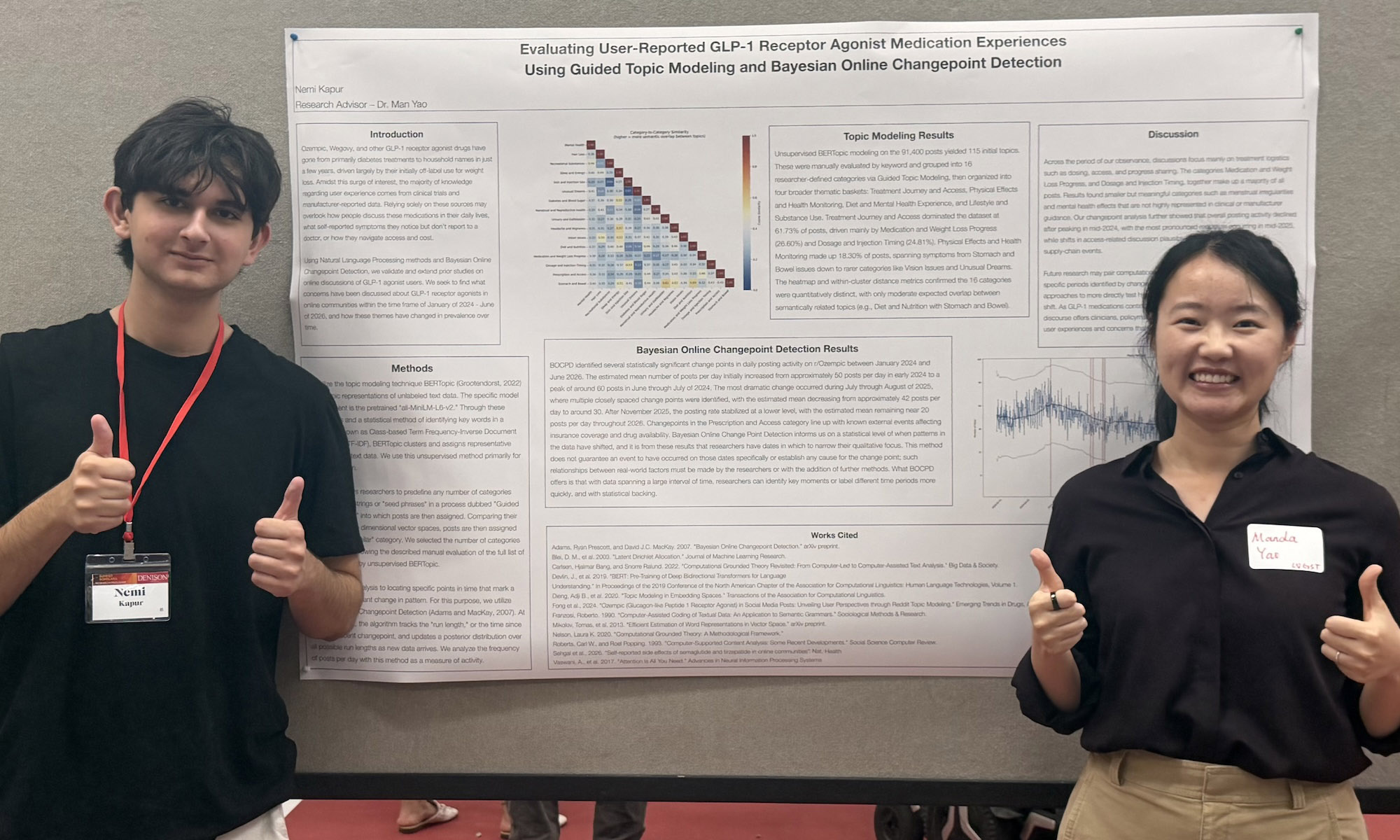
Kapur offered his findings on weight-loss medications in a project he called “Evaluating User-Reported GLP-1 Receptor Agonist Medication Experiences Using Guided Topic Modeling and Bayesian Online Changepoint Detection.” He began his work last fall as a research assistant under the guidance of Assistant Professor Manda Yao (Women’s and Gender Studies/Data Analytics/East Asia Studies) last fall. Yao encouraged him to pursue the topic further through summer research.
Kapur’s work involved evaluating the individual experiences of GLP-1 users to better understand their experiences with the medication. He used topic modeling, a process that involves taking textual accounts and mathematically encoding the language, allowing the researcher to spot trends within the datasets.
These results yielded valuable insights into how patients using GLP-1 medications think about and observe their progress regarding physical health, weight loss, diet, mental health, and other experiences commonly monitored in patients using GLP-1s.
Kapur believes this work is vital as the volume of GLP-1 users increases. Kapur also says that monitoring online discourse offers clinicians, policymakers, and researchers an easily accessible view into user experiences and concerns that might otherwise be missed.
Podcasts on leadership
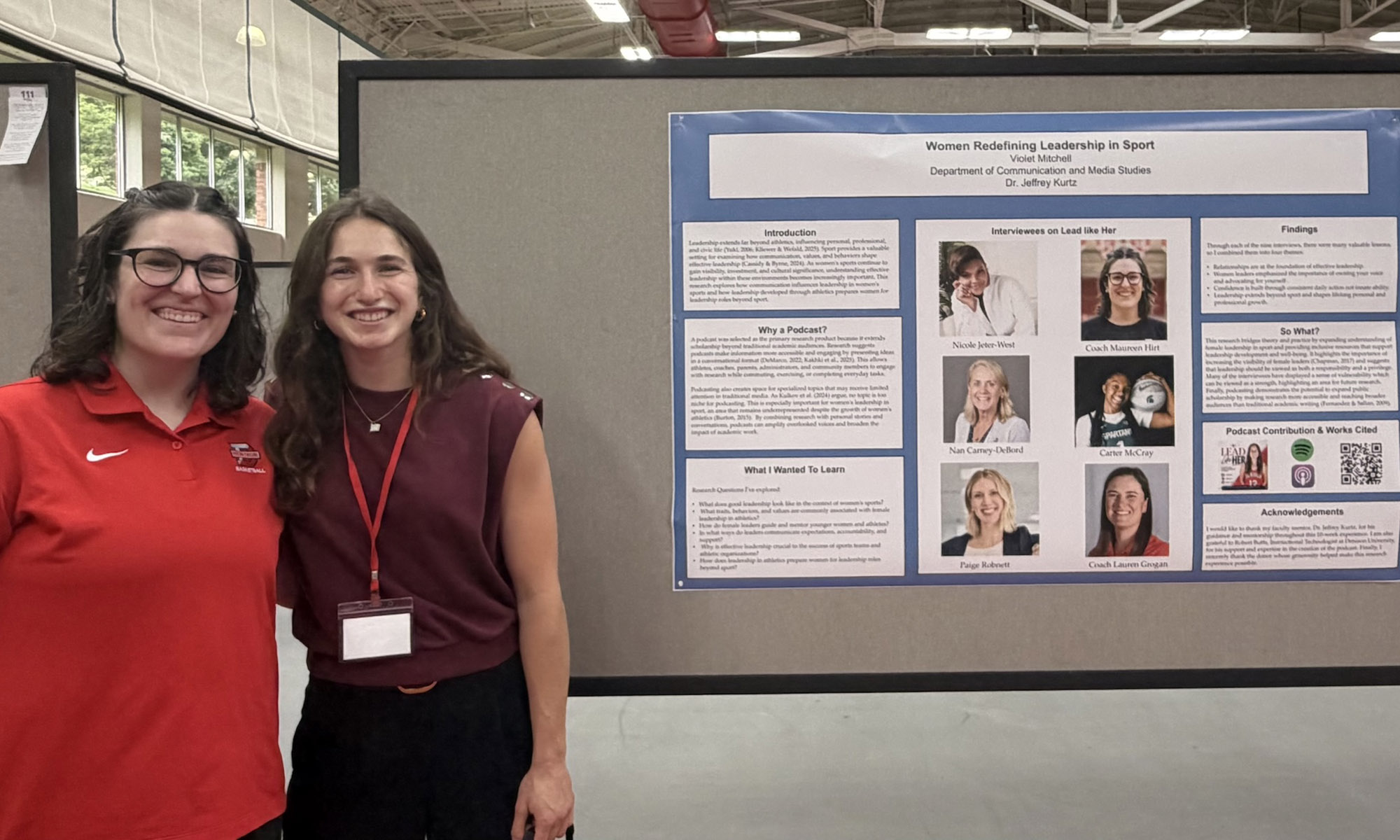
Women’s basketball coach Maureen Hirt with Violet Mitchell ’27
Mitchell sought to understand how female leadership, particularly in athletics, impacts the spaces women inhabit, including the economy, leadership roles, communication skills, values, and more.
Mitchell initially drew inspiration from an activity in which her varsity basketball team participated — writing down a goal the players wanted to achieve during the season. She said improving confidence was a core goal for the group. “The coaches, professors, and any person in your life shape that,” she said. “And so, what I wanted to look at specifically is, ‘What does good leadership look like in the context of female sports?’”
The Big Red won the program’s first NCAA title in 2026.
Mitchell opted to use a podcast to reach her audience, believing it would increase accessibility and attract the audience of women in sports that she hopes to reach. She invited and spoke with many female leaders who emphasized the importance of using one’s voice and building confidence through consistent daily action. “With the growth of women’s sports, you have to learn how to coach them to their best ability, because it really shapes who they are as a person,” Mitchell said.
Mitchell’s podcast, “Lead Like Her,” featuring conversations with women’s basketball coach Maureen Hirt and other influential women in sports, is available on Spotify and Apple Podcasts.
How does social media frame abuse?
Zhu sought to answer the questions, ‘How do survivor accounts and support influencers on Chinese platforms frame domestic violence? And to whom is the discourse addressed?’ Zhu worked to answer these questions by studying survivor accounts on social media platforms such as Douyin, Xiaohongshu, and Bilibili.
The three platforms revealed different patterns of content distribution, with Douyin most strongly highlighting survivor accounts. The encoding of content on these platforms revealed that abusers reported speech uses love to convert control into care. Zhu’s work also found that it is rare for survivors to directly address their abusers. On Douyin and Xiaohongshu, only 1.1% of coded speech was addressed to the abuser, while on Bilibili, it was just 1.0%.
Zhu believes that these findings contribute to the harm experienced by women, asking them to recognize, document, endure, escape, and recover, while the man causing the harm is asked nothing. Two services within Chinese law already exist to support survivors: perpetrator fines, which fund survivor services, and the enforcement of separation orders. Zhu found that stronger implementation of new programs like abuser intervention would strongly support survivors of domestic violence in China. Zhu’s work shines light on the undue burden survivors of domestic violence face in their fight against abusers, who are not often called to answer for their violence.
The three students appreciated the support of the Laura C. Harris Foundation for its sponsorship and were grateful for the mentorship of their advisors: Yao, Professor Jeff Kurtz (Communication), and Professor Isis Nusair (Women’s & Gender Studies/International Studies/Middle East North African Studies).