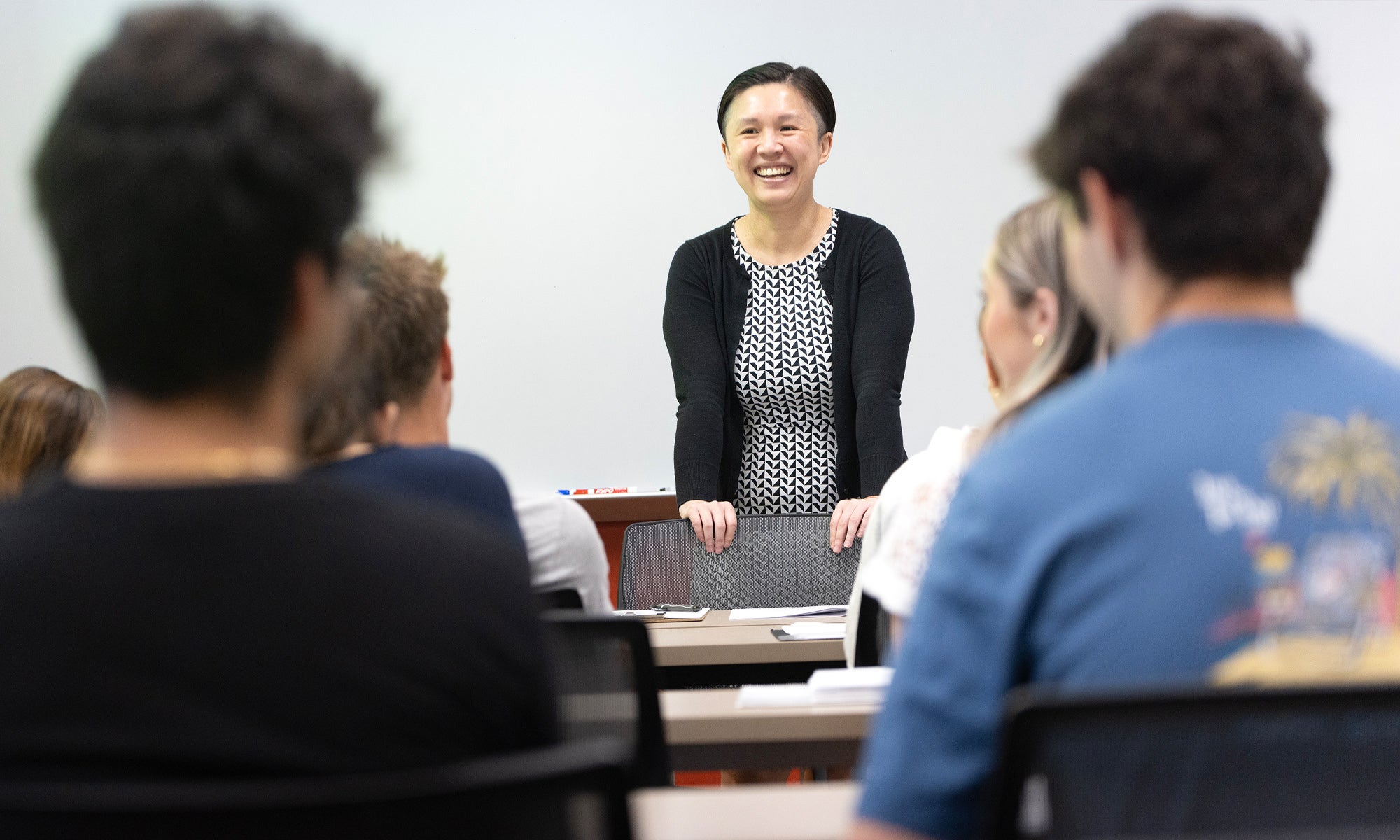
Mathematics Professor May Mei, who is part of a team enlisted by the American Institute of Mathematics (AIM) to explore the nature of quasicrystals, is a co-author on a recent paper detailing the research.
A quasicrystal is a material that hovers between an amorphous solid such as glass, which doesn’t have a repeating atomic structure, and a crystalline solid such as a diamond, which has a highly structured atomic lattice. Quasicrystals are strong, exhibit little friction, and are poor conductors of heat and electricity. They are used in everyday objects such as non-stick cookware, surgical instruments, and LEDs. Quasicrystals’ unique properties could also make them valuable in a host of new applications, such as quantum mechanics.
While quasicrystals are three-dimensional objects, Mei and her collaborators — Rice University Professor David Damanik, Virginia Tech Professor Mark Embree, Texas A&M Professor Jake Fillman, and UC Irvine Professor Anton Gorodetski — work to understand the mathematics of these structures in one- and two-dimensions. They have been gathering for week-long working sessions in AIM’s Pasadena, California, facility to delve into the research.
“I like to think of AIM’s campus as a math monastery, a place where you go to focus on what matters, removed from the distractions of the real world,” said Mei. “After working together, we take breaks to eat in the dining hall and to commune with the turtles in Caltech Pond.”
The group has published a new paper, “Discontinuities of the integrated density of states for Laplacians associated with Penrose and Ammann–Beenker tilings,” that seeks to develop new tools, techniques, and ideas to advance understanding of mathematical models of quasicrystals.
The paper, which was featured on the cover of the 2026 AIM newsletter, uses a mix of theory and computation. In the words of the authors, “These results suggest a host of questions about spectral properties of the Laplacian on aperiodic tilings.”
“The American Institute of Mathematics is a special place,” said Mei. “It’s a privilege to work with these amazing mathematicians from all over the country to help advance our knowledge of this structure, the discovery of which won a Nobel Prize.”