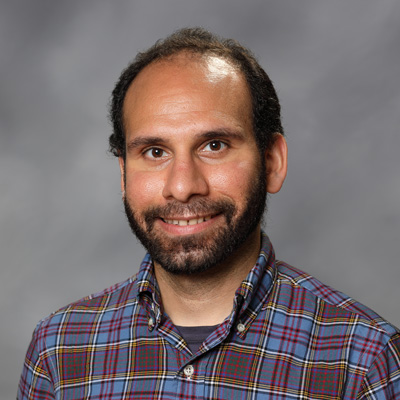
I was born and raised on the island of Cyprus in the Mediterranean Sea. My father is from Egypt and Lebanon, and my mother is from central Illinois, so I grew up with a mix of cultures, foods, languages, and ways of seeing the world. From a young age, I enjoyed mixing, tinkering, taking things apart, and solving problems, which drew me toward chemistry, physics, and mathematics at Calvin College. I later completed graduate work at the University of Texas at Austin and Columbia University, where I became fascinated by lasers, spectroscopy, and the semiconductor materials behind technologies such as screens, sensors, medical devices, and energy technologies. Before coming to Denison, I was a postdoctoral researcher at UCLA, where I studied infrared-emitting materials relevant to deep-tissue imaging and remote sensing.
What I love about chemistry is that it is connected to nearly everything we encounter. The paint on our walls, the clothes we wear, the devices we use, the medicines we take, the food we cook, the energy we depend on, and the bodies we live in all involve chemistry. Even a basic grasp of chemical ideas can change how we see the world, revealing an underlying universe of atoms, molecules, light, and energy. I enjoy helping students develop that way of seeing and giving them the tools to ask better questions about the world around them.
Away from Denison, my wife and I spend much of our time with our two children, often exploring museums, playgrounds, parks, gardens, and local communities. I also enjoy cooking, trying new foods, gardening, hiking, board and card games, computer games, and miniature painting.
Learning & Teaching
- Chemistry 131: Principles of Chemistry: Atoms and Molecules
- CHEM 132: Organic Structure and Reactivity
- Chemistry 343: Intermediate Physical Chemistry
- CHEM 411: Materials Chemistry: Principles and Devices Driving Innovation
Research
I am interested in how light interacts with next-generation semiconductor materials, especially low-cost materials based on organic molecules, colloidal nanocrystals, and hybrid organic–inorganic structures. These materials are promising for technologies such as LEDs, solar cells, sensors, transistors, and photocatalysis, but their behavior is often controlled by subtle structural features that are easy to overlook.
A central question in my research is: after a material absorbs light, where does that energy go? It may move through the material, emit light, transfer across an interface, become trapped, or be lost. My lab uses optical spectroscopy and microscopy to understand these processes and to learn how chemistry, structure, and interfaces control the flow of energy and charge.
In the Atallah lab, undergraduate researchers synthesize, grow, and characterize semiconducting materials. We use wet-chemical synthesis, solution crystal growth, and physical vapor transport to prepare materials ranging from colloidal semiconductor nanocrystals to organic and hybrid single crystals. Current projects include silver phenylchalcogenolate crystals, doped and undoped organic crystals, and colloidal nanocrystals.
As a spectroscopist, I use light to study materials after they are excited. My lab uses photoluminescence, absorption and reflectance spectroscopy, Raman spectroscopy, polarization-resolved measurements, microscopy, cryogenic measurements, and time-resolved photoluminescence with picosecond lasers. These measurements allow us to ask how far and how fast energy moves, whether it becomes trapped, whether it transfers to another material, and which structural features lead to useful emission or unwanted loss.
At Denison, I especially value that students can participate in the full research process: making materials, adapting measurements, analyzing complex data, and connecting their results to larger questions about how structure controls function in semiconductors.
Works
Recent Publications
First Publication with Denison students:
- Nguyen, L. T.; Zupnick, R.; Vo Truong, Quynh; Atallah, T. L.; Low-Dimensional AgTePh Disordered Aggregation Versus Directed Coalescence for Shortwave-IR to Visible Semiconductors Nanoscale 2025, 17, 19136-19142. https://doi.org/10.1039/D5NR02425K
- Shin, A. J.; Zhao, C.; Shen, Y.; Dickerson, C. E.; Li, B. Y.; Roshandel, H.; Bím, D.; Atallah, T. L.; Oyala, P. H.; Alson, L. K.; Kerr, T. A.; Alexandrova, A. N.; Diaconescu, P. L.; Campbell, W. C.; Caram, J. C. Toward Liquid Cell Quantum Sensing: Ytterbium Complexes with Ultra-Narrow Absorption Science 2024, 385, 651-656.
- Tenney, S.; Tan, L.; Tan, X.; Sonnleitner, M.; Coffey, B.; Williams, J.; Ronquillo, R.; Atallah, T. L.; Ahmed, T.; Caram, J. Efficient 2D to 0D Energy Transfer in HgTe Nanoplatelet-Quantum Dot Heterostructures through High-Speed Exciton Diffusion. J. Phys. Chem Lett., 2023, 14, 9456-9463.
- Bailey, A.; Deshmukh, A.; Bradbury, N. C.; Pengshung, M.; Atallah, T. L.; Williams, J. A.; Barotov, U.; Neuhauser, D..; Sletten, E.; Caram, Exploring the Design of Superradiant J-Aggregates from Amphiphilic Monomer Units Nanoscale, 2023, 15, 3841-3849.
- Sica, A. V.; Hua, A. S.; Lin, H. H.; Sletten, E. M.; Atallah, T. L.;* Caram, J.* Spectrally-Selective Time-Resolved Emission through Fourier-Filtering (STEF) J. Phys. Chem. Lett. 2023, 14, 552-558. *Co-Corresponding Author
- Guan, X.; Erşan, S.; Hu, X.; Atallah, T. L.; Xie, Y.; Lu, S.; Cao, B.; Sun, J.; Wu, K.; Huang, Y.; Duan, X.; Caram, J. R.; Yu, Y.; Park, J. O.; Liu, C. Maximizing Light-Driven CO2, and N2 Fixation Efficiency in Quantum Dot–Bacteria Hybrids Nat. Catal. 2022, 5, 1019-1029.
- Tenney, S. M; Tan, L. A.; Sonnleitner, M. L.; Sica, A. V.; Shin, A. J.; Ronquillo, R.; Ahmed T.; Atallah, T. L.; Caram J. R. Seeded Growth of Mesoscale Quantum-Confined Semiconductor Nanoplatelets Chem. Mater. 2022, 34, 6048-6056.
- Deshmukh, A. P; Geue, N.; Bradbury, N. C.; Atallah, T. L.; Chuang, C.; Pengshung, M.; Cao, J.; Sletten, E. M.; Daniel Neuhauser, D.; Caram J. R. Bridging the Gap between H- and J-Aggregates: Classification and Supramolecular Tunability for Excitonic Band Structures in 2-Dimensional Molecular Aggregates Chem. Phys. Rev. 2022, 3, 021401.
- Chen, P.;* Atallah, T. L.;* Lin, Z.; Wang, P.; Lee, S-J.; Xu, J.; Huang, Z.; Ping, Y.; Huang, Y.; Duan, X.; Caram, J. R.; Duan, X. Approaching the intrinsic exciton physics limit in two-dimensional semiconductor diodes, Nature, 2021, 599, 404-410. *Co-First Author
- Friedman, H. C.; Cosco, E. D.; Atallah, T. L.; Sletten, E. M.; Caram, J. R. Establishing design principles for emissive organic SWIR chromophores from energy gap laws, Chem, 2021, 7, 3359-3376.
- “Rapid One-Pot Synthesis of 2D AgTePh: Pathways Governing SWIR (Aggregates) vs Visible (Platelets) Emission”, Oral, American Chemical Society National Meeting and Exposition, Atlanta, GA, Spring 2026.
- “Doping of Organic and Nanocrystalline Semiconductors Enhances Optoelectronic Properties”, Poster, American Chemical Society National Meeting and Exposition, New Orleans, LA, Spring 2024.
- “Doping Next Gen. Semiconductors: Principles of “Performance Enhancement”, Department Seminar, Denison University, Granville, OH, Fall 2023.
- “Chemical Doping in Crystalline Organic and Nanocrystalline Semiconductors Unlock New Optoelectronic Properties”, Poster, American Chemical Society National Meeting and Exposition, Indianapolis, IN, Spring 2023.
- “Photocurrent Imaging and Photoluminescence Lifetimes Reveal Intrinsic Excitonic 2D PN Junction Behavior”, Oral, American Chemical Society National Meeting and Exposition, Indianapolis, IN, Spring 2023.
- “Exciton-Charge Auger Limit Photovoltaic Performance of 2D Semiconductor Devices”, Oral, Material Research Society Meeting and Exhibit, Boston, MA, Fall 2022.
- “Semiconductors and Devices on A Plane: Accessing Fundamental 2D Atomic Semiconductor Properties”, Invited Seminar, Kenyon College, Gambier, OH, Spring 2022.
Service
- American Chemical Society
- Materials Research Society
Other
- UCLA Chemistry & Biochemistry Postdoctoral Research Award (2021)
- ACS UCLA Research Showcase Fellowship (2019)
- Dr. Enno and Mrs. Lucile Wolthuis Physics Scholarships (2009)
Current:
- Alyssa McPhee
- Caden Hazelton
- Cam Phan
Recent Alumni:
- Lewis Nguyen ’26
- Kyle Eller ’26
- Quynh Vo Truong ’25
- Riley Zupnick ’25
- Bella Rosabal ’25