Lew Ludwig
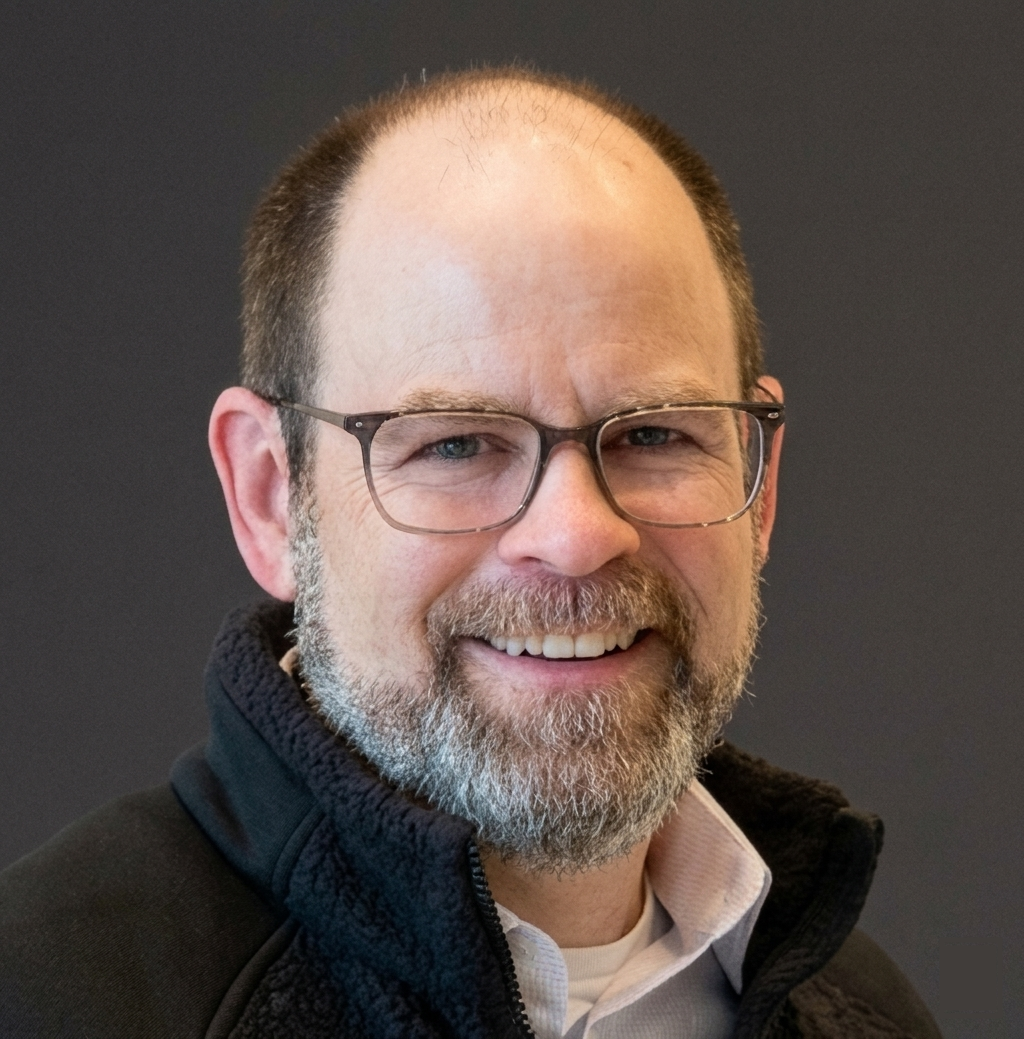
Lew Ludwig is the Benjamin Barney Chair of Mathematics at Denison and Co-Director of the GLCA Consortium for Teaching and Learning. He joined the Denison faculty in 2002 as a point-set topologist and later expanded his research into knot theory to involve undergraduates. He co-edited The Concise Encyclopedia of Knot Theory (Chapman & Hall/CRC, 2020) and has mentored eleven undergraduate researchers whose work has produced five peer-reviewed publications.
In 2020, he became director of Denison’s Center for Learning and Teaching, a role he held through May 2025. Since 2023, his work has focused on generative AI in teaching and learning. He is co-author, with Todd Zakrajsek, of The Science of Learning Meets AI: A Practical Faculty Guide (Routledge, 2026), and has delivered more than 70 invited keynotes, workshops, and webinars on AI in higher education. His TEDx talk, “AI: Today’s Dumbest Genius,” and his There and Back Again column for the Mathematical Association of America help faculty think about generative AI as something to engage rather than fear.
He received the Ohio Section MAA Distinguished Teaching Award in 2013 and the POD Innovation Award in 2021.
Learning & Teaching
- FYS 102/HNRS 132 - The Art of Mathematical Thinking
- Writing 101 - Finding Your Voice in the Age of AI
- INTD 184 - When the Liberal Arts Meets AI
- MATH 115 - Mathematical Methods for the Physical and Social Sciences
- MATH 130 - Essentials of Calculus
- MATH 135 - Single Variable Calculus
- MATH 145 - Multi-variable Calculus
- MATH 213 - Linear Algebra and Differential Equations
- MATH 300 - Introduction to Proofs
- MATH 395 - Technical Communication I
- MATH 415 - Operations Research
- MATH 440 - Advanced Analysis
- MATH 445 - Topology
- MATH 451 - Senior Research
- MATH 471 - Advanced Mathematical Topics - Knot Theory
- MATH 495 - Technical Communications II
- 2026 - present Benjamin Barney Chair of Mathematics
- 2023 - present Co-Director, GLCA Consortium for Teaching and Learning
- 2020 - 2025 Director of the Center for Learning and Teaching
- 2016 - 2018 Chair, Department of Mathematics and Computer Science
- 2015 - present Professor
- 2014 - 2019 Nancy Eshelman Brickman Endowed Professor
- 2008 - 2015 Associate Professor
- 2002 - 2008 Assistant Professor
Research
Since 2023, Ludwig has focused his research on generative AI in teaching and learning at colleges and universities. With Todd Zakrajsek, he co-authored The Science of Learning Meets AI: A Practical Faculty Guide (Routledge, 2026). With Aubrey H. Wang, he is co-editing the 2026 special issue of the Journal on Excellence in College Teaching, Reimagining Learning Outcomes Through AI-Enhanced Pedagogy. His article "Who's Afraid of Generative AI?" (with Gizem Karaali and Kira Hamman) appeared in Notices of the American Mathematical Society in March 2025; the article grew out of the MAA OPEN Math workshop of the same title that he conceived and co-led in 2024 and 2025. He writes the monthly column There and Back Again for the Mathematical Association of America.
Trained as a point-set topologist, Ludwig worked early in his career on alpha-normal and beta-normal spaces and on kappa-Frechet-Urysohn spaces. To include undergraduates in his work, he expanded into knot theory, where he and his students have published on intrinsic knotting and linking in straight-edge embeddings of complete graphs and on knot mosaics, an equivalent knot representation developed by Lomonaco and Kauffman. He is co-editor of The Concise Encyclopedia of Knot Theory (Chapman & Hall/CRC, 2020).
Works
Books and edited volumes:
- Ludwig, Lewis D., and Zakrajsek, Todd D. The Science of Learning Meets AI: A Practical Faculty Guide to Purposeful Integration, Student Engagement, and Ethical Practice. Routledge, 2026.
- Wang, Aubrey H., and Ludwig, Lewis D., guest editors. Reimagining Learning Outcomes Through AI-Enhanced Pedagogy. Special issue of Journal on Excellence in College Teaching, vol. 37, 2026.
- Adams, Colin, Flapan, Erica, Henrich, Allison, Kauffman, Louis H., and Ludwig, Lewis D., editors. The Concise Encyclopedia of Knot Theory. Chapman & Hall/CRC, 2020. Authored Chapters 1 and 5.
- Abell, Martha L., Braddy, Linda, Ensley, Doug, Ludwig, Lewis, and Soto, Hortensia (Project Leadership Team). MAA Instructional Practices Guide. MAA Notes #89, MAA Press, 2018.
- Flapan, Erica, et al. From Molecules to the Universe: An Introduction to Topology. American Mathematical Society, 2015. Coauthored Chapters 4 and 11.
Articles on generative AI in higher education:
- Wang, Aubrey H., and Ludwig, Lewis D. “Studying a Moving Target: Generating Evidence on AI’s Impact on Teaching and Learning.” Journal on Excellence in College Teaching, vol. 37, Special Issue, 2026.
- Ludwig, Lewis D. “There and Back Again: When Knowing Gets in the Way of Learning.” MAA FOCUS, February/March 2026.
- Ludwig, Lewis D., Karaali, Gizem, and Hamman, Kira. “Who’s Afraid of Generative AI?” Notices of the American Mathematical Society, March 2025.
- Ludwig, Lewis D. “The Higher Ground.” MAA FOCUS, December 2024/January 2025.
- Ludwig, Lewis D. “Taking the Plunge: Navigating the Rocky Path of AI in Education.” RealClear Education, October 2024.
- Ludwig, Lewis D., and Djupe, Paul A. “Chat GPT on Campus One Year Out: A View from the Faculty.” The Teaching Professor, February 2024.
Articles on teaching and faculty development:
- Ludwig, Lewis D. “The Cheat-Proof Calculus Test.” MAA FOCUS, April/May 2022.
- Anderson, Kenneth, Boyd, Diane, Jasperson, Amy, and Ludwig, Lewis D. “Harnessing the Promise of Flexible Course Design.” Change, September/October 2021, pp. 33-40.
- Ludwig, Lewis D. “Why I Learned the Rubik’s Cube: Seeing the Expert Blindspot.” MAA FOCUS, April/May 2020.
- Ludwig, Lewis D. “The One Question Calculus Final.” MAA FOCUS, August/September 2019.
- Ludwig, Lewis D. “Introduction to Proofs Over-Easy: A Low-Cost Alternative to the Flipped Classroom.” In Beyond Lecture: Techniques to Improve Proof-Student Writing Across the Curriculum, edited by Rachel Schwell, Aliza Steurer, and Jennifer F. Vasquez. MAA Notes #85, MAA Press, 2016.
Mathematics research articles:
- Ludwig, Lewis D., Paat, Joseph S. ‘11, Lee, Hwa Jeong, and Peiffer, Amanda ‘16. “Knot Mosaic Tabulation.” Involve, vol. 11, no. 1, 2018, pp. 13-26.
- Ludwig, Lewis D., Evans, Erica L. ‘11, and Paat, Joseph S. ‘11. “An Infinite Family of Knots Whose Mosaic Number is Realized in Non-Reduced Projections.” Journal of Knot Theory and Its Ramifications, vol. 22, no. 7, 2013.
- Arbisi, Pamela ‘07, and Ludwig, Lewis D. “Linking in Straight-Edge Embeddings of K7.” Journal of Knot Theory and Its Ramifications, vol. 19, no. 11, 2010, pp. 1431-1447.
Service
- Contracted by the American Mathematical Society to develop a hands- on activity in knot theory for the two-day USA Science and Engineering Festival in Washington, D.C. which drew over 150,000 attendees.
National service:
- Conceived and led the MAA OPEN Math national workshop, Who’s Afraid of Generative AI? Promises and Challenges of AI for the Mathematics Classroom, 2024 and 2025. NSF-funded, peer-reviewed faculty development workshops; two consecutive years at full enrollment. Co-led in 2024 with Gizem Karaali and Kira Hamman, and in 2025 with Feryal Alayont, Gizem Karaali, and Nick Shay.
- Chair, Small Colleges Special Interest Group of the POD Network (SC-POD), 400+ members, 2022-23.
- Member, MAA Committee on the Teaching of Undergraduate Mathematics, 2009-2015.
- National Counselor in Mathematics and Computer Science, Council on Undergraduate Research, 2007-2015.
Editorial and review:
- Guest editor (with Aubrey H. Wang), Journal on Excellence in College Teaching, special issue Reimagining Learning Outcomes Through AI-Enhanced Pedagogy, vol. 37, 2026.
- Guest editor, Topology Proceedings, vol. 30, no. 2, 2006.
- Reviewer for the National Science Foundation (CCLI Phase I and II; S-STEM) and the Council on Undergraduate Research Posters on the Hill.
- Reviewer, Zentralblatt MATH.
- External evaluator for tenure and promotion cases.
Regional service:
- Programming Committee Chair, Ohio Section of the MAA, 2013-2014.
- Chair, Ohio MAA Committee on Section Activities, 2007-2011.
Other
Over $500,000 in NSF funding including:
- Co-PI and project team coordinator for the MAA Instructional Practices Guide, a guide to evidence-based instructional practices in undergraduate mathematics. Over 20,000 unique downloads in its first year.
- Founder and host of the Undergraduate Knot Theory Conference (2009, 2012, 2016, 2019), a 3-day national event held at Denison University and the University of Washington-Bothell. The four iterations combined drew 95-110 participants per conference and 135 scholarly presentations.
- Creator of Technically Speaking, an NSF-funded resource that trains STEM students to give technical talks to non-technical audiences.
- POD Innovation Award, Professional and Organizational Development Network in Higher Education, 2021. For The Rubik’s Cube Challenge: An Expert Blindspot Learning Adventure. Featured in The Wall Street Journal.
- Distinguished Teaching Award, Ohio Section of the Mathematical Association of America, 2012-2013.
Recent student-AI collaboration:
Jack Williams ’26 used ChatGPT in extended back-and-forth dialogue (“cyborg” mode rather than copy-paste “centaur” mode) to earn a perfect score on the take-home final exam in business calculus, then in a 48-hour challenge used the same approach to teach himself improper integrals and demonstrate mastery in a verbal exam. The case is documented (under pseudonym, per IRB protocol) in two installments of Ludwig’s There and Back Again column for MAA Math Values: “Can AI Pass the Test, Part I: Of Centaurs and Cyborgs” (May 14, 2024) and “Can AI Pass the Test, Part II: Playing to Space” (May 16, 2024).
Selected undergraduate research projects:
Joseph Paat ’11 and Amanda Peiffer ’16, Knot Mosaic Tabulation.
Joseph Paat ’11 and Erica Evans ’11, An infinite family of knots whose mosaic number is realized in non-reduced projections, won best presentation at MathFest 2010 and JMM 2011 Poster Session.
Joseph Paat ’11 and Jacob Shapiro ’10, Tabulating knot mosaics, won best presentation at JMM 2010 Poster Session.
Sam Behrend ’09, Linking in straight-edge embeddings of K9, won best presentation at MathFest 2008 and JMM 2009 Poster Session.
Rachel Grotheer ’08, Linking in straight-edge embeddings of K8, won best presentation at MathFest 2007 and JMM 2008 Poster Session.
Pamela Arbisi ’07, Linking in Straight-edge embeddings of K7.
Colleen Hughes ’06, Linking in straight-edge embeddings of K6, won best presentation at MathFest 2004 and JMM 2005 Poster Session.