

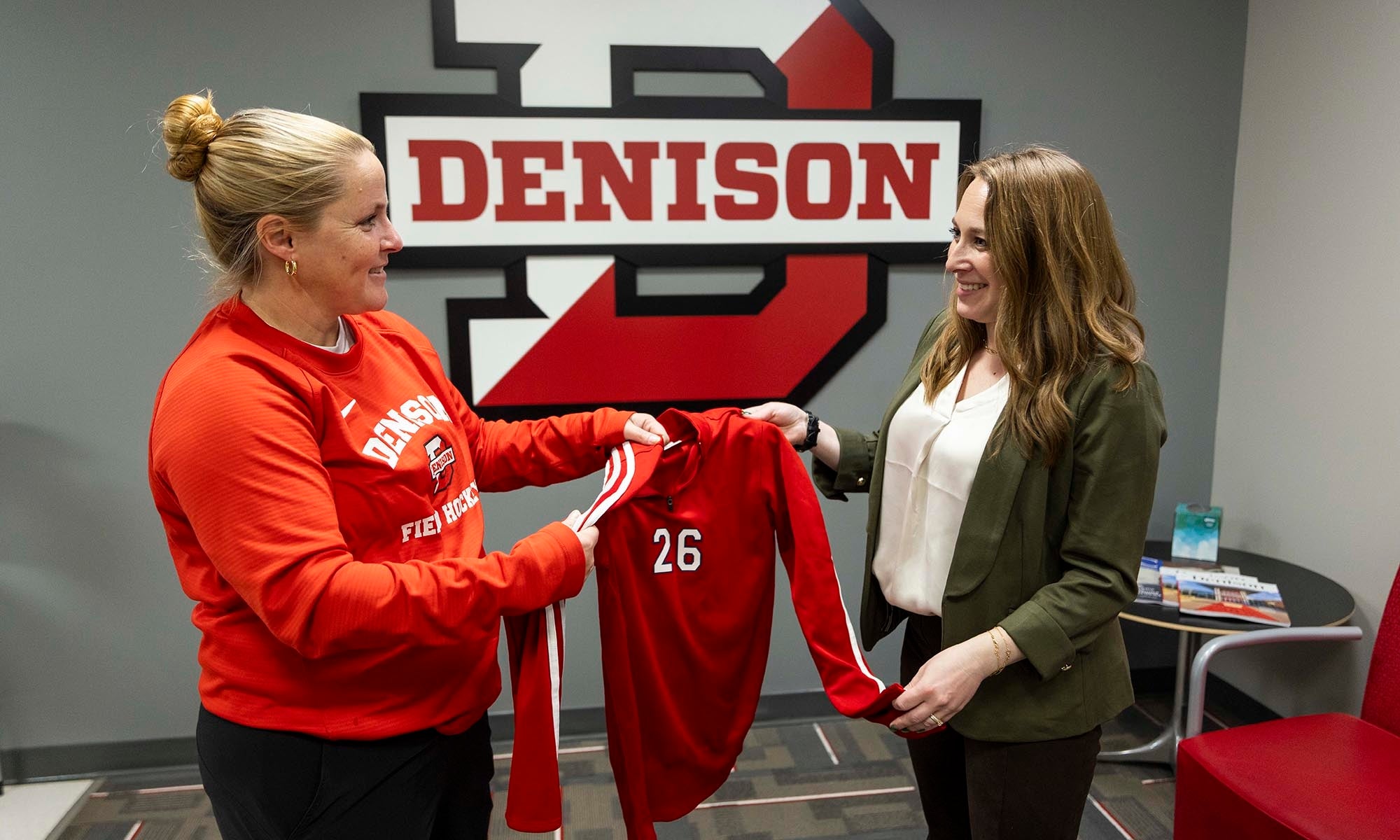
Denison field hockey coach P.J. Soteriades calls it “Boss Lady Energy,” a colorful term for a tenacious player driven to find solutions where others see only problems.
Soteriades spotted the admirable trait in her former left-side defender, Emily Marshall ’10, now a member of Denison’s faculty. Marshall wasn’t the fastest, strongest, or biggest player — she stands just over 5 feet tall — but she evolved into a two-time, all-conference defender by frustrating opposing attackers with her competitiveness and guile.
“Emily played chess when others played checkers,” Soteriades said. “She was fun and relatable, but also very solutions-driven. Emily gets things done.”
Marshall has brought the same energy and problem-solving ability back to her alma mater. Since arriving at Denison in the fall of 2024 as associate professor of Economics and director of Quantitative Initiatives, she has helped build curriculum across departments, fostering a spirit of collaboration.
She enjoyed her nine years at Dickinson College, a liberal arts school in Carlisle, Pennsylvania, but she jumped at the chance to come back to The Hill.
“This is my dream job,” Marshall said. “It’s one that’s statistically improbable: returning to your alma mater in a faculty position.”
Marshall watched from afar as Denison added powerhouse majors Global Commerce; Data Analytics; and Health, Exercise, & Sport Studies (HESS), while remaining true to its liberal arts mission. She has built on the university’s commitment to academic innovation under President Adam Weinberg and Provost Kim Coplin by helping author the proposal for the new Finance major and assisting the Data Analytics department in designing the new Sports Analytics domain.
The take-charge approach Soteriades admired in her former player is still evident in Marshall’s second act at Denison.
“I’m someone who operates at a pace where I feel like, ‘Yes, we need to be thoughtful and careful and do good work, but we also can’t be stuck in a cycle where we’re returning to the same things over and over again,’” Marshall said. “Because if we’re too slow to make change, we’re going to fall behind, and if we fall behind, our students fall behind.”
‘Oh my gosh, I think we’re moving.’
Denison has undergone significant changes since Marshall majored in Economics, captained the field hockey team, and served as president of Delta Gamma.
But as she walks across the Academic Quad talking with students and professors and meeting with families, the campus vibe is unmistakably familiar.
“This is just a happy place,” Marshall said. “People are happy to be here, and I think that comes from the experiences that they’re having academically, having socially, and having outside the classroom.”
She’s a big believer in the “Power of And” that Weinberg often references and that Denison embodies. Students can do many things here. The skills they develop in one facet of their university experience are transferable to others.
Growing up in Louisville, Kentucky, Marshall wanted to step outside her comfort zone and be challenged. Denison provided the ideal milieu, especially playing field hockey and changing positions midway through her Big Red career.
“It helped me develop my confidence and leadership abilities,” Marshall said. “I don’t think I would have been the student that I was without being the player that I was.”

Emily Marshall ’10 was a two-time all-NCAC defender.
She took her first Economics class from Professor Ted Burczak, who was a mentor and adviser before years later becoming a colleague.
Burczak recalls Marshall being a bright student and a diligent researcher. He cites the work she did examining the Federal Reserve’s role in the 2008 housing bubble crisis.
The professor wrote letters of recommendation for Marshall and remained in contact with her as she earned her master’s and doctorate degrees at the University of Kentucky. Burczak knew of her desire to work at a liberal arts college and shared his experiences teaching at Dickinson College.
She became an associate professor of economics at Dickinson as well as the director of the Quantitative Reasoning Center. She founded the college’s data analytics program in 2020, modeling it on Denison’s.
“The way Denison has evolved over the last 15 years is remarkable, and I don’t think it’s represented well by changes in college rankings or any of those other sorts of more quantitative metrics,” Marshall said. “The hardest thing for higher education institutions is making changes, in part because they have been around so long. You can become very insular in your thinking and not pay much attention to what’s happening outside your walls.
“Denison has completely popped the bubble in that way of thinking,” Marshall added. “It hasn’t changed its values or foundation or even its feel, but it’s changed in terms of getting students where they need to be.”
Burczak and Coplin were aware of Marshall’s dream of returning to Denison, which was not only her alma mater but is much closer to the family homes of her and her husband, a mechanical engineer from Cleveland.
Coplin said Marshall had been on Denison’s radar for several years. When a position opened in the economics department, one perfect for Marshall’s skillset, Burczak was thrilled to reach out.
“It’s good for Denison to have people who really want to be here,” Burczak said. “That’s not a trivial matter.”
Marshall had multiple conversations with Coplin and Weinberg about the opening.
“I remember after my first conversation with Adam on the phone,” Marshall said. “I got off the phone, and I told my husband, ‘Oh my gosh, I think we’re moving.’”
Building for the future
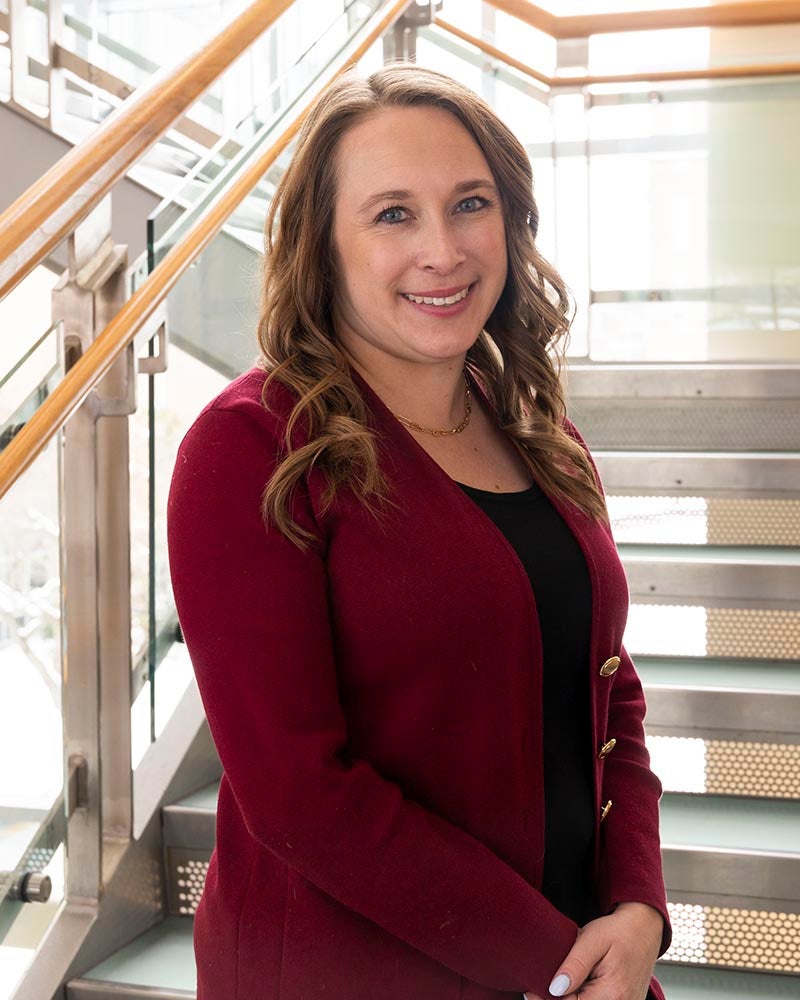
Emily Marshall ’10
Marshall will begin the 2026-27 academic year with a new title: inaugural director of the Emily Hauser King and Robert E. King Center for Data and Innovation.
Coplin said Marshall will bridge the connections between data analytics, economics, and mathematics. She adds Marshall has a passion for ensuring students across the curriculum have the data literacy and quantitative fluency to thrive after graduation.
“She loves curriculum building,” Coplin said of Marshall. “And if you read her curricular proposals, you’re like, ‘Oh my gosh, this is somebody who’s really well versed in how to think through putting together a curriculum program.’”
Marshall will continue teaching economics because, she said, it’s important to relate to students and faculty and understand their classroom experiences.
But Marshall is eager to start in her new role. She envisions creating internship opportunities and strengthening ties with the Knowlton Center for Career Exploration, which was most recently ranked the No. 2 best career services program in the country by the Princeton Review.
Two years after returning to Denison, Marshall still cannot believe her good fortune. Her family lives in Granville and is raising a 3-year-old daughter. She takes advantage of alumni events, sometimes inviting old classmates to stay in her home.
As for those who remain on campus from Marshall’s days as a student, they continue to benefit from her “Boss Lady Energy.”
“The fact that she is now shaping the next generation of students at Denison is a gift,” Soteriades said. “The competitor in me is also thrilled that we have her back here, rather than another university, benefiting from the value and impact I know she brings, and will continue to bring.”