


Associate Professor Jessica Bean knew business-minded Denison students would be delighted with the creation of a dedicated finance major. There had been growing interest in more coursework in the rapidly expanding field.
What Bean, the chair of the economics department, had not anticipated was the feedback from alumni working in the financial sector. Since the general faculty approved the new major in September 2025, Bean and others in the Economics Department have received congratulatory emails, phone calls, and offers of assistance.
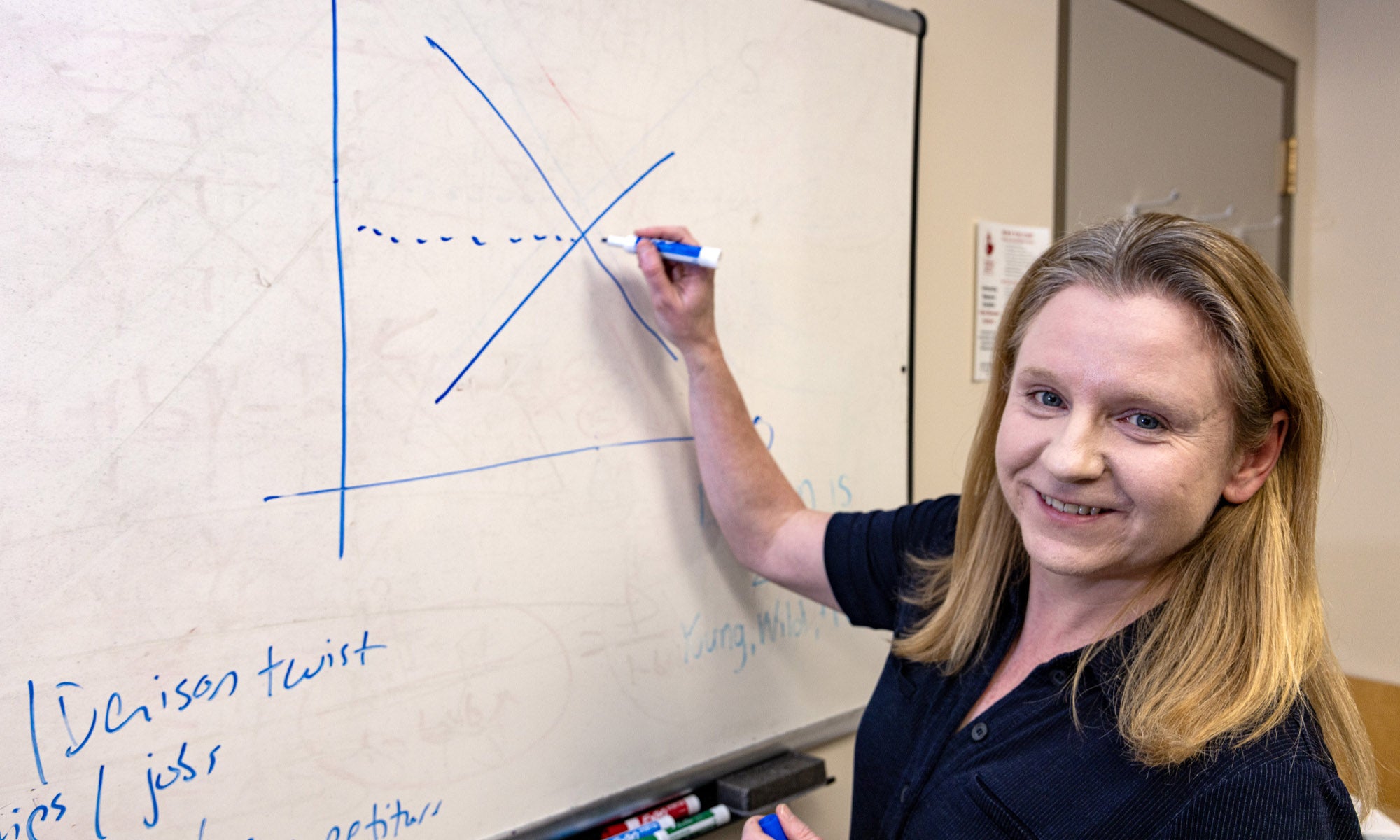
Associate Professor Jessica Bean has been Economics Department chair since 2021.
“The alums are coming out of the woodwork with excitement for what we’re doing here,” Bean said. “I’m getting random emails from people asking, ‘What can I do?’ or, ‘Can I come visit your class?’ The engagement has been terrific. I have never had as many meetings with alumni.”
The glowing response from students and alumni alike is a testament to the hard work of the entire Economics Department to make the new major a reality. Professors listened to feedback, recognized trends, marshalled their resources, and built a dynamic finance major from existing and newly created classes.
It’s another example of Denison staying at the forefront of higher education while remaining true to its liberal arts mission and values.
“This will give us the opportunity to be a leader in the finance space at liberal arts institutions,” said Associate Professor Emily Marshall ’10, director of quantitative initiatives. “The finance major will have the technical aspects students need to succeed in a highly quantitative field, but taught in our own innovative way.”
Denison previously offered a financial concentration within economics, but elevated it to major status after more than a year of research, curriculum building, and the addition of a third professor to teach financial courses. The university saw significant opportunities to spark student interest and boost career placements and internships in the diverse field.
Finance involves money management in areas such as investing, saving, borrowing, and budgeting to achieve financial goals. Its popularity as a major is driven by an increased demand for financial expertise, high earning potential, and the industry’s rapid evolution with new technology.
In 2024, the Bureau of Labor Statistics estimated the financial sector will experience a faster rate of job growth than the average of all occupations over the next 10 years. Finance is also considered the most appealing and stable sector to work in among 18 to 25 year olds, according to a 2023 report from the CFA Institute, a nonprofit focused on financial education.
“Finance has become a bigger part of the macroeconomy; it’s become a bigger part of economic institutions,” Marshall said. “Students realize this, and more of them are interested in it. We’re responding to what the students want, what they want to do, and evolving opportunities in the workplace.”
Denison is just the third university in the top-50 liberal arts colleges, as ranked by U.S. News & World Report, to offer finance as a major. The publication recently ranked Denison No. 34 among liberal arts institutions, rising 21 places since 2016, and No. 1 in Ohio. Denison is also listed as the No. 4 most innovative national liberal arts college for the second year in a row.
Of the university’s 80 graduates with an economics degree last year, 25 were enrolled in the finance concentration. However, the two requisite courses were typically only available to juniors and seniors.
“I kept hearing two things from students,” said Hyun Woong Park, an associate professor of economics who teaches finance courses. “They wish they could have taken these classes earlier, and they often asked, ‘Are there more finance classes I can take?’”
The new major doubles the number of finance course requirements. They include: Principles of Finance; Money, Finance, and the Macroeconomy; Corporate Finance; and a senior capstone.
Students will now typically start the finance course sequence in their sophomore year.
“Waiting to take your first real finance class in your junior year was too late in terms of the internship process, which often starts during your sophomore year,” Bean said. “And then taking the more advanced finance class in your senior year — and often in spring of your senior year — is not actually really helping in a job search.”
‘Breadth of knowledge’

Hyun Woong Park, an associate professor of economics, says the skills students learn in finance courses “can be very flexible and used elsewhere — not just in finance.”
The financial economics concentration was added in 2016, a seismic year for the university in terms of curriculum. Denison unveiled three new majors: data analytics, global commerce, and health, exercise, and sport studies (HESS). The university was among the first liberal arts colleges to offer a data analytics major.
All three majors are deeply interdisciplinary, a hallmark of a Denison education. All three rank among the university’s top-10 for graduates in recent years.
“The future will belong to people who can think across disciplines and who can adapt to change,” President Adam Weinberg said in 2016 as he introduced the new majors and concentrations. “I worry tremendously about national trends to train students narrowly within a field or discipline. The future will be shaped by people who can think broadly and boldly.”
Since 2016, Denison has also added journalism, applied math, and legal studies to its roster of academic programs. Many of them, in one form or another, are offered at colleges across the nation, but Denison’s interdisciplinary approach, small class sizes, and outstanding faculty set it apart.
“Adam has done an amazing job of taking a really strong liberal arts college and making it stronger,” Bean said. “He identified existing strengths and, in talking with faculty, asked how we could build on those strengths and integrate them into new curriculum.”
Like many Denison majors, finance has a distinctly interdisciplinary emphasis. It’s a stand-alone major housed in the economics department, and requires its students to take economics courses. In fact, students in economics, finance, global commerce, data analytics, and philosophy, politics and economics (PPE) all must take introductory classes in macro and microeconomics.
“With finance, it’s interesting to think about how a highly technical major could be done better than a lot of other places in a liberal arts environment,” Marshall said, “because our students are getting this breadth of knowledge from so many academic areas.”
Bean said finance majors will not focus exclusively on “theories and numbers,” but incorporate the same broadbased learning from across the Denison curriculum.
“Finance students will be taught historical backgrounds, social context, critical thinking, and the ethical consideration for applying what they learn,” Bean said.
Alumni perspective
Julie Zhao ’24 is one of five Denison graduates working in the Salt Lake City office of Goldman Sachs. The Big Red alums meet for lunch and occasionally talk about their time on The Hill.
Zhao, who earned degrees in economics and psychology, cherished her Denison experience and says she would have considered finance as a major had it been offered.
“What finance really did was pull me out of theories and give me a scope for the current world,” said Zhao, who took the two finance classes offered at the time. “I was able to connect the history of how economics developed and how finance played such an important part. That’s when the world became more of a complete picture.”
Zhao is happy current Denison students will have the option to major in finance. First-years and sophomores who are majoring in economics may also switch to finance, Bean said. The university plans to incorporate Chartered Financial Analyst (CFA) topics into lessons, Park said, and students will be encouraged to participate in the CFA Research Challenge and the CFA Stock Pitch Challenge. The university has nine Bloomberg terminals, which give students access to financial data and real-time analysis.
“Finance is what makes the economy grow and work and operate,” Park said. “It’s a significant,indispensable part of the economy. The skills that you learn in these finance courses can be very flexible and used elsewhere — not just in finance.”
Zhao, a private wealth management analyst, believes finance is a perfect fit for Denison.
“I can’t say enough good things about how liberal arts impacted me in a positive way,” Zhao said. “I continue to grow, my world continues to expand, and the education never ends. Finance as a major at Denison will give students who are curious and explorative an opportunity to ready themselves for a good career.”