Degree Requirements
Politics and Public Affairs Major
Majors must complete:
A total of eight courses in Politics and Public Affairs, consisting of:
| Code | Title |
|---|---|
| Three introductory Courses | |
| PPA 102 | Introduction to Policymaking in Democracies |
| PPA 122 | Introduction to Global Governance |
| PPA 132 | Introduction to Theorizing About Political Life: Normative Issues Common to Democratic Systems |
| And | |
| PPA 201 | Sophomore Seminar |
| And | |
| Three upper level departmental electives | |
| And | |
| PPA 491 | Senior Seminar |
In addition, all majors must fulfill the following requirements:
- Complete a Major Proposal
- Complete a Curriculum Plan
- Complete one statistics course, recommended to be fulfilled by the end of sophomore year, from an approved list of classes available from the PPA office.
- Declare a Concentration of Study by the end of Sophomore Seminar (PPA 201). Politics and Public Affairs defines three possible Concentrations of Study:
- International Affairs
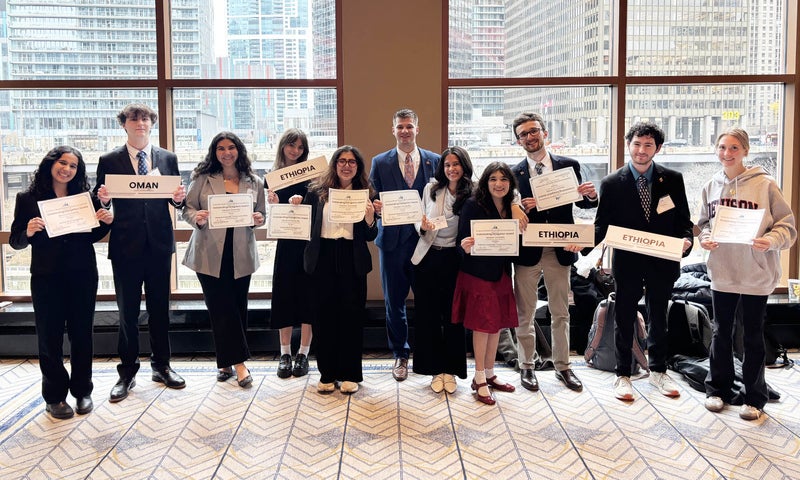
The International Affairs concentration puts you at the center of global decision-making. You’ll dive into big questions shaping our world, such as how countries negotiate conflicts, how the UN and other global organizations respond to challenges, and how corporations, global non-profits, or even celebrities influence international politics. Through hands-on simulations (including our award winning Model UN team) and engaging coursework, you won’t just study global challenges like war, human rights, migration, trade, poverty, or national security—you will practice solving them. You’ll learn to analyze evidence, craft diplomatic strategies, and understand how cooperation (and competition) unfold on the world stage.
This concentration is a good option for students seeking careers with international and regional organizations, including as members of the diplomatic, national security, or international development, health, or aid communities.
Students in this concentration grapple with questions such as: Why do states go to war? What prompts states to work together? How do international organizations mediate conflict and facilitate cooperation? How can we prevent or stop human rights violations or international crime? How and why do global orders change over time?
-
Policy Analysis
The Policy Analysis concentration provides an insider’s view of how policies are developed, evaluated, and put into practice in the United States and around the world. You’ll study why certain policies move forward; how institutions, political actors, and political cultures shape decisions; and what conditions support effective implementation. Coursework spans key policy domains such as immigration and asylum, national security, and environmental policy. Through case studies and applied research, you’ll build strong analytical and problem-solving skills, learning how to assess policy options, interpret data, and understand the trade-offs that decision-makers face. By the time you graduate, you’ll know how to design and recommend smart, evidence-based solutions that can make a meaningful impact in government and public life.
This concentration is a good fit for students seeking careers in non-profits, foundations, think tanks, public administration, and working with elected officials.
Students explore and discuss questions such as: Who defines what counts as a policy problem? What are potential policy solutions? Which of the available policy solutions are feasible? What are the costs and benefits of a given policy? How can you measure policy outcomes to determine if the policy is effective?
Government and Legal Affairs
The Government and Legal Affairs concentration provides a grounded understanding of how governments work, with a focus on the United States. You’ll explore the role of legislatures, executive leaders, courts, and the citizenry, while learning how laws are created, interpreted, and applied. You will understand the core principles underpinning democratic government and legal authority in order to better assess what distinguishes democracies from dictatorships. You will discuss the normative values that ground political institutions, then learn how these normative beliefs and constitutional frameworks guide political decisions and public debates. Throughout your coursework, you’ll examine how institutional design and political culture shape what governments can do and what the people expect from political leaders.
This concentration is a good fit for students interested in running for office, working with elected officials and on political campaigns, in law enforcement, joining the intelligence community, attending law school, or seeking to be ethical and effective leaders in a democratic society.
Students interested in government and legal affairs debate questions such as: Why/do we need government? What values should be prioritized when forming a government? What makes a democracy “democratic”? What is the rule of law? How do democracies differ from each other? How do branches of government interact and limit each other? What tools do the people have to hold leaders accountable? What explains the distribution of public goods and services?
Students may also propose their own Concentration during Sophomore Seminar, subject to departmental approval.
5. Complete three cognate courses from outside the PPA department geared toward the emphasis of Concentration as indicated on the Curriculum Plan:
-
International Affairs
- One additional language course beyond Denison's foreign language requirement.
- Two additional cognate courses on their “theme” of emphasis (one of these may be a foreign language course).
-
Policy Analysis
- 3 additional courses focusing on the analysis of empirical data
-
Government and Legal Affairs
- 3 cognate courses reflecting the area of emphasis established in Major Proposal
6. Participate in an off-campus experience, PPA 050 - PPA Off-Campus Experience, confirmed by the end of Sophomore Seminar, examples include:
- Semester (or summer) enrollment in a Denison-approved Off-Campus Study program.
- An off-campus internship that advances/enhances the coursework for your selected Concentration.
- Participation in Moot Court, Model UN, or similar co-curricular activities which augments the focus of your Concentration of study.
Grand Strategy Program
At Denison, the Grand Strategy Program connects big picture thinking with hands-on experiences. You’ll study world events past and present, travel with faculty on off-campus programs, explore study-abroad options, and take part in internships customized to your interests. Along the way, you’ll work with classmates who bring diverse perspectives to the table, helping you build the kind of teamwork and analytical skills that employers value across all fields.
This program is only available for students completing the PPA major, but it adds an exciting layer of interdisciplinary and experiential learning. Whether you’re imagining a career in government, law, nonprofits, business, journalism, or something entirely different, the Grand Strategy Program strengthens your ability to think broadly, analyze deeply, and tackle complex problems with confidence. It’s designed to prepare you not just for your first job—but for leadership in a complex and rapidly changing world.
The Grand Strategy Program within the PPA major requires the following in addition to the requirements of the PPA major described above:
• PPA 351 - Principles of Grand Strategy
• PPA 352 - Applied Grand Strategy
• An off-campus Immersive Grand Strategy Experience
• An off-campus experience approved by the department, related to the student’s concentration and relevant to the Grand Strategy program
Additional Items of Note:
Cognate courses may also fulfill GE requirements.
No more than two cognate courses can come from a single department or program. Two need to be courses above the introductory level (199).
Because off-campus study is an integral part of the PPA major, courses taken off-campus cannot be brought in to replace any of the eight required PPA courses; however, one course from an off-campus program may fulfill a cognate course requirement.
Politics and Public Affairs Minor
Minors in PPA would complete six courses: the three introductory courses and three upper-division electives in PPA. Minors would not declare a concentration of emphasis nor would an off-campus experience be required.