



Sometimes Nelson Griggs ’93 still has those ‘a-ha’ moments, times when he recognizes that the education he received at Denison shapes his career trajectory even now.
“Now that I’m 55, I see that Denison as a whole was a defining moment for me,” says the president of Nasdaq, one of the world’s leading stock exchanges. “It’s more looking back at all these points in my life and saying, ‘Wow, that was a Denison skill, and that was a Denison skill’ … you have so many more of these skills that you collected over four years in college than you realized at the time.”
Griggs joined Nasdaq in 2001, in large part because he had maintained a professional connection, just as generations of students have learned to foster on The Hill.
When not leading Nasdaq through an era marked by rapid-fire technological advances, Griggs looks forward to fishing and skiing with his family. Raising three sons has also meant significant time spent at lacrosse fields, he says. And he’s intentional about giving back — and getting back — to Denison when he can, mentoring students and hosting visits at Nasdaq.
“It’s a thrill to meet students and spend time on campus, seeing where the university has gone and is going,” he says.
Let’s start with your Denison experience. How did you come to Denison? Did you enter college knowing you wanted to work in the financial sector, or did that passion develop later on?
I knew I wanted a liberal arts college; that was mostly what I had applied to. When I visited Denison, it just felt right. I was a poli-sci major and really did not have any indication that I would end up with a business career. I just knew I wanted something that would involve teamwork, communication, and critical thinking. That’s what drove me in my interviews, and that’s what I found in business.
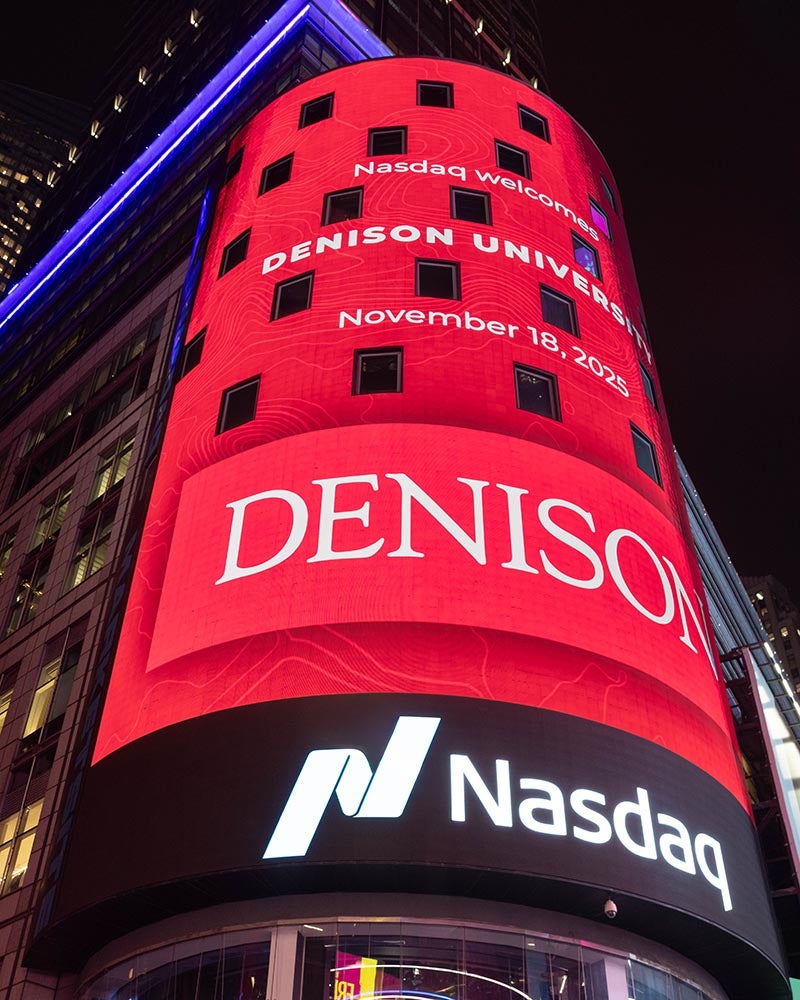
The Big Red helped illuminate the Big Apple during a Denison University event at Nasdaq in New York in fall 2025.
You’ve been at Nasdaq for 25 years. How did you initially land there, and what about the work motivated you to stay as long as you have?
I started my career at Fidelity Investments and spent a little over five years there. After two years with a tech startup, which dates me, my former boss at Fidelity was at Nasdaq, and he brought me in. He and I had stayed in touch. As you go through your career, relationships matter a lot. How you leave an employer matters a lot. It’s a small world. Your career will take many different pivots and turns, and keeping those relationships matters.
I’ve stayed at Nasdaq because I like the people I work with, it is an innovative culture, and I’ve had the opportunity to grow. We always say it’s never boring. In my career, I always wanted to feel like I was having an impact, and that’s what I found at Nasdaq. It’s been fun.
Denison has seen growing interest from students in business-related majors, and the college recently introduced a finance major to its academic offerings. What does a liberal arts education offer a student who is interested in careers in business or finance?
Many financial firms value liberal arts graduates. They have developed these differentiated liberal arts skills: adaptability, strong communication, critical thinking. These are very highly valued. Having a true financial major will pair those highly valued skills with the technical skills that you do need to have. It makes Denison graduates very viable candidates for the financial sector.
Technological innovation, particularly in the AI arena, is poised to bring about a societal and economic sea change. What conversations are occurring these days at Nasdaq?
Although we serve the financial community, we are a technology company and a data company. Technology is always moving very quickly, but AI is accelerating at a pace we’ve never seen before.
We are focused on how technologies can help us innovate and do more for our clients, but also on how we might be disrupted.
Across the economy, there will be disruption to current jobs, to processes that we’ve become comfortable with. But new things will evolve from that. That will create new opportunities, and staying abreast of them will be absolutely critical.
Given the changing landscape, what advice would you give to students and recent graduates looking to enter the financial sector?
We have to be honest that historically entry-level jobs, particularly in finance, are changing. They’re not disappearing, but they are transforming at a very rapid pace, particularly with regard to AI. A year ago, you needed to know AI language. Now, you need to know how it operates in practice, and if you don’t, you need to find a path to get there because we’re looking for graduates who have actual AI use cases, things they’ve done, how they can add value in this new world.
The expectation is they will be needing that skill set coming in. They need to be more than just conversant in AI. Can they show that they have actually used the tools? Ideally, they’ve done it within projects and have a grasp of the impact it can have on financial services. You want to really look at, and be ready to demonstrate, how you stand out with these skills.
Any final thoughts?
Students should be excited about the Denison background they’re getting in this technology-driven world, particularly with AI. The skill sets coming out of Denison are going to be more important than ever. Just make sure you’re also very deliberate in keeping pace with the changes that are coming your way.