

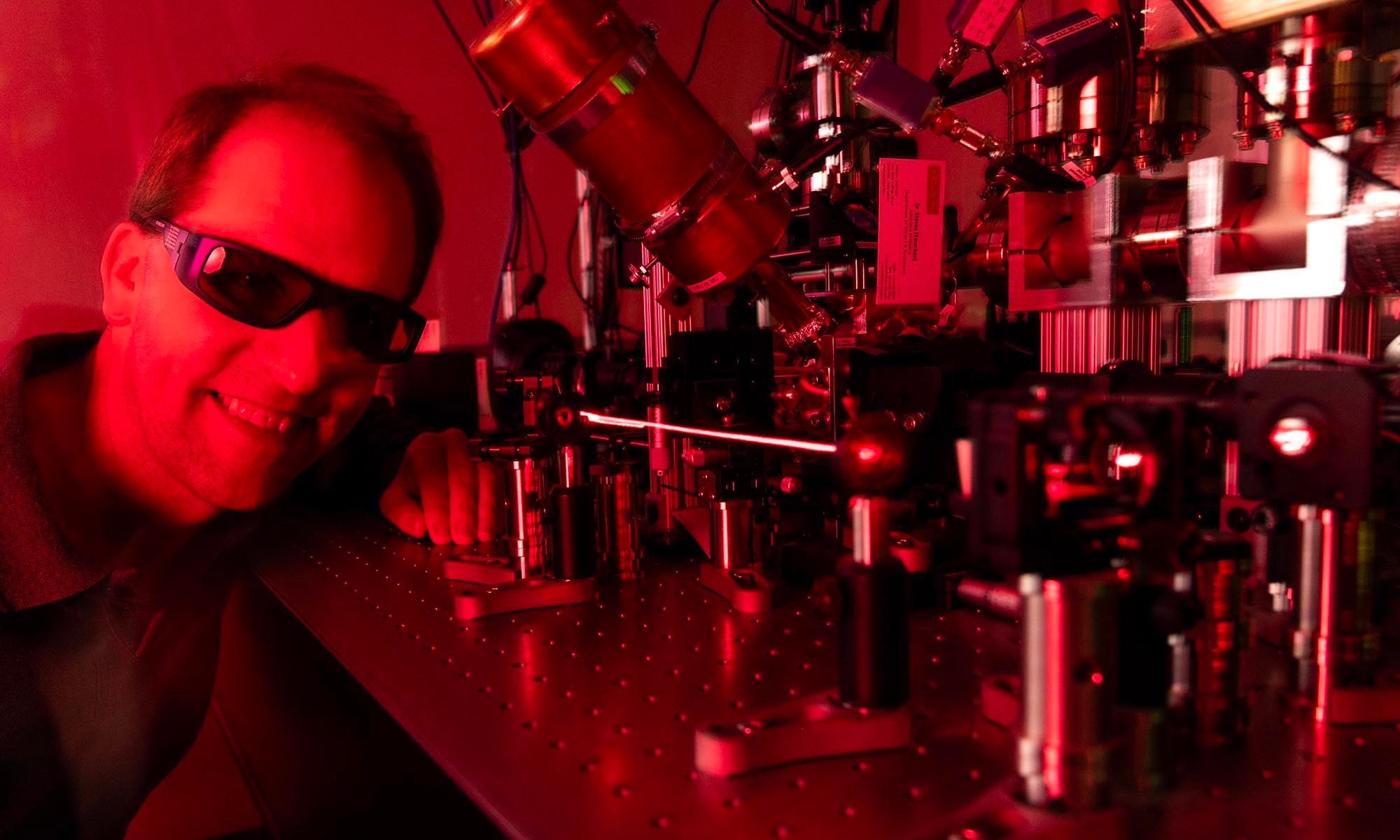
Associate Professor Steven Olmschenk has the knowledge and technical know-how to control atoms, electrons, and light. As one of only a few atomic physicists with experience in quantum technology in Ohio, he’s been tapped to work on a new state-funded research project to repurpose fiber-optic cables in ways that can help build quantum computing networks.
The Ohio Federal Research Network (OFRN) grant connects academic, research, and business leaders to find practical applications for new technology. Olmschenk is partnering with NASA’s Glenn Research Center, the Air Force Research Lab, optics engineering company SRICO, and fellow atomic physicist and Ohio State University assistant professor Kevin Singh. Together, they are developing and testing methods to capture quantum data and send it through fiber-optic cables.
While electric cables transmit digital data as 1s and 0s by converting it to electrical signals, fiber-optic cables transmit data as pulses of light. Particles of light, known as photons, can exhibit quantum superposition. Instead of being 1 or 0, the data, like a coin spinning on a finger, can be both 1 and 0 at the same time.
But when the coin lands, it can no longer be both heads and tails; it must be one or the other. This is equally true of photons. When the data is observed, the “both/and” property is destroyed, and the record of the original data — the coin’s face before it was spun — disappears. Olmschenk is testing a way to hold the data in memory by coupling a photon with a charged atom.
In his model, atoms serve as a memory, storing data, and photons released by the atom can connect these memories over long distances. When the atom releases the photon, the memory of the original data point can be retained.
But to make this work, the atom must first be snared.
To accomplish this, Olmschenk and two student researchers are designing what may be one of the world’s smallest cages. Building Olmschenk’s ingenious atom trap requires patience and skill.
It starts with optic fibers that Columbus industry partner, SRICO, has laser-machined to create small indentations at the tips. The indentations act as infinitesimal mirrors, which Olmschenk’s team installs on tiny mounts. They will collaborate with a technical assistant in Denison’s physics lab to build the mounts in a vacuum chamber. They need to be adjustable and capable of making fine measurements.
Eventually, they will point the mounted mirrors at each other to form an optical cavity.
“We want the cavity to be reflective enough that it efficiently collects light from the atom, and transparent enough so the collected light quickly leaves the cavity,” Olmschenk said. “If the light is reabsorbed by the atom, that alters the data.”
After Olmschenk’s team traps atoms in oscillating electric fields of nearby electrodes (the electrodes also shield the atoms from external disturbances), they will bring the tips of two optical fibers — the centers of which are about one-tenth the width of a human hair — close to the atoms. The goal is to collect as much of the light from the atom as possible.
Within 18 months, they aim to develop a process and apparatus that can be reproduced for commercial use to help build a quantum network, and enhance quantum computing.
In the last decade, private companies such as Google, IonQ, and Quantinuum have started building quantum systems.
Fiber-optic cables are a strong contender to help assemble them. These systems blanket about half the country. A single cable can hold as many as 7,000 fibers — and manufacturers are pushing that number higher to accommodate the growing demand for bandwidth.
Quantum systems have unique applications that make them worth the investment.
“A quantum computer can do certain things better than a classic computer,” said Olmschenk. “They excel at solving problems where efficient algorithms don’t exist.”
Encryption is one example. Because atoms and photons can be both 0 and 1 at the same time, a quantum computer can test numerous answers simultaneously and break a code more quickly.
They are also excellent at simulating working models of quantum systems. Quantum materials, such as those used in superconducting systems, are extraordinarily difficult to model with traditional computers.
“Recently, a classic computer simulated 50 atoms, which was a huge achievement,” Olmschenk said. “But every time you add one more atom, it becomes twice as difficult for those computers. Quantum computers can model atoms and other very complex systems with incredible efficiency.”
The majority of the $1.1 million OFRN grant will go to SRICO for its fabrication efforts. Denison will receive about 10%. For student researchers, the experience may be priceless.
They’ll participate in project meetings and learn some cutting-edge quantum technology. The team will also make site visits to the NASA Glenn Research Center, the Air Force Research Lab, and SRICO to see how photonics are used in federal labs and manufactured in an industry setting.
“I believe our students get a great experience working closely with faculty on research,” Olmschenk said. “In this project, they will be able to see the academic research side of things, as well as the commercial applications of our work.
“It is an extraordinary opportunity to explore a problem without a known solution in a very in-depth way.”