

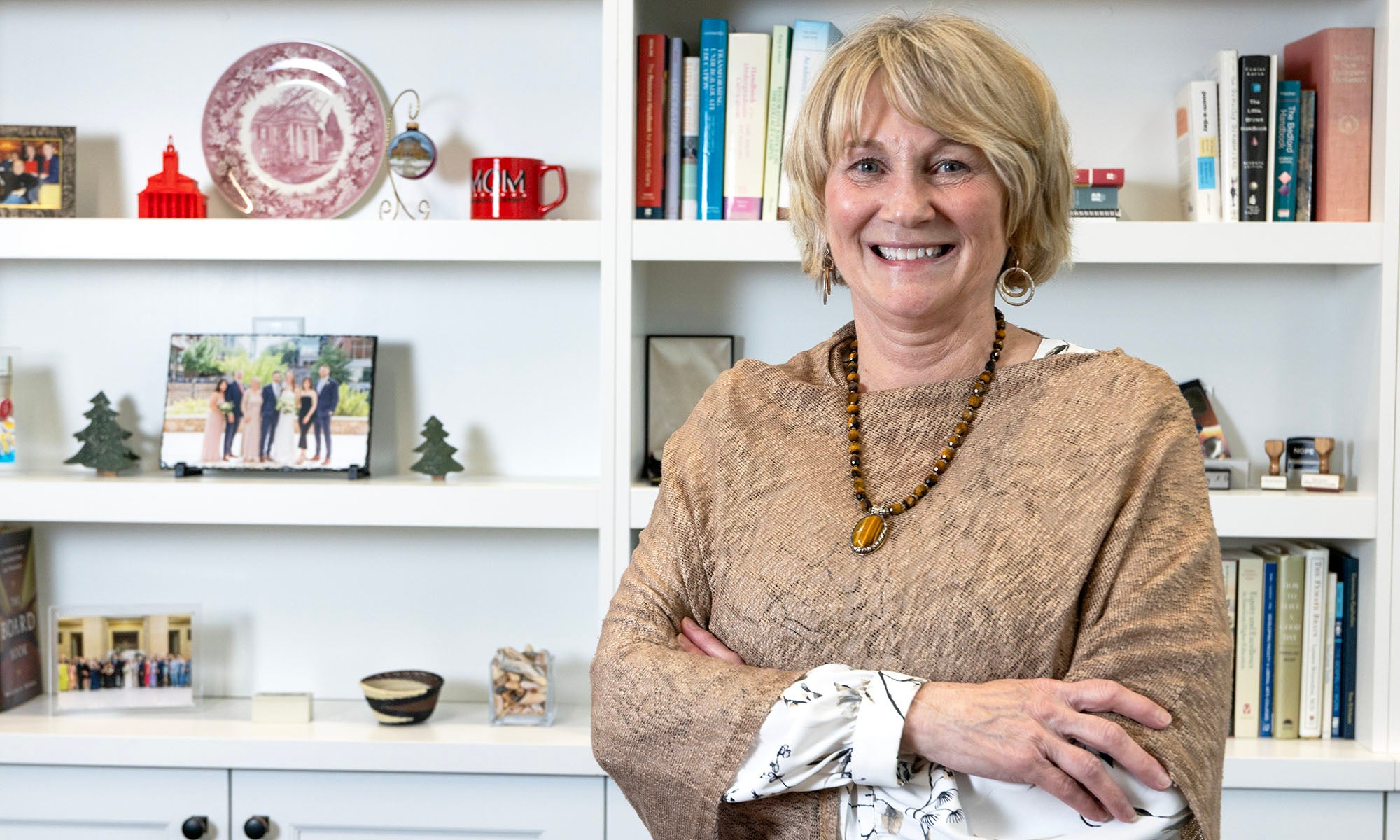
Denison Provost Kim Coplin ’85 thought her time on The Hill was over after her sophomore year.
While thriving academically, Coplin’s two-year scholarship from a hometown foundation was expiring. That’s when Denison stepped forward, as it does for so many students, and provided the assistance necessary to make her education affordable.
Given her three decades of exemplary service, the university’s investment in Coplin turned out to be a great investment in its own future. Her long list of Denison achievements includes:
- Becoming valedictorian and a member of the first class of President’s Medalist winners in 1985.
- Returning to Denison in 1993 as a physics professor who inspired others to teach and do research.
- Transitioning to administration in 2006 and helping transform the university academically over the past 13 years as its longest-serving provost.
“Denison has been here since the 1830s, and it will be here in 100 years,” says David Goodwin, professor of Earth and Environmental Sciences. “All of us will just be names in the archives, but our job is to make sure that we receive the college and then hand it off to somebody, after our careers are over, in a good place. I can’t think of someone who has exemplified that ethos better than Kim.”
Since announcing her retirement, which takes effect July 1, 2026, tributes have poured in from colleagues and alums who admire Coplin’s sincerity, intelligence, strategic thinking, and ability to make tough decisions with empathy.
Goodwin cites her integrity. Dean of Faculty Jeff Thompson raves about her relationship-building.
“What makes her so successful is the ability to connect with people and help identify the commonalities and what we’re striving for,” Thompson says. “There are times when Kim has to make hard decisions on behalf of the college, and sometimes that might be at odds with what an individual faculty member or department wants. But, she’s able to build those connections, foster the trust between the people that are involved, and really help people understand the nature of what we’re all trying to do collectively.”
Under her leadership and with faculty approval, the university launched innovative academic majors that have propelled Denison in national collegiate rankings. She led key initiatives to expand global learning, deepen faculty mentoring, and enhance student success. During Coplin’s time as provost, the university has hired more than two-thirds of its current faculty.
“What stands out most about Kim is her steadfast commitment to the people of Denison,” President Adam Weinberg says. “She has been a trusted mentor and advocate for countless faculty and staff, a tireless teacher and researcher, and a deeply respected colleague across the college, locally, and in higher education.”
Altering history’s course
From her office in Reese House, Coplin laughs at memories of her original college plans.
Before Denison offered financial assistance in the summer of 1983, she intended to transfer to a university closer to her family home in Carrollton, Ohio.
“My appreciation for Denison was growing and, at the last minute, I changed my mind,” says Coplin, whose maiden name is Mallarnee. “I waited so late they didn’t even have dorm space for me at first.”
It wasn’t just the financial aid and a love for her physics courses that swayed her decision. Kim met Rick Coplin ’85 during their sophomore year and they began dating as juniors.
Rick Coplin, now associate director of Red Frame Lab, enjoyed a fine academic career at Denison but was admittedly not nearly as studious as Kim.
“I was never going to be a college valedictorian, so I married one,” Rick Coplin says. “Kim is such a strong, independent person, and she’s really intelligent. I admire those traits in her.”
Adding to a storied Denison tradition, the college sweethearts married in 1986 and raised children who would attend their alma mater.
Forty years later, Coplin, a first-generation college graduate, still appreciates the university’s commitment to Ohio students and the financial aid available. She mentions how Denison offers full-tuition scholarships for any high school valedictorian or salutatorian from Ohio.
“This is just one example of Denison’s commitment to Ohio students,” Coplin says.
She earned a master’s degree in physics at Johns Hopkins University, but before pursuing her doctorate from Ohio State University, Coplin took a gap year to work in the science research labs at Battelle in Columbus, Ohio.
She considers that time pivotal in her career trajectory.
“After a few months, I was like, ‘Yeah, this is really good, but I want to return to the academic environment, I want to teach,’” she says. “It’s a story that I’ve shared with my students. Because if you’re going to graduate school to get a Ph.D., you really have to be dedicated to that study.”
Family matters
Melanie Lott ’04 recalls sitting in Coplin’s office in Olin Science Hall as a student discussing her senior research project.
Lott admired her teaching style and the way Coplin connected with students, taking an interest in their lives outside the classroom. Coplin was more than an instructor. She was a role model, an inspiration.
“I remember looking around her office thinking, ‘Wow, I could see myself doing this, I’d love to be like Kim,’” Lott says. “I didn’t have the confidence at the time, but Kim helped me with that as well.”
Coplin’s mentorship continued as Lott matriculated through graduate school, encouraging her to pursue a career in academia. Lott joined the Denison faculty in 2013 and serves as an associate professor and chair of Physics & Astronomy — a role once held by Coplin.
Lott and Kim Stroka ’06, an associate professor of bioengineering at the University of Maryland, are impressed with how Coplin has balanced her career and family. Her two sons, Dan and Jacob ’20, spent lots of free time on campus, playing basketball and hanging out in Olin Hall.
Coplin’s students were often invited to the family home for barbecues and swim parties, with several helping babysit the boys. Lott, who now has two sons, became Jacob’s advisor for his senior research project.
“Kim was such a great example for us,” Stroka says. “Amazing professor, wonderful mentor, and a mother with a strong Christian faith. When I come back to Denison, I try to communicate to her how important she was to me.”
David Clark ’99, a branch head for strategic resourcing in the U.S. Navy, says his former professor was fully invested in her students’ learning. It was more than lecturing, assigning homework, and grading papers.
“She’s one of those professors who made Denison a special place,” says Clark, who taught physics in the Navy. “She made time outside class to answer questions. She didn’t take for granted that everyone was keeping up.”
Coplin is proud of her high-achieving students who carved out careers in the sciences. But she also derives pleasure from educating students required to take introductory physics.
“I loved it when a kid would write on their course evaluation, ‘I thought I would hate this class so I waited to take it, and, you know what, it wasn’t as bad as I thought it was going to be,’” Coplin says.
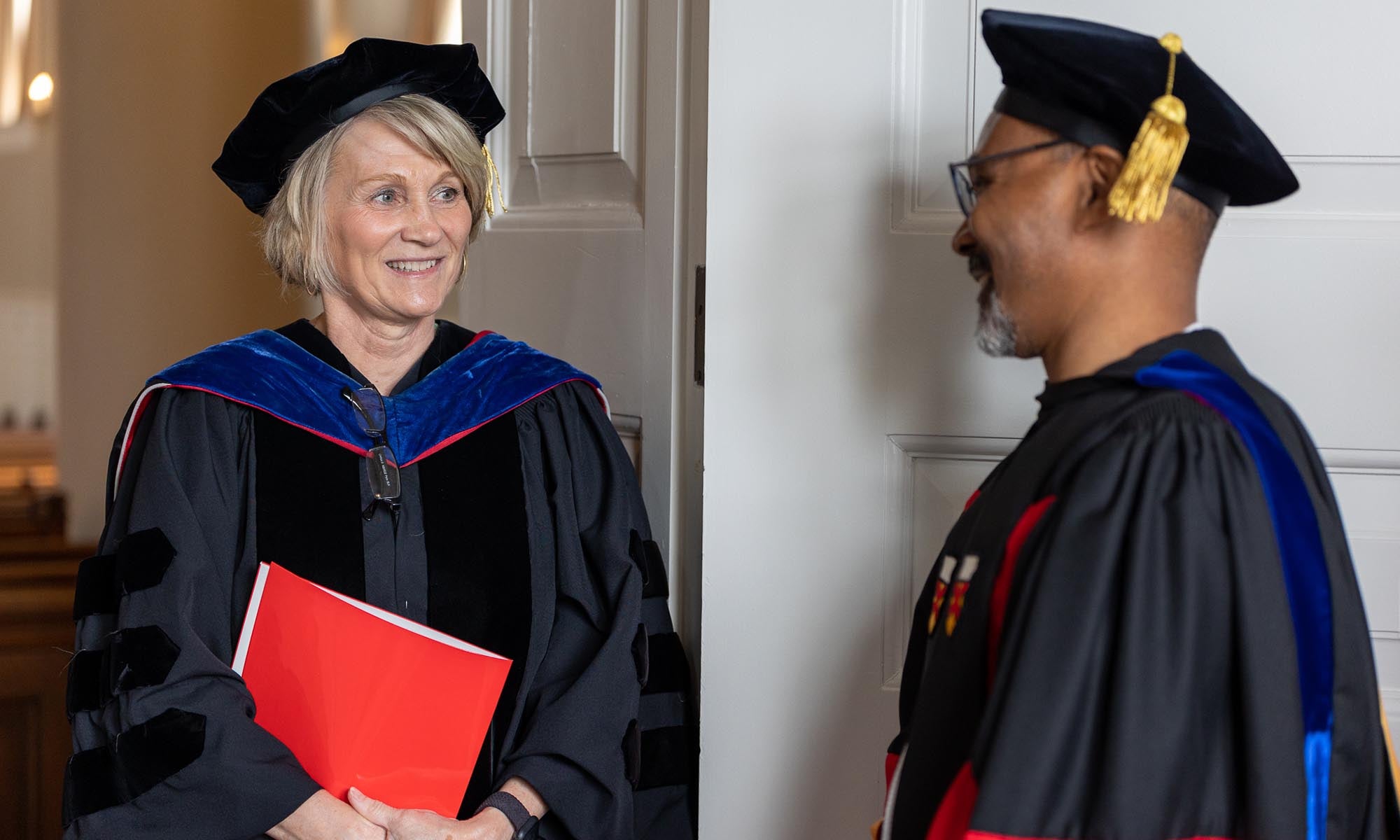
Provost Kim Coplin ’85, known for her relationship building, speaks with Associate Professor John Davis of anthropology
‘People trust her.’
Like many students, Coplin experienced feelings of homesickness in her first weeks at Denison. Twenty-five years later, she experienced similar longings despite the short move across campus.
“There would be times early on, like my first five years in the Provost’s Office, when I would walk into Olin and think, ‘This is where I belong,’ and ‘Why am I over there in the administrative building?’” she says.
As responsibilities of the Provost’s Office expanded, the administration asked Coplin to make the switch in 2006. Her work as a department chair and a member of the President’s Advisory Board made her an ideal candidate.
“I was eager to have Kim aboard, knowing her to be a seasoned faculty member who had all the right traits as our new associate provost,” says Keith Boone, associate provost emeritus.
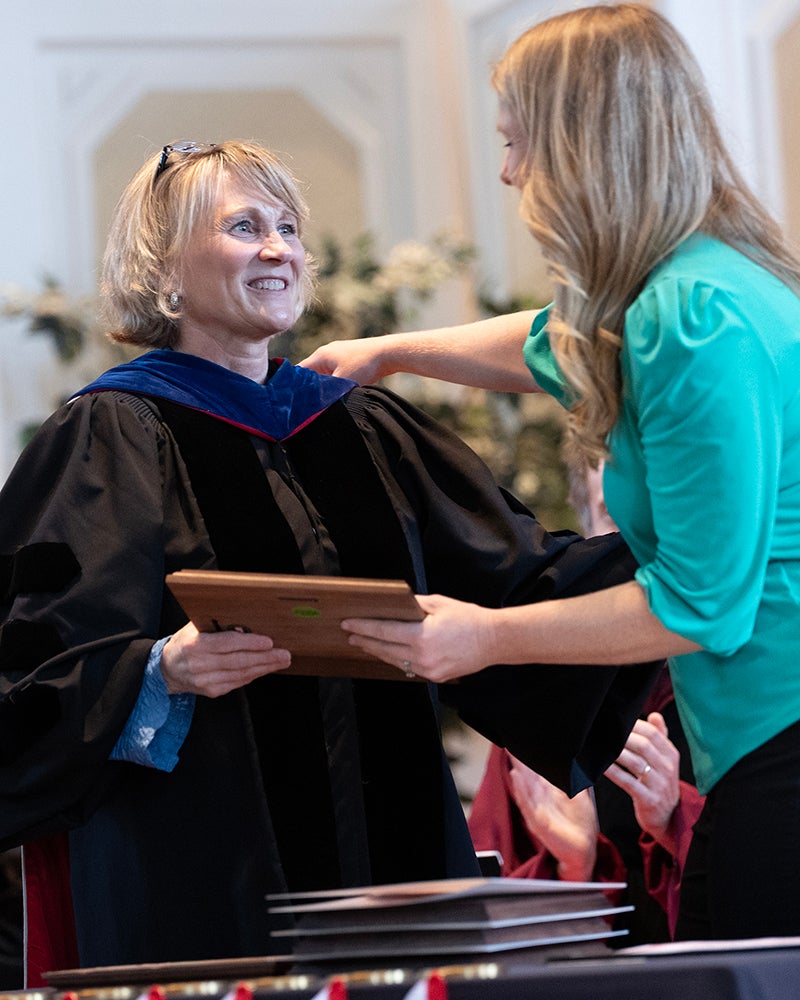
Provost Kim Coplin ’85 on the stage at Swasey Chapel with Erin Henshaw, professor of psychology.
Coplin planned to hold the position for three years before returning to the physics department. But as we’ve seen already, her Denison “plans” tended to change.
She excelled in her new role, and by 2013, there were changes at the senior leadership level with former President Dale Knobel retiring and Provost Bradley Bateman leaving to become president of Randolph College.
Coplin was named interim provost as Denison welcomed Weinberg to the university. The new president spent his first year getting to know faculty and inquiring about their needs. Weinberg was so impressed with Coplin’s work, he recommended removing the “interim” title to the board.
“Kim was a breath of fresh air in the Provost’s Office, and even though she was a physicist, that wasn’t what guided her when she acted as provost,” says Michael Mickelson, professor emeritus of Physics & Astronomy. “Her primary mission was to make sure Denison was the best institution it could be, and Denison has become that.”
‘Watershed moment’
When Weinberg joined Denison, the university had not introduced a new major since 1993. Acting on recommendations from faculty, Denison added Data Analytics, Global Commerce, and Health, Exercise, & Sport Studies (HESS) in 2016.
All three majors are deeply interdisciplinary, a hallmark of a Denison education. All three rank among the university’s top 10 for graduates in recent years. Since then, Denison has also introduced Finance, Global Health, and Journalism to its growing roster of majors.
“Kim and Adam have turned out to be a remarkably good team because they’re so different in their styles,” Goodwin says. “Adam is caffeinated and exuberant, and public in his persona. Kim is reserved and steady and those two things really go well together.”
Coplin lauds Weinberg’s vision and his ability to listen to faculty and assure them their recommendations were being heard. She considers the transformative additions of the past decade a collective victory.
“It was a faculty-driven effort,” she said. “A request came from the top to come up with ideas for new programs, but then we followed our process to have curricular proposals drafted and vetted. So, yeah, it was a watershed moment.”
The duties of provost — the university’s Chief Academic Officer — are vast and far-reaching. Coplin oversees all academic programs, faculty hires and reviews, and runs committees too many to mention.
Associate Provost Sam Cowling considers Coplin “an institution” and marvels at her multitasking abilities.
“Kim’s work is so connected to the processes that make student education possible,” Cowling said. “She is constantly thinking about the integrity of the processes with which we treat students, with which we treat faculty, and how students and faculty come together to make the academic experience a good one. She is the nexus of so many processes that it’s often mind-boggling, and they’re sometimes held together by her decency and the fact that people trust her.”
‘The best’
Weinberg considers Coplin one of the most impactful provosts in the nation. Professor May Mei goes a step further.
“Kim is the best,” says Mei, chair of the mathematics department. “You can quote me on that.”
Mei travels frequently in her role as chair of the Committee on Program Review of the Mathematical Association of America. She offers assessments of math departments and often meets with high-ranking administrators.
The Denison professor knows universities can run into trouble for many reasons, and a big one is when the relationship between faculty and administration grows toxic, and trust erodes.
“Once you lose trust, it’s very hard to get out of that situation,” Mei says. “You’re probably going to need a new provost. I have never seen Kim act in that space. Has she made decisions I disagree with? Yes, of course. But I haven’t seen her make a decision that she’s not willing to stand behind, not willing to share her rationale. And she never loses empathy for the people who wanted the decision to go the other way.”
Vice President for Student Development Emeritus Laurel Kennedy, who retired six years ago, mentions Coplin’s generous spirit. Among the things she misses most are their morning walks, occasionally discussing tricky ethical questions that arise at universities. Kennedy says those conversations always remained private, even as Coplin worked behind the scenes to collaborate with others to reach the best possible resolution.
“I interacted with a lot of other vice presidents or deans of students at other institutions,” Kennedy said. “I would say that I was the envy of many of my peers because of the relationship that Kim and I had and because of the way she conducted herself in that office.”
After answering several questions about Coplin, Mei asks one of her own as a way of illustrating the provost’s character.
“Who do you call to pick you up from the airport?” asks Mei, chair of mathematics. “Not just a normal afternoon flight when everything is going to be on time, but one that might get delayed and land at a weird hour. Kim’s the person who’s there waiting for you. It’s that dependability, trustworthiness, consistency that we value in her.”
Last call
For more than a decade, audiences attending Denison’s Commencement watched Coplin read through the roll call of graduates as they walked across the stage to receive their diplomas.
What the public didn’t see is the hours of research and attention to detail Coplin put into the assignment — checking with the Registrar’s Office for phonetic spellings and listening to recordings of students saying their names. She has even emailed seniors to double-check pronunciations, ensuring she’ll unknot potential tongue twisters.
But in the weeks leading up to her final roll call, friends, colleagues, and family worried about her composure in reading one particular name.
Lia Coplin ’26.
Six years ago, the worldwide pandemic forced cancellation of an in-person Commencement, denying Coplin the opportunity to read her son Jacob’s name to the audience. She has also welcomed a nephew and a niece to the stage for their diplomas, but calling the name of her daughter … well.
“Hopefully, I’ll be able to get through, but I don’t know if I’ll be able to do it without choking up,” Coplin says.
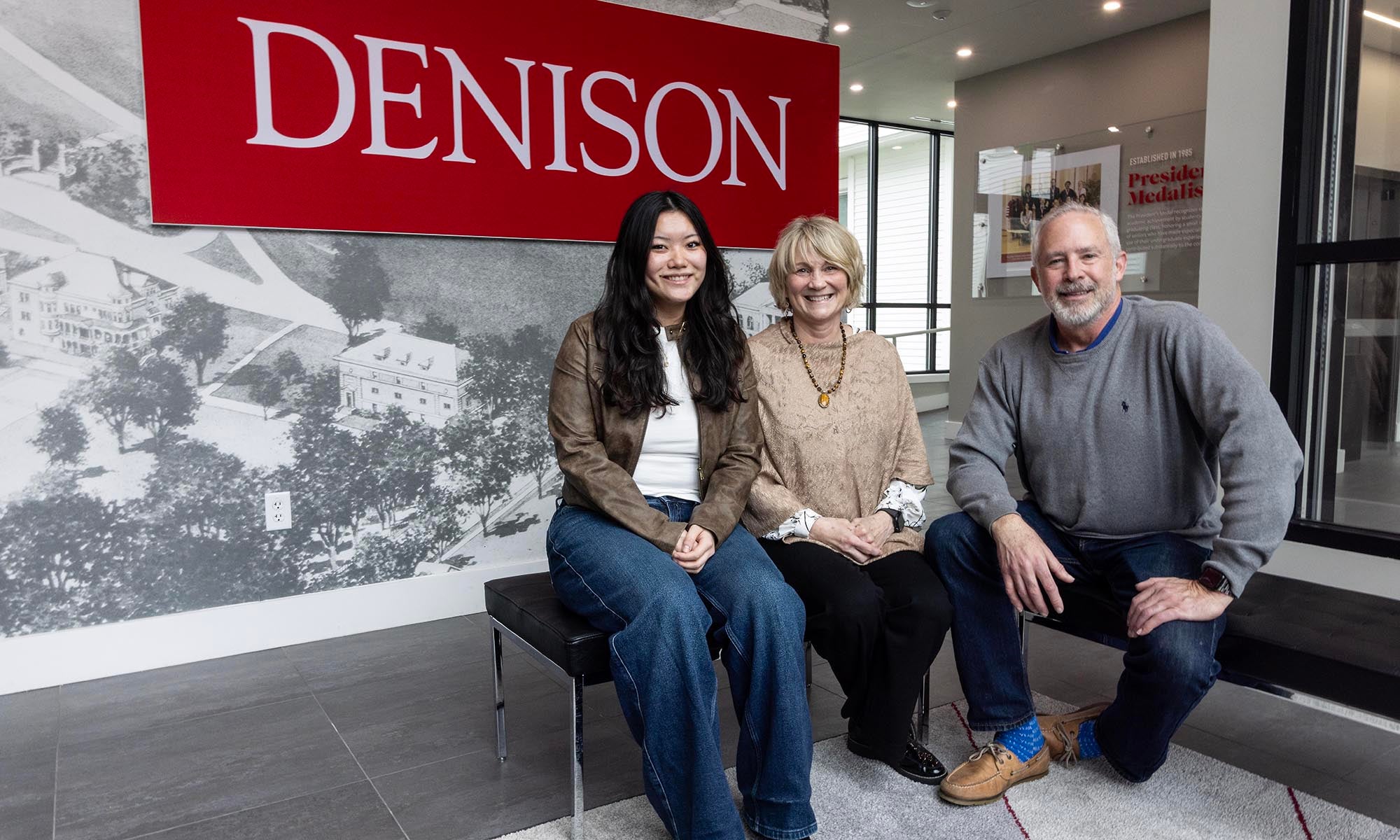
Kim and Rick Coplin ’85 with their daughter, Lia Coplin ’26.
The Coplins embody the multi-generational appeal of Denison – and it might not end with Jacob and Lia. Just like his parents, Jacob married a fellow Denisonian, Dr. Jessica Nix Coplin ’18, and the couple has an infant son, Liam. Coplin’s sister, Karolyn Fox ’91, and two of Karolyn’s children, Jillian Fox ’19 and George Fox ’25, also made The Hill their home.
“I think a key factor here is the Denison community and the relational nature of Denison,” Kim Coplin says. “Denison students make great friends, and our alumni stay connected. My daughter decided to attend Denison because she saw the amazing experience her brother had, and I think this is true for many legacy families.”
Even if Coplin had not returned to Denison after graduation, she would be an unwavering champion of the liberal arts.
“My first semester, I had calculus, chemistry, introduction to theology, and a literature class,” she says. “Being in this range of courses allowed me to appreciate the breadth of a liberal arts education immediately.”
Within a few weeks, Coplin will hop into her Denison-red Jeep and ride into retirement. She has no immediate plans other than reigniting her passion for casual reading, spending time outdoors, and driving to South Carolina to visit her grandson.
Jacob and Lia laugh at the thought of their mother with loads of free time, given her penchant for hard work.
“She tried taking up knitting during Covid — that didn’t go well,” Jacob says.
Dan Coplin, who lives in Arlington, Virginia, and occasionally wears Denison shirts, is impressed with how many people recognize the university’s brand and its strong academic reputation.
“People know Denison and know it’s doing really well,” he says. “I think part of that is it’s being run well by the people at the top, and my mother has been a big part of that.”
For someone who didn’t think she would spend more than two years at Denison, Kim Coplin has forged a remarkable legacy. The accomplishments are legion; the selflessness is legendary.
What makes her most proud is the faculty that Denison has assembled in her time as provost.
“We have hired good people who are committed to working with students,” Coplin says. “They remind me of the faculty I had as a student, who made such a difference in my life. That’s what we are all about at Denison.”