
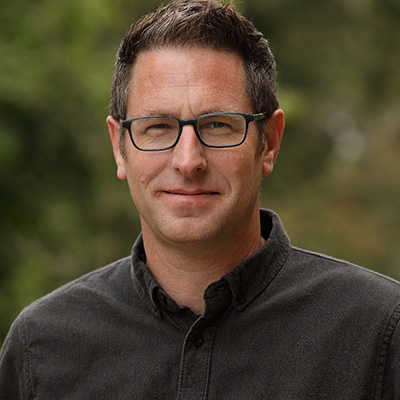


Everywhere you look on The Hill, you’ll see signs of leadership.
Hallmarks of leadership are illustrated every time a student starts a club, seeks a post with the Denison Campus Governance Association, or is elected an officer in their fraternity or sorority.
The signs were never more evident than earlier this spring, when Denison student-athletes secured two national titles in a matter of hours, in women’s basketball and in men’s swimming & diving.
Leadership is also front and center whenever Denison faculty break new ground in their fields of research or devise engaging new ways to teach and mentor students.
And proof of institutional leadership is spelled out in every course catalog, where newer majors like Finance and Data Analytics mesh with Denison’s liberal arts foundation to break exciting educational ground. Further proof has risen quite literally on campus; Denison’s new Knobel Hall and the King Center for Data and Innovation are set to open this year, serving as a technological learning hub and as a pioneering model for higher-education institutions everywhere.
Our alums carry this leadership tradition far from The Hill, decades into the future, and around the world.
We asked five Denisonians about their own leadership styles, experiences, and any advice they might have for students and younger alums.
The qualities these successful leaders appreciate the most are grounded in lessons they learned at Denison: Be curious. Gain wisdom from other perspectives. Care about your team. Show up and do the hard work. Keep learning.
Read more about their personal journeys and the common threads that link them to one another and their formative years at Denison.
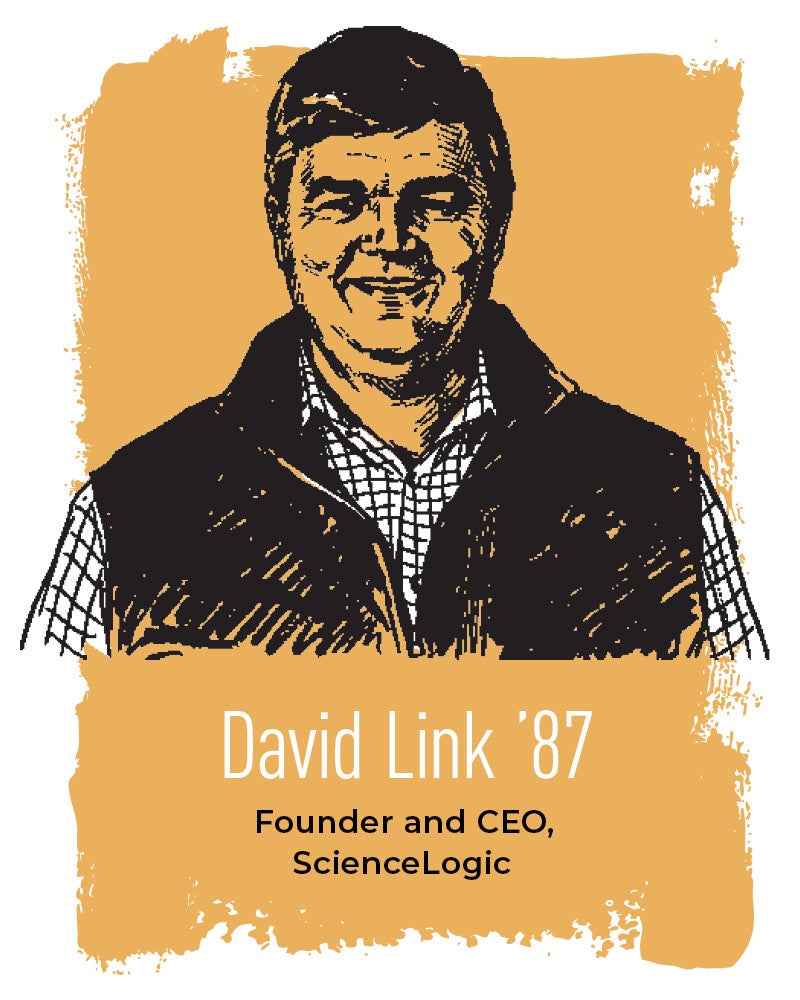
Long before he became the founder and CEO of one of the fastest growing technology companies in the world, David Link ’87 was a geology student who blew a key job interview on the Denison campus — only to resurrect his chances and change the course of his life with a bold and unorthodox move.
The story highlights core attributes that have served him as a leader: his penchant for introspection, an unflinching review of all available data, intellectual humility, and dogged persistence.
Link was planning to earn his master’s at Vanderbilt University after graduation when he went to the on-campus job interview with a recruiter from CompuServe, a pioneering online service provider founded in Columbus, Ohio.
Link had a budding interest in computers because he saw their value in geological modeling, but he hadn’t done his homework for the job interview. The recruiter peppered him with questions that should have been obvious: Why would a geology major want to work at CompuServe? How are you qualified?
Afterward, Link had to admit that all data pointed to one conclusion. He had flubbed it.
“I stewed about it for an hour or two, and I said to myself, ‘I’m going back,’” he says.
He waited for the recruiter to wrap up for the day.
“I told him, ‘I didn’t do a good job in this interview. You asked me this question. I gave you this answer, but I should have said this.’ I just went through all the ways I hadn’t done well.
“He looked at me, and he said, ‘Dave, I’ve done about 3,000 interviews on 20 campuses in the last five years — by the way, you were a no. You were not getting a second interview. You were done. You were out of here. But you are the only person who has ever come back after the interview and made a case for why we should hire you. You’re getting another interview.’
“And ultimately I got the job.”
Link spent 10 years at CompuServe learning the ins and outs of global networks and large scale systems technology. For the past 23 years, he has led ScienceLogic, a business he built from the ground up to manage complex IT systems in better and smarter ways.
“This is a business I started with — candidly — no money, forcing us to initially use the garage to save every penny as we bootstrapped the company for the first seven years before securing venture capital to further accelerate our rapid growth,” he says. “Since then, we have built it into a global enterprise with teams and customers all over the world.”
Ask him to categorize his leadership style, and he puts himself firmly in the transformational visionary group.
“You really get performance out of a team when they believe they’re on the same journey you are, to really change the world, to change things for the better,” Link says. “People want to get more than just a paycheck. They want to be part of something bigger than themselves, something that they aspirationally are aligned with.”
You can’t fake that, he says, and you can’t let your ego stand in the way of the best decisions.
“If you don’t have that sense of humility, to care less about being right and more about getting it right, for a customer, for a partner, for your team? Good luck. Good luck to you.”
He advises alums just starting out to treat their job as mission-critical, regardless of where they fall on any corporate ladder.
“You can be at the lowest level of a business but still help that company know you understand the mission,” he says. “People don’t have to have a ‘leader’ title to be a leader.
“Build a competency, so you feel confident about what you’re doing, and then be a good communicator about that competency when you’re on that first job — what you’ve done, why it matters, and how it’s helping,” he says. “That’s the pathway to success if you keep it up.”
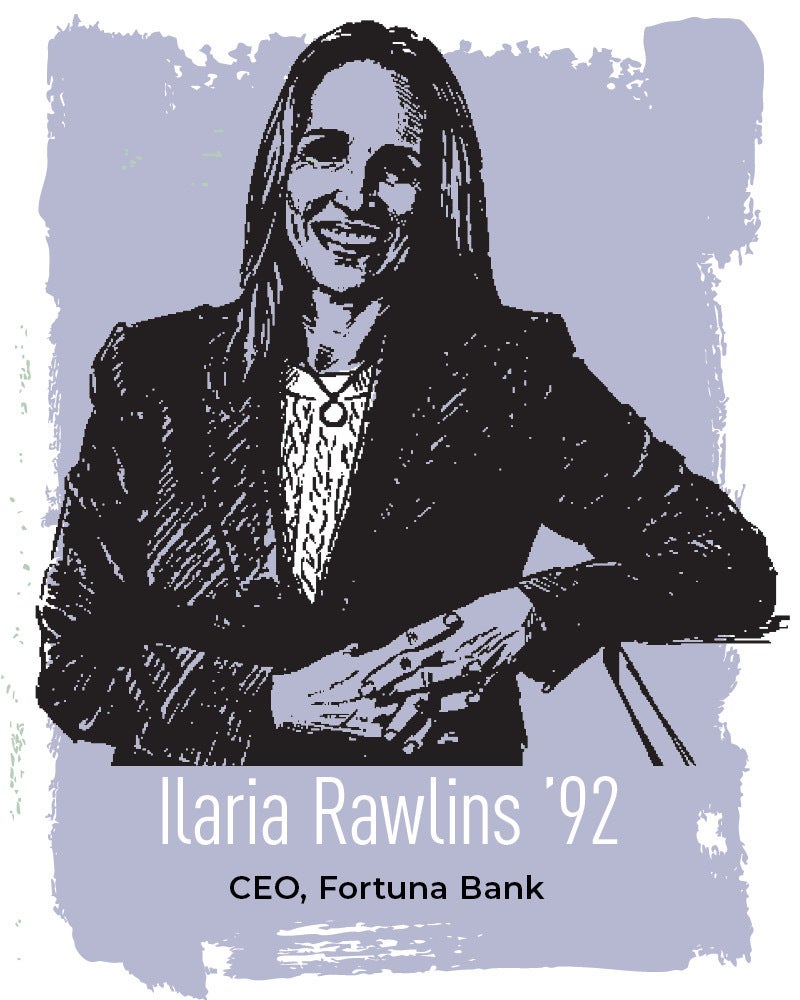
Ilaria Rawlins ’92 has amassed a career’s worth of business and financial insights. Still, her primary advice to students and recent Denison graduates applies across the board, regardless of college major or career trajectory.
“I’m a huge advocate for finding mentors to guide you,” says Rawlins, CEO of the Ohio-based Fortuna Bank. “I don’t feel like I did that as much as I should have when I was younger. That was a ‘miss’ in my space.”
Rawlins, co-founder of Fortuna, which opened in 2024, was recently named Columbus CEO magazine’s 2025 CEO of the Year in the Small For-Profit category. Fortuna was intentionally founded as a woman-owned bank, and a key part of its mission is providing better support, education, and mentoring for women entrepreneurs.
For leaders, she says, “It’s really important to celebrate the success of the now, but also to be very conscientious of not losing sight of coming changes or potential disruption.”
Rawlins started at Denison with an eye on broadcast journalism but found herself drawn to economics. As she built her career in banking, she drew on the leadership styles of those she admired.
Some lessons that at first may have seemed small continue to resonate. When she was in her 20s, she says, one manager pointed out that, “I would always end my questions with, ‘or no,’” Rawlins says. “And she said, ‘Stop allowing them to say no right off the bat. Just ask your question and have confidence in using your voice.’”
Another boss took a chance on her when Rawlins personally felt she was still “really green” — and she surprised herself by stepping up to the challenge.
“That taught me to be intentional about taking a chance on people who show potential and believing in their ability to thrive,” she says. “You don’t always have to have all the boxes checked before moving into the next role.”
While at Denison, Rawlins says she learned to appreciate the inherent worth of team members who bring varied perspectives and disparate strengths to the table.
“Employers appreciate someone who has the curiosity to learn more about not only their own role and what they’re doing, but also the other lines of business in an organization,” she says. “I would encourage students not to stop learning when they leave Denison, and I would be very intentional in finding a leader who could help guide you, who will challenge you, and will take the time to understand what your strengths are, what your weaknesses are. Someone who would be an advocate for you.”
This doesn’t come easy, she says; it takes intentionality and effort.
“I think every promotion I’ve received was because I asked for it,” she says. “It’s easy to sit and wait for the next promotion or the next opportunity, but you have to be the driver of your own career.
“And give yourself the grace to enjoy the journey.”
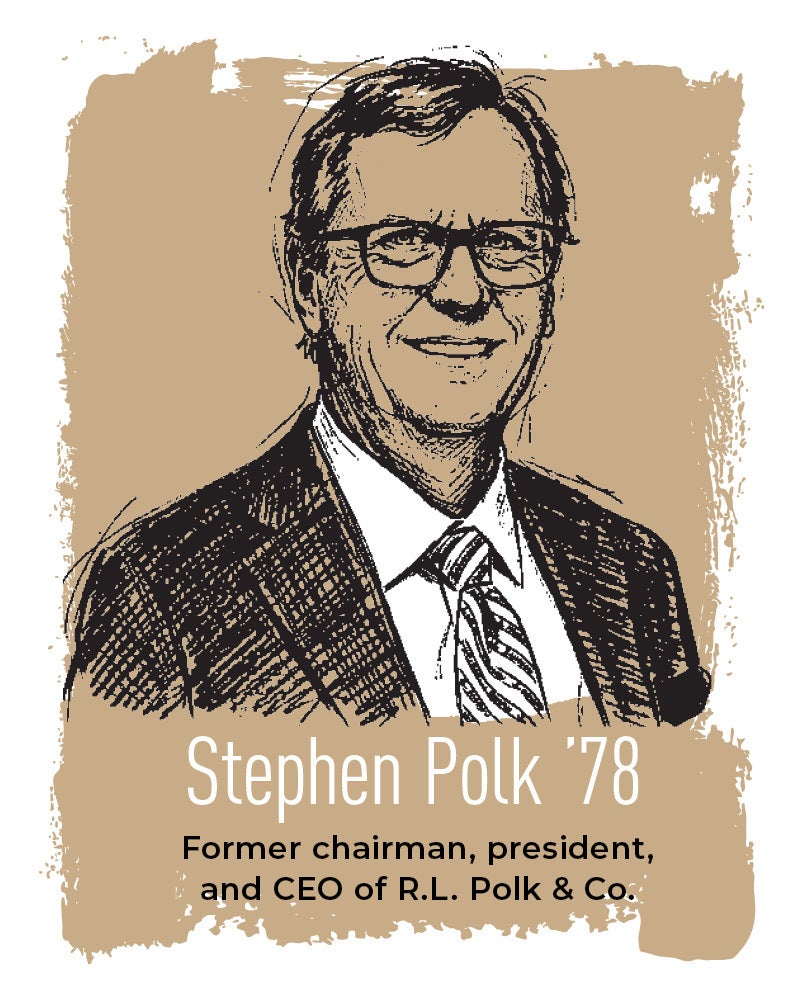
As the chairman, president, and chief executive officer of R.L. Polk & Co. — a company his great-grandfather founded in 1870 and the parent company of Carfax, an automotive data service — Stephen Polk ’78 made countless consequential leadership decisions, right up to the 2013 sale of the business to IHS.
R.L. Polk & Co. began as a publisher of city directories and grew into a global automotive data firm that changed the industry and the car-buying experience for consumers worldwide. The company began serving the auto industry in the early 1920s when Alfred P. Sloan, president and later chairman of General Motors, asked Ralph Lane Polk II to collect and publish impartial automotive statistics.
Stephen Polk joined the business in 1981, a few years after graduating from Denison. During his career, he restructured the organization around customers’ needs. He accelerated the development of new products and services, streamlining operations and sharpening the company’s focus to become the leading provider of information and marketing solutions for the automotive industry.
“The culmination of my career was the sale of the business after 140 years,” Polk says. “That process went extremely well, but it certainly was bittersweet. It was a matter of recognizing the time was right.”
When he talks about receiving feedback on his leadership style, Polk just as quickly reflects on his 17 years of coaching youth soccer.
“That was a fun way to test leadership skills,” he says with a laugh. “Coaching elementary school kids, they quickly point out your weaknesses. You can also tell who has natural talents for leadership at a young age. It’s remarkable.
“My focus in leadership is really about collaboration and working with the team of people around you,” he says. “I want to know what their ideas are and want them to know mine, so that even if we don’t agree, we all understand how we got where we are and how we move forward together.
“It is very important you learn from the people you work with, and from the people along the way,” he says. “Nobody knows everything.”
Polk said frank business conversations are particularly essential during times of upheaval.
“People expect tough decisions in tough times,” he says. “But they want to know that you’re present, and that you still care about them.”
He advises young alums to seize leadership opportunities whenever and wherever they arise, such as the one he took at his Denison fraternity, Phi Gamma Delta.
“For whatever reason, I volunteered to be the kitchen steward,” he says, laughing. “That was certainly an intriguing balance in leadership — policing the kitchen in a raucous fraternity.
“You see people who don’t make the effort to engage,” he says. “That’s missing out on huge opportunities for personal growth if you don’t stay involved and interested in what’s going on, and realize that you have a part to play.
“There are leadership opportunities pretty much every day in everyone’s life,” he says. “You just need to look around you.”
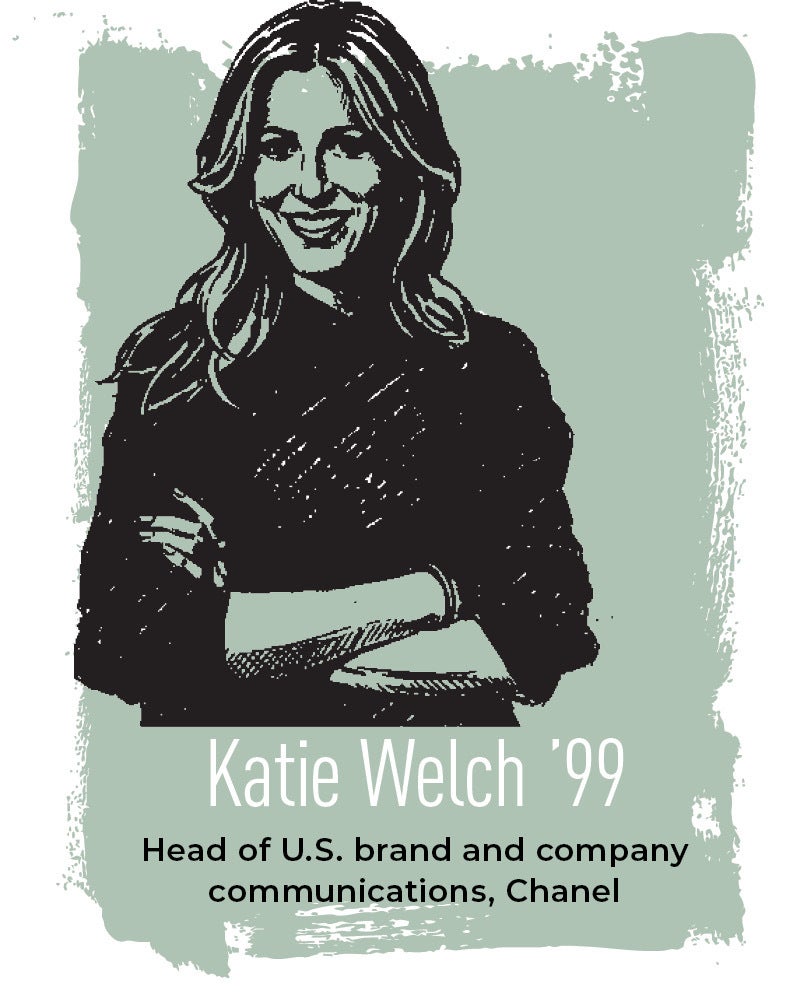
Katie Welch ’99 stayed busy at Denison, singing with Ladies Night Out, serving as president of Delta Delta Delta, and majoring in English with a minor in theater.
“But my community, my friends, extended far beyond my activities, courses, and even year,” she says. “That’s what makes Denison so special. Denison is a place where you’re encouraged to engage deeply with your friends, your classmates, your professors, your environment.
“One of the biggest lessons I took with me after graduation is that relationships matter,” she says. “The way you treat people, the way you show up for others — it’s foundational. And today, that translates directly into my leadership style.”
At the start of 2026, Welch joined the luxury label Chanel as its head of U.S. brand and company communications, and as a member of its U.S. management committee.
Prior to Chanel, Welch was the chief marketing officer at Rare Beauty. She was also the general manager for beauty at The Honest Company and chief marketing officer at Hourglass Cosmetics, where she worked before and after the makeup brand’s acquisition by Unilever.
Her belief that relationships are foundational has been reaffirmed throughout her career.
“I’ve been incredibly fortunate to learn from leaders across very different environments,” Welch says. “Each one shaped a different part of how I lead. Some taught me the importance of high standards and accountability, like Carisa Janes, founder of Hourglass. Others, like Selena Gomez, founder of Rare Beauty, showed me how to lead with heart, how to build culture, and how to make people feel valued.
“I’ve also learned just as much from peers and everyday experiences, the good and the bad,” she says. “It’s these experiences that sharpen your instincts and help you define the kind of leader you want to be.”
“Mentorship isn’t just about one person,” Welch says. “I have found that mentorship is about collecting perspectives over time and integrating them into your own voice.”
She describes her leadership style as human-first and purpose-driven. And she says young employees who regularly step up are noticed by management.
“Early in your career, you have to lead yourself,” she says. “And it’s your biggest learning lesson. I appreciate those on my team who are reliable, curious, and generous with their time and ideas. I never underestimate how important those qualities are.
“Leadership starts much earlier than you think,” she says. “It’s not about having a big title or even direct reports. Leadership is how you show up. Do you take ownership? Do you support your peers? Do you raise your hand for hard things? Do you bring positive energy into a room?”
She shared advice for younger alums.
“I wish I had understood that careers aren’t linear,” she says. “There isn’t one perfect path; there are many paths, and each one teaches you something.”
“You don’t have to have it all figured out. Focus on learning, stay open, and trust that it will come together in ways you can’t yet see.”
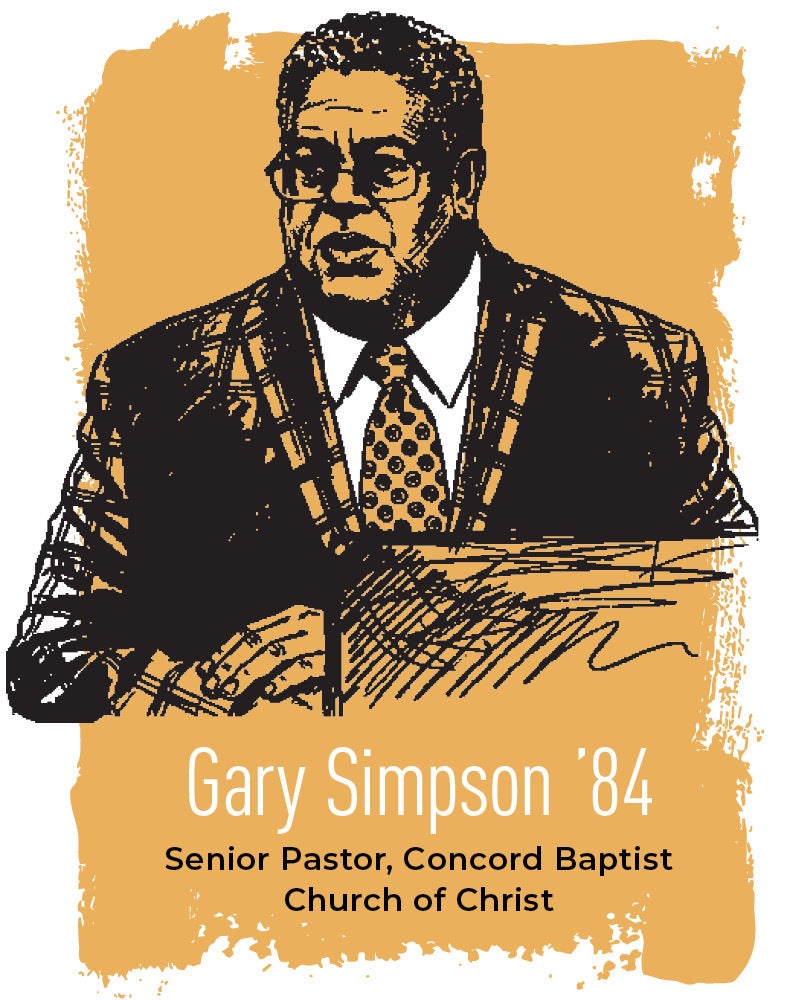
A few years into his pastorate at Concord Baptist Church of Christ, one of Brooklyn’s leading churches, Gary Simpson ’84 met with a group of visiting Denison students.
The meeting would prove to be a key lesson for Simpson about leadership — more precisely, the moment stands for him as a reminder of a time when he still wasn’t much good at it.
“I was so awful in that meeting, as I now understand leadership, because I was doing the performative thing,” Simpson says, laughing at the recollection. “I was telling them how many members we had, all the things that I don’t think people who are being led really care about.”
“What people care about is that they are seen and they are valued, and that the big folks up top are paying attention to their personhood,” he says. “I’ve discovered that what really makes one a leader is the ability to get with the people one is leading.”
Simpson has led Concord Baptist for 36 years; he is the 10th pastor in the church’s 179-year history.
He grew up in Columbus, Ohio, where he preached his first sermon at 15 years old. He studied Religion and Black Studies at Denison, graduated Phi Beta Kappa, and went on to earn his Master of Divinity from Union Theological Seminary and his Doctor of Ministry from United Theological Seminary. He is an associate professor at Drew Theological Seminary.
“Denison just kept giving me opportunities to participate, to practice leadership, and to negotiate in the public space, when I was in places where I was truly a visible minority and when my perspective would be the minority,” he says, “and to not be afraid to give voice and put things in the air even though they might not be viewed the same way by most people.
“College is not just a place to show you what you can do,” he says. “It also gives you a safe space to learn your limitations.”
He’s come a long way from that awkward meeting as a new pastor.
“I had no clue when those students came to see me,” he says. “Leadership is a relationship. It is an investment of the leader and the people in each other.”
He has leaned on many mentors along the way. He recalls a moment when he was on The Hill for a Board of Trustees meeting and simultaneously trying to sort out a problem that had arisen at his church back home.
“I was in Slayter at the pay phone; that tells you how long ago this was,” he says.
Bill Bowen ’55, who had retired as president of Princeton University and was at the time the president of the Andrew W. Mellon Foundation, saw Simpson’s distress and approached. Simpson said, “Bill, I can’t seem to get this thing right.”
“Gary,” Bowen replied, “the question is not, ‘As a leader am I going to make mistakes?’ but, ‘Can I fix them?’”
“Part of leadership,” Simpson says, “is just continuing to show up.”
“You can’t lead if you’re not willing to follow,” he says. “It’s just that simple. In the church we would say, ‘Have a teachable spirit.’ Leadership is about continuously learning. Don’t be afraid to try something new, even if it’s awkward or painful. It might end up being the thing that you really love to do.”
Having pastored his congregation for the better part of four decades, his thoughts now include the logical next step in any life of leadership.
He reaches back to quote a song, Kenny Rogers’ “The Gambler.”
“You gotta know when to hold ‘em, and when to fold ‘em,” he says. “All leadership is a relay race, where I’m going to pass the baton on to somebody else. And I’ve seen a number of Olympic racers get disqualified because they messed up on the hand-off.
“Leadership is always in-community,” he says. “It is not about always being on the platform. It is about putting other people on the platform and being in the first row, cheering them on.”