Fill your paper with the breathings of your heart
— William Wordsworth
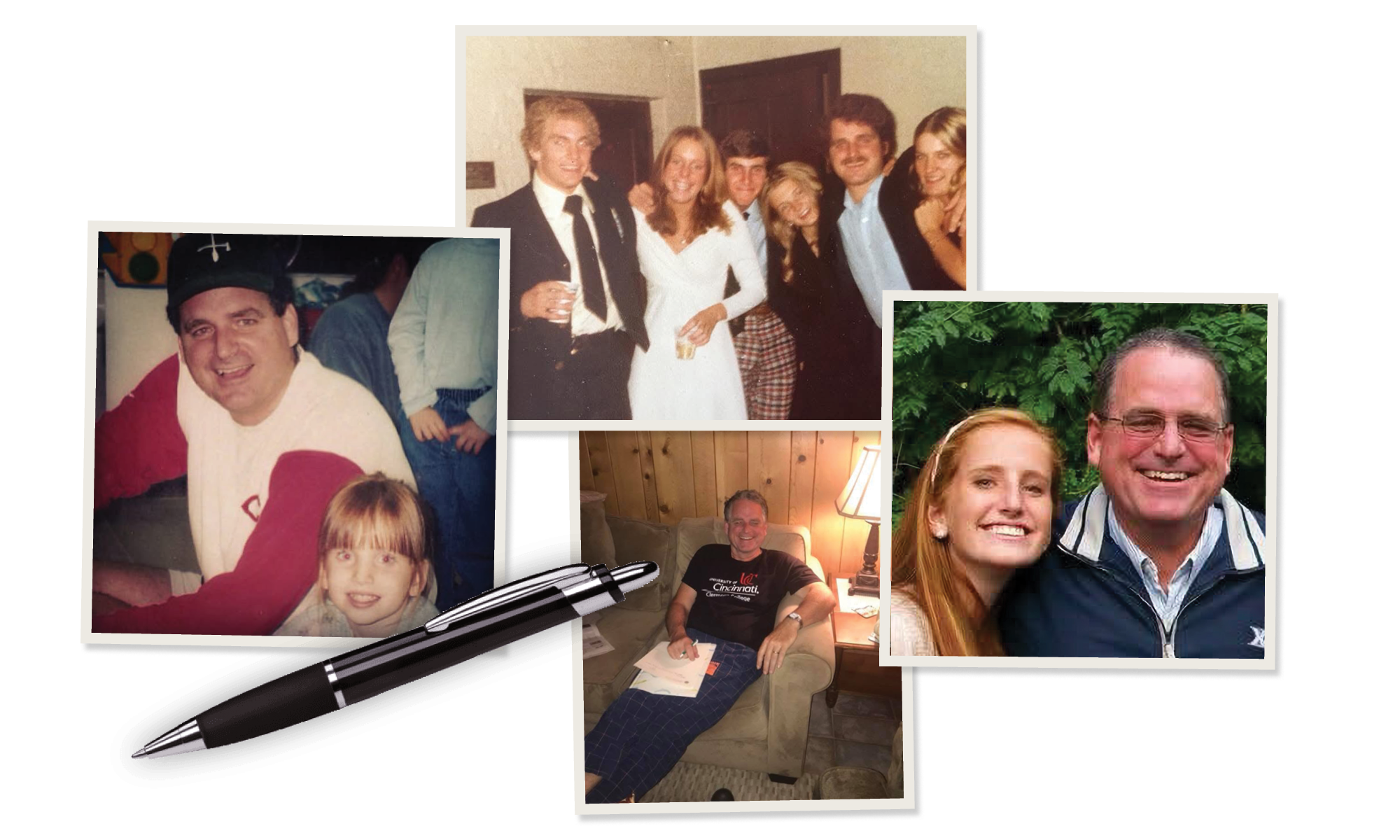
What this grew into, just in the past year, is a worldwide phenomenon called the Dad Letter Project. But its humble foundation was laid decades ago by Buz Ecker’s mom.
Peg Ecker was the letter writer of the Ecker family.
“She wrote to me every day at Denison, and when I was at a summer camp as a boy,” says Buz Ecker ’79. “I still have those letters, and I look at them every once in a while. I know that they’re filled with love for me, and I’m glad that I still have them.”
Ecker inherited her habit. He wrote to his children throughout their lives, and when grandchildren came along, he wrote to them, too.
Ecker, a retired adjunct English professor at the University of Cincinnati Clermont College, had just checked off a bucket list item by earning his doctorate in leadership change with a certificate in creative writing at Antioch University. He was looking for something to fill his time.
Ecker’s daughter, 30-year-old Rosie Paulik, had an idea. She brought it up on TikTok that July.
“Would you want a letter from my dad?” she asked the app’s users. “Or know someone who could use a little kindness from a retired professor with a killer signature and a fountain pen?”
Father and daughter were, it’s fair to say, flabbergasted by the response.
“I really kind of did this for my dad, and I had no idea how many people were going to request a letter,” Paulik says. “Last I checked, we had over 9,000 requests.”
Requests have poured in from around the globe, seeking fatherly wisdom, words of comfort, and sometimes dad jokes.
Ecker and the roughly 30 other dads recruited so far for the project do their best to oblige.
“I write 10 letters a day, seven days a week,” Ecker says. “Rosie thinks that I’ve written 2,000 letters so far. I think it’s more like 1,800, but it’s somewhere around there.”
To The Hill
Ecker’s mother may have been his inspiration for letter writing, but it was his father who inspired him to attend Denison.
David Ecker ’48 graduated from Walnut Hills High School in Cincinnati in 1942 and enrolled at Denison, where he was a member of Beta Theta Pi.
“He got interrupted by World War II,” Ecker says.
David Ecker served in the U.S. Office of Strategic Services, established in 1942 to conduct espionage, sabotage, and unconventional warfare behind enemy lines. He landed in Normandy, France, on June 10, 1944, four days after D-Day, and he participated in the liberation of St. Lo, Paris, Drancy, Carcassonne, Clermont Ferrand, and Sete.
“When he came back, he was in no shape to go back to school, so he did not graduate,” Ecker says. “The war took a toll on him.”
His sons picked up where their father had left off. Mike Ecker ’75 came to The Hill first; Buz Ecker arrived as part of the Class of 1979.
“I wanted to go where Dad had,” he says.
He majored in English and pledged Beta, just as his father and brother had before him.
“Denison means a lot to our family,” Paulik says. “I know almost all of his fraternity songs. I traveled so far to get my teeth cleaned and seen by a dentist who was his fraternity brother.”
It makes sense. Why would you trust your daughter’s teeth to anyone other than Donn Mettens ’79, a pledge brother of Ecker’s at Beta?
To the post office
The fledgling Dad Letter Project blew up overnight. Ecker and Paulik were interviewed by the likes of ABC News, The Washington Post, and TODAY.
Other dads joined their effort, but it quickly became clear that a reassessment was in order.
“We were able to get out close to 3,000 letters,” Paulik says. “We also completely stopped marketing, because we don’t have the systems we need in place yet.”
Brakes thus applied, they began developing a screening process for prospective dads, researching how to respond to people in crisis, and working toward tax-exempt status.
“Then we can start fundraising, we can get full-time staff on board, and we can start figuring out all the problems we’ve gotten ourselves into since July,” Paulik says.
Meanwhile, Ecker and the other writers, who have undergone background checks, chip away at the backlog.
Much of the press coverage has focused on the heartwarming aspects of all this. And it can be exactly that. But Ecker says there is a darker side, too. Many of the letter writers candidly reveal their experiences with some of life’s worst traumas: abuse, abandonment, terminal illnesses, suicide.
“There are some letters that don’t leave me,” Ecker says. “One lady got woken up in the middle of the night as a little girl so that she could watch her father beat her mother, and I had to respond to her. And that’s just the tip of the iceberg.”
“None of these dads is a therapist, and that’s the point of it,” Paulik says. “People don’t want to hear from a therapist when they write to us. They want to hear from a dad, but because they’re not therapists, we want to make sure that we’re saying the right things. There’s so much learning to do.”
As the backlog shrinks, a binder kept by Ecker grows thicker.
“In a world that is tragically increasingly divided, your warmth and love brought tears to my eyes,” reads one note from a woman in Canada. “Words cannot express how deeply grateful I am to you and how you lifted a stranger’s spirit.”
“I’ve put my heart and my soul into every letter that I’ve written,” Ecker says.
“He cares a lot,” his daughter says. “He always has.”
What is it that makes a letter so special? To answer this, Ecker returns to those boxes full of his mother’s letters, sent to him at camp, then at Denison, all those years ago.
She’s been gone 11 years, this May. But her letters remain within her son’s reach, should he ever need a tangible reminder that one person’s love, kindness, and empathy can mean so much to another.
“She touched the letters, and I touched the letters,” Ecker says. “That’s a bond that never leaves.”