
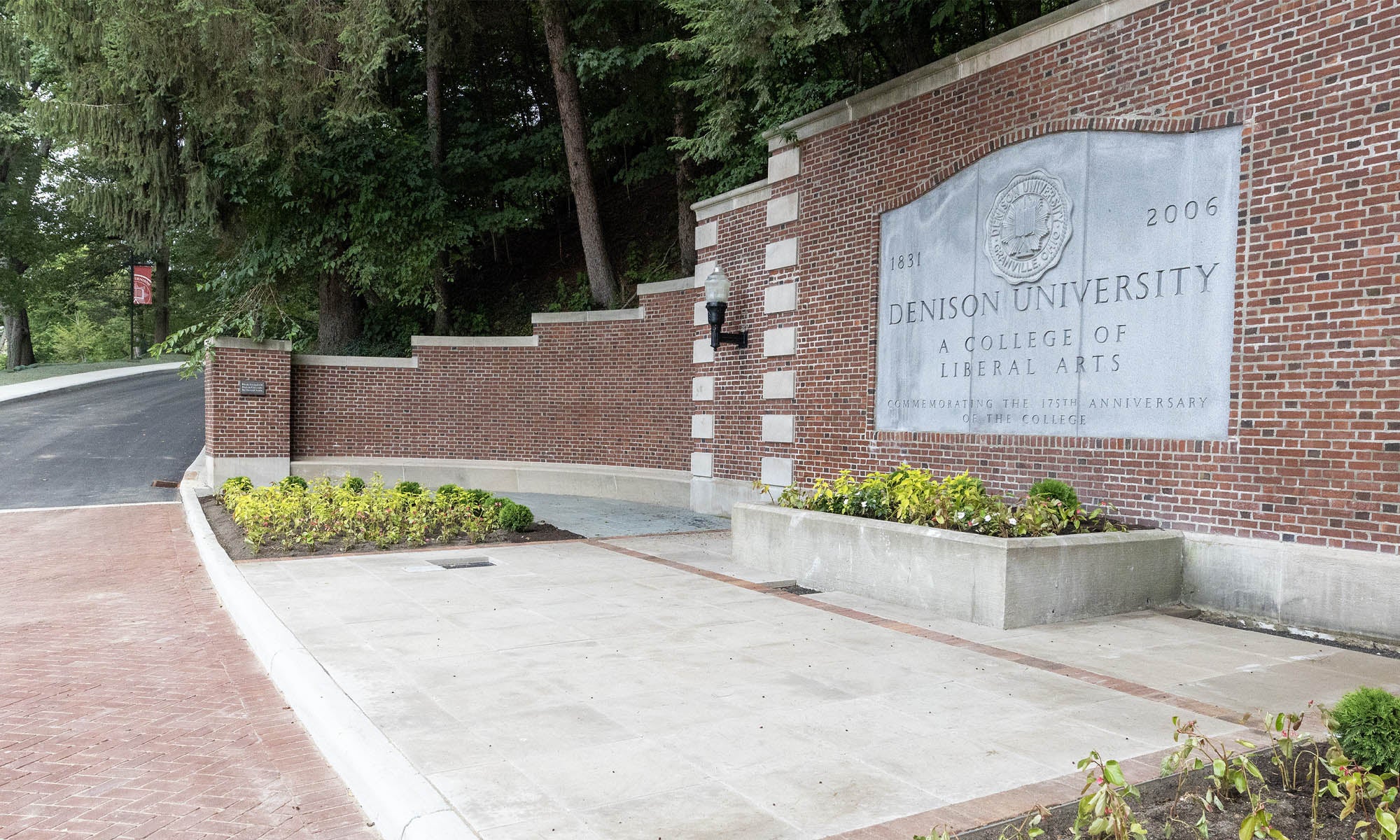
At the top of Presidents’ Drive, the newly restored, tree-lined road up The Hill, a new sign of Denison’s innovation and momentum is taking shape.
Construction on Dale and Tina Knobel Hall, formerly Doane Hall, is underway and on schedule to meet an anticipated fall 2026 opening. Denison’s renovation and expansion will transform the space into a state-of-the-art campus hub devoted to integrating data across the curriculum.
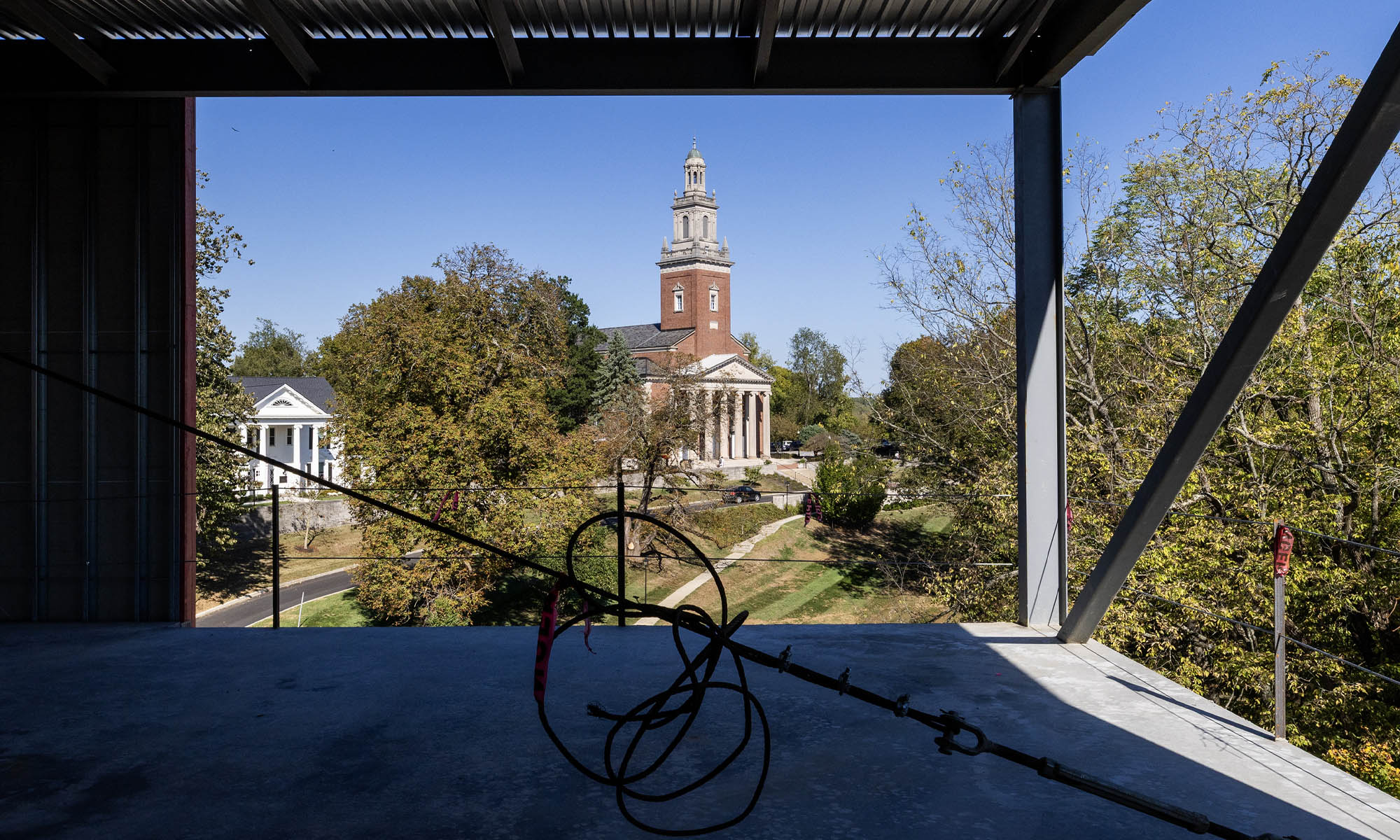
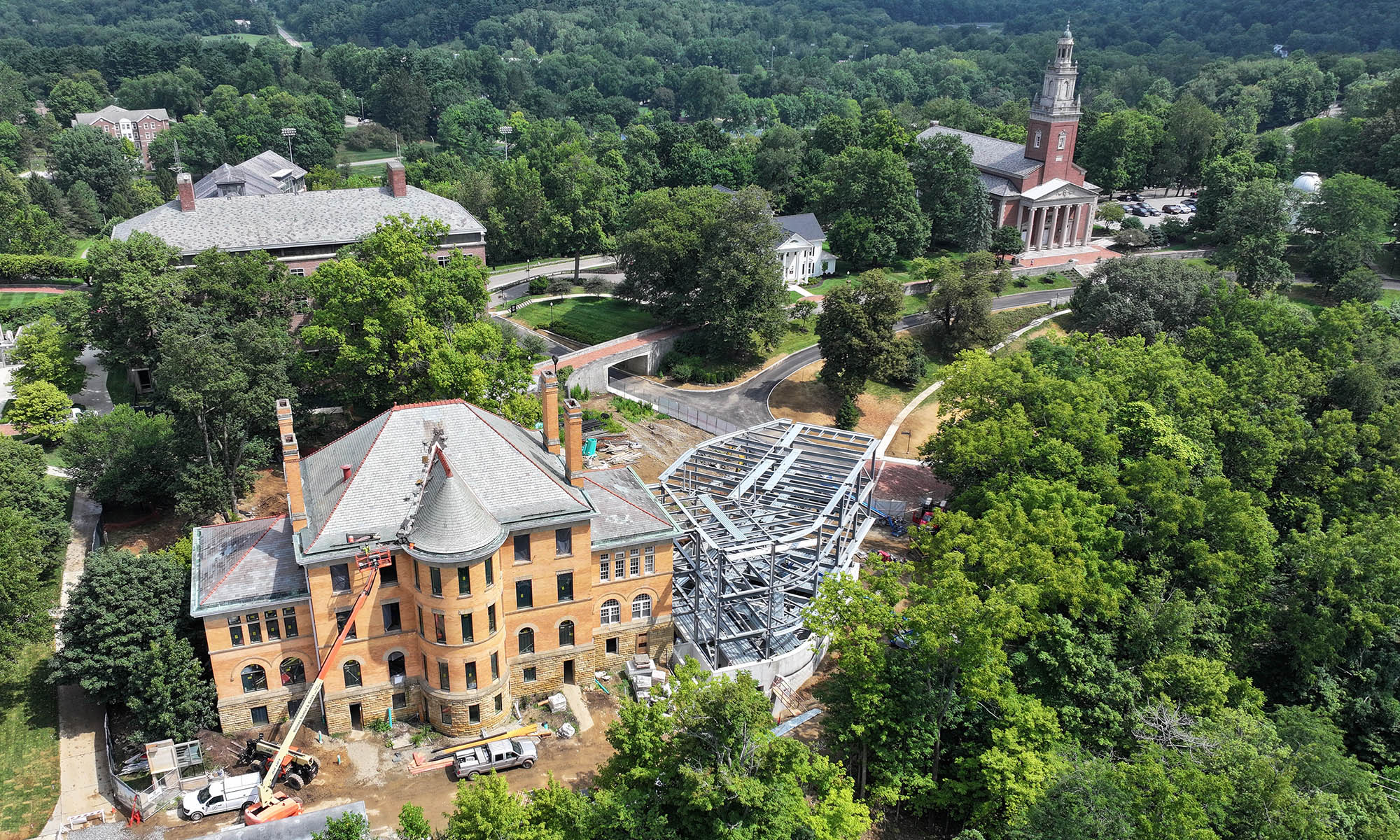
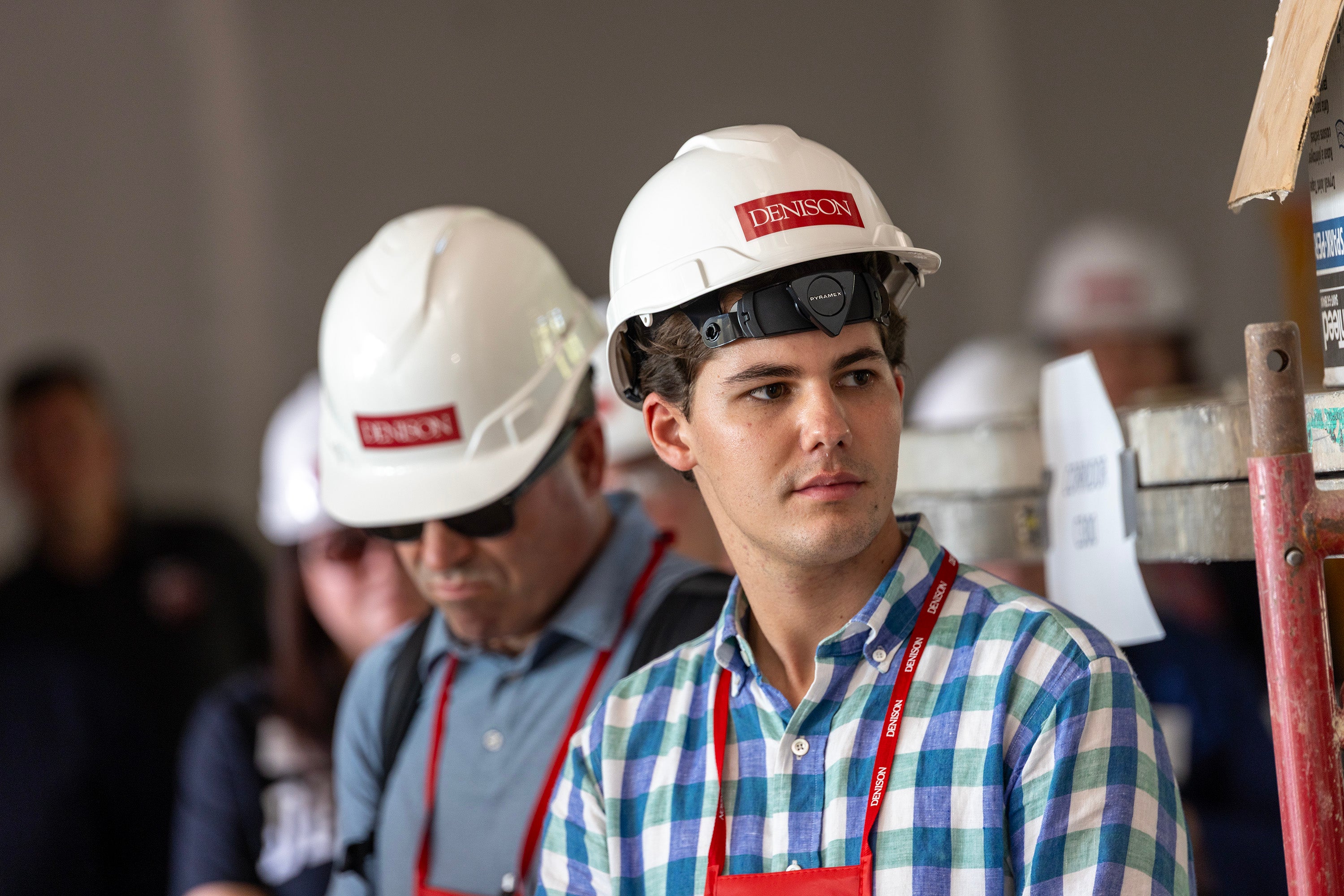
(Top) A novel view of Swasey from Knobel Hall, framed by construction girders for the new addition; (middle) Aerial view of Knobel Hall and King Center for Data and Innovation; (bottom photo) Hardharts are de rigour while touring the facility.
One of the most prominent and historic buildings on campus, the former Doane Hall has been renamed in recognition of a lead gift from the Sherman Fairchild Foundation to support the building’s renovation, made in honor of President Emeritus Dale Knobel and his wife, Tina. Denisonians Wally Burke ’71 (also a Denison life trustee) and President Emeritus Knobel are members of the foundation.
A second lead gift from Emily Hauser King ’63 and Robert E. King will establish the Emily Hauser King and Robert E. King Center for Data and Innovation, a new addition that anchors the expanded facility. The building will house Denison’s computer science and data analytics departments and serve as a campus-wide resource for courses in applied mathematics, digital humanities, financial economics, and data for political research.
Students, faculty, and visitors will enter Knobel Hall and the King Center through the building’s original doors, beneath the iconic sandstone archway. Terrazzo floors and wood-clad walls will lend a natural touch to high-tech areas. Large windows will flood spaces with light and open expansive views to Swasey Chapel and the Academic Quad. Exterior finishes on the addition will meld with the 1890s brick and sandstone, and the original building’s east exterior wall will be exposed in the new spaces.
“This is a defining moment for Denison,” said President Adam Weinberg. “This will help propel Denison graduates into successful lives and careers. Every single profession that our students will go into will be impacted by technology, data, large datasets, and artificial intelligence.”
Weinberg said the new center will empower Denison graduates to thrive in a world increasingly shaped by data while staying true to the liberal arts tradition that grounds their education.
“The liberal arts give the data sciences their heart, their soul, and their greatness,” he said. “Our students will not only master technical skills but also learn to ask the right questions, tell compelling stories, and lead with integrity.”
The extensive construction project, which necessitated a 12-week closure of Presidents’ Drive to enable the delivery of construction materials for Knobel Hall, opened new possibilities for Denison’s iconic entrance to campus.
Reconstructing Presidents’ Drive involved removing the existing road to a depth of two feet, installing new drainage, building a new stone foundation, and finishing with over eight inches of asphalt.
The drive has also been widened to a consistent 20 feet, improving safety and access. Using materials inspired by campus architecture — including red brick, limestone, and blue stone pavers — the reinvigorated entryway feels like a natural extension of The Hill, said Jake Preston, director of physical plant and capital projects.
“Presidents’ Drive is embedded in the memories of countless Denisonians,” Preston said. “It’s our visitors’ first experience on campus, we want to restore that first impression and renew that sense of arrival to Denison.”
A bold new entrance harkens to Denison’s history
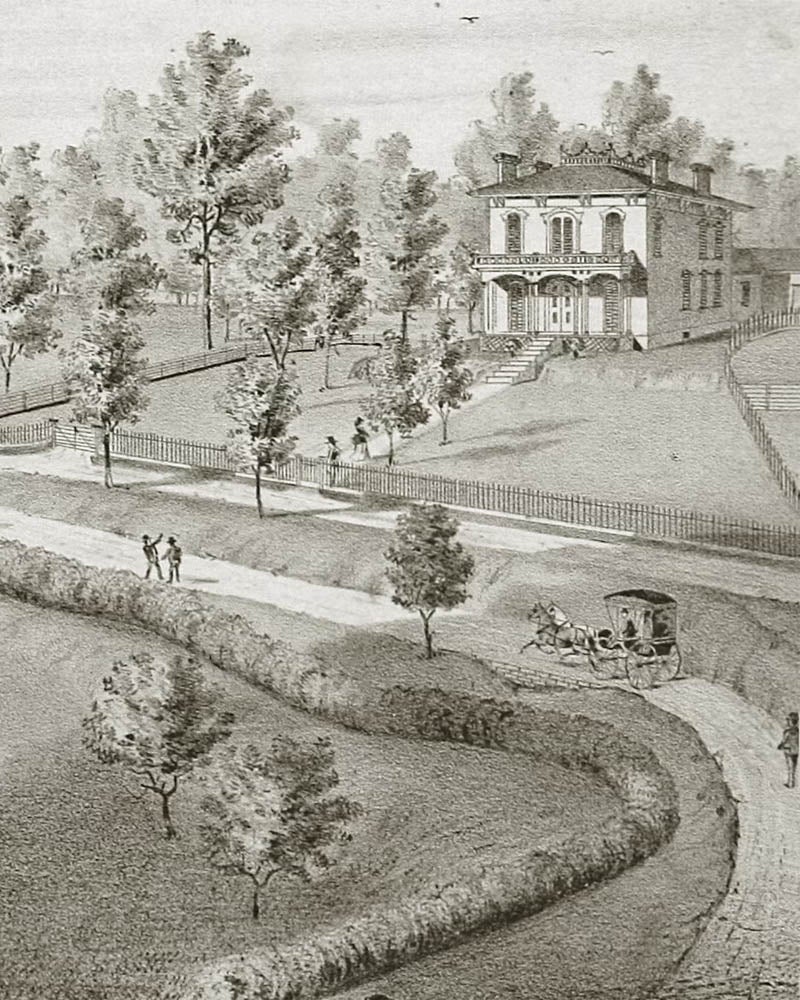
Fletcher O. Marsh’s home, now the location of Reese House.
Denison’s campus has continually evolved since its 1831 inception as the Granville Literary and Theological Institution.
In Denison University, 1831-1931: A Centennial History, Denison Professor and Trustee Francis W. Shepardson noted that the main campus grew from “24 acres, nearly half of it being a grove of old forest trees” to the 350-acre campus today, including dozens of beautification projects.
Eugene J. Barney, Denison Trustee 1881-1917, was responsible for adding several charming settings on The Hill at his own expense, including Davis Plaza, just south of the Academic Quad overlooking College Street.
Barney’s dedication to Denison was a legacy of his father, Eliam E. Barney, a Denison trustee who had been a professor of classics at Granville College before it was renamed Denison University.
Though Eliam Barney had moved his family to Dayton, where he had established a successful railroad car manufacturing company, Barney’s son, Eugene, retained his father’s high regard for the college. In addition to numerous beautification projects, Eugene donated Barney-Davis Hall, formerly known as the Barney Memorial Science Hall, to Denison in 1984 in honor of his father, who died in 1880.
In 1908, when Denison’s student count of 584 was “the highest number on record,” Barney installed the two familiar grand archways along College Avenue at the Burg Street curve and adjacent to Bryant (then Cleveland) Hall. Barney also had constructed a third, “most elaborate” entrance, at the top of today’s Presidents’ Drive.
The new entryway celebrates innovation while paying homage to Barney’s vision. Knobel Hall’s modern glass walls will overlook a green hillside and Presidents’ Drive. Wide stairs, reminiscent of the 1908 entrance, will lead up a gentle slope to terraces where students can learn in an outdoor classroom or enjoy some sunshine between classes.
A sidewalk winding around the Denison University wall creates a location for first-year and graduation selfies. Plantings, also heavily used in Barney’s plan, will provide a softening counterpoint to the architecture, as well as year-round color and interest.
“Our architects have accomplished something very special on this project,” Preston said. “They approached a beautiful old building with respect and innovation, and created an arrival that will resonate with Denisonians for years to come.”
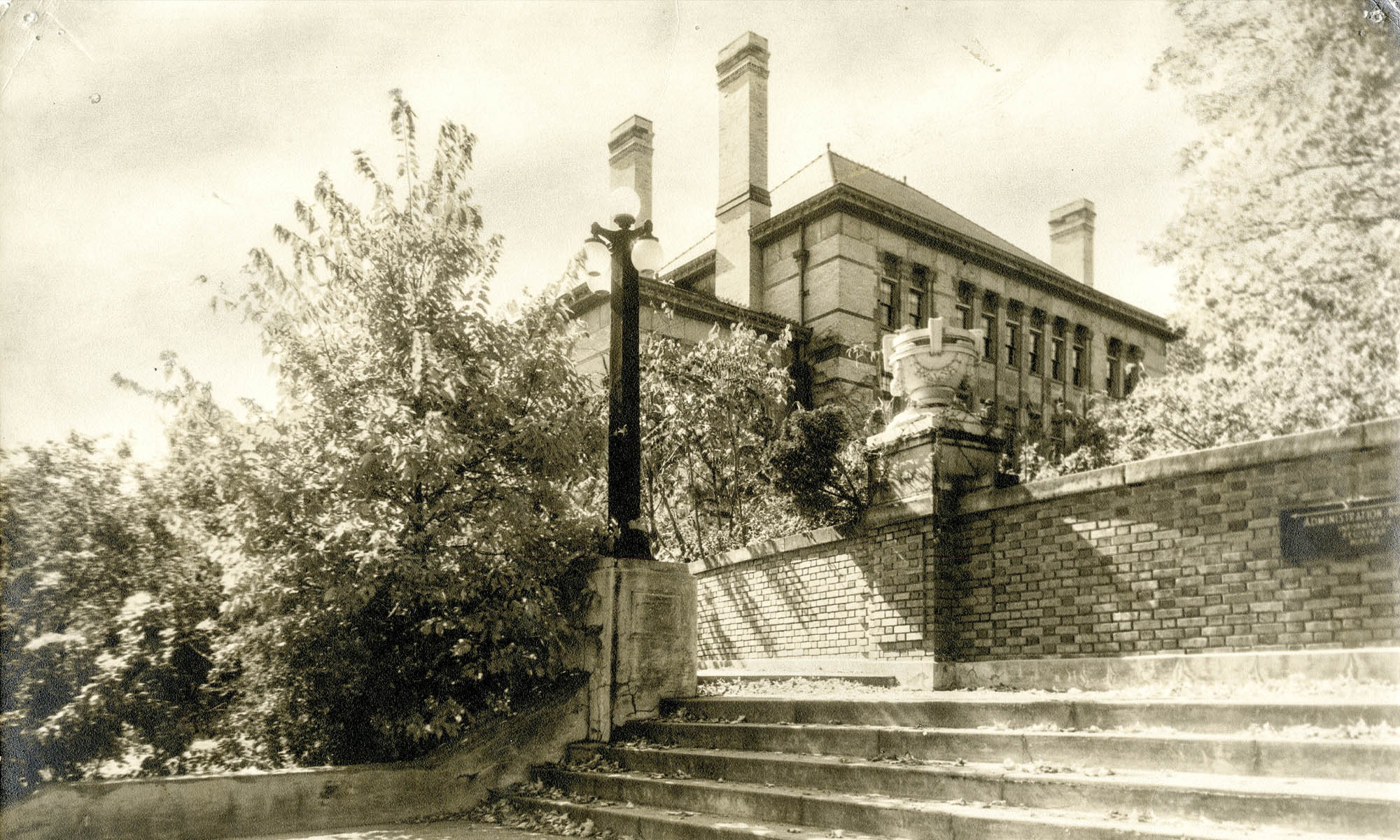
The former Grand Entrance, the “Avenue Gate,” as it was called in Shepardson’s book, was in place through 1964, when it was torn down as part of a larger Academic Quad update that included the construction of Fellows Hall and widening the underpass beneath the Chapel Walk bridge to accommodate sidewalks.
A long and winding road to the top of The Hill
It’s difficult to imagine visiting Denison without ascending Presidents’ Drive, but when the college first opened for classes, it quite literally wasn’t on the map. Instead, campus was entered via Burg Street through the West Gate entrance, near today’s Shorney Hall.
Denison Professor and one-time acting President Fletcher O. Marsh orchestrated the current entrance off Main and College streets in 1867.
Marsh’s home was on the site of what is now Reese House. Its location may have spurred him to act on his vision of an elegant, curved entryway to campus. In 1867, he purchased the acreage, surveyed the sinuous road, and donated that land to the college.
Denison constructed the drive, and in a shrewd move, Marsh sold the acreage, minus the portion he deeded to Denison, for the original purchase price. His road was quickly adopted as the main entrance to campus.
A road by any other name
For many years, Marsh’s entryway was named College Avenue. Records surrounding the change to Presidents’ Drive are unclear. Denison Archives places the official name change between 1930 and 1960.
On Arbor Day 1931, elms were planted along the drive, and small plaques honoring each president were installed. This may be the source of the road name today, but for several decades until the mid-1960s, maps indicated “Main Drag” was the name of choice.
Soon, a roadway that has welcomed generations of students, families, faculty, staff, alums, and notable visitors to The Hill will be crowned with a symbol of Denison’s continual forward-looking approach — bridging the liberal arts with cutting-edge technology and preparing students to lead in fields yet to be imagined.
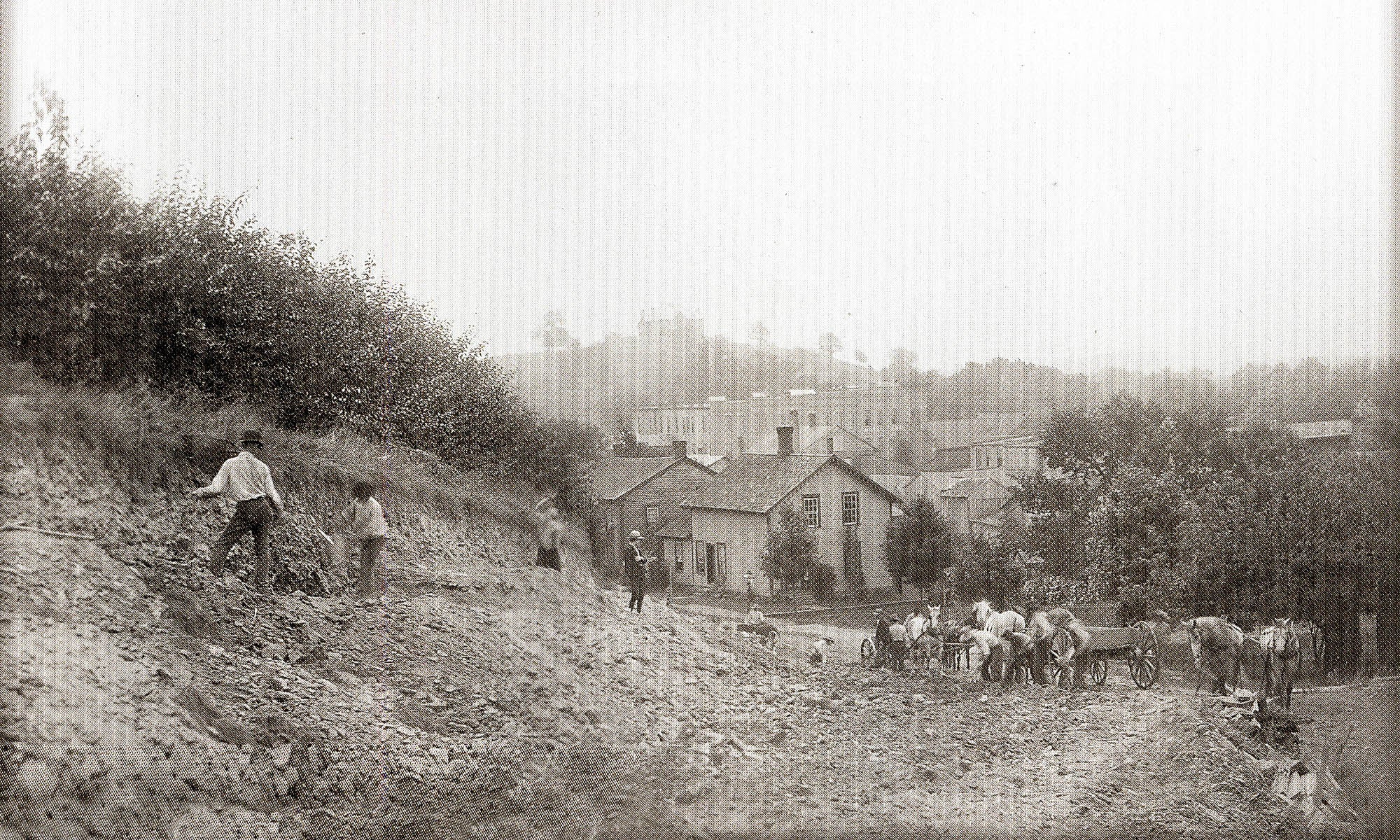
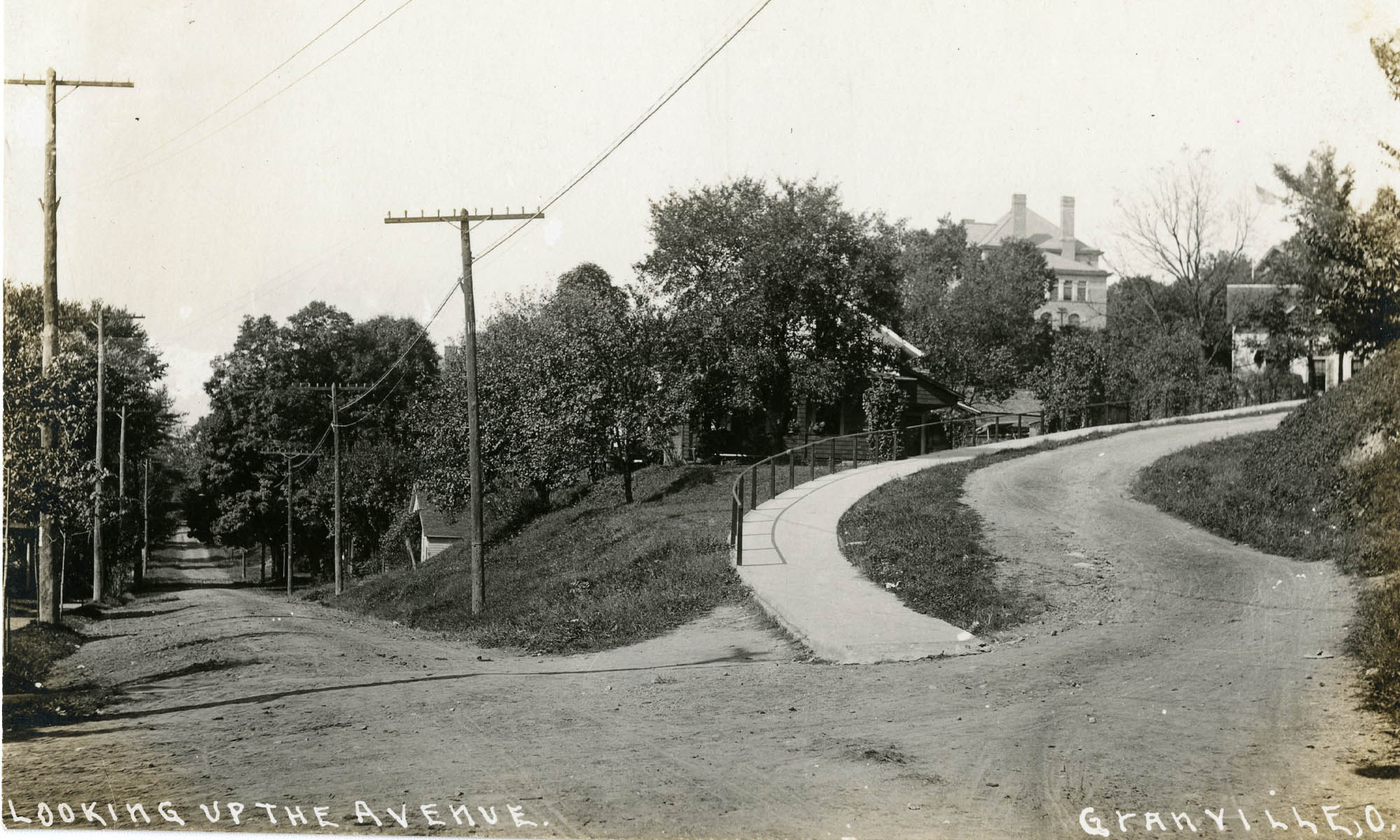
(First photo) Construction of the Marsh driveway cost $300 in 1867; (second photo) The approach off College Avenue, prior to the addition of the brick pillars and plaza in 1931, to honor the college’s 100th anniversary.
Grand Archways
The Gateways were embellished with quotations to “awaken and stimulate the minds of students.”
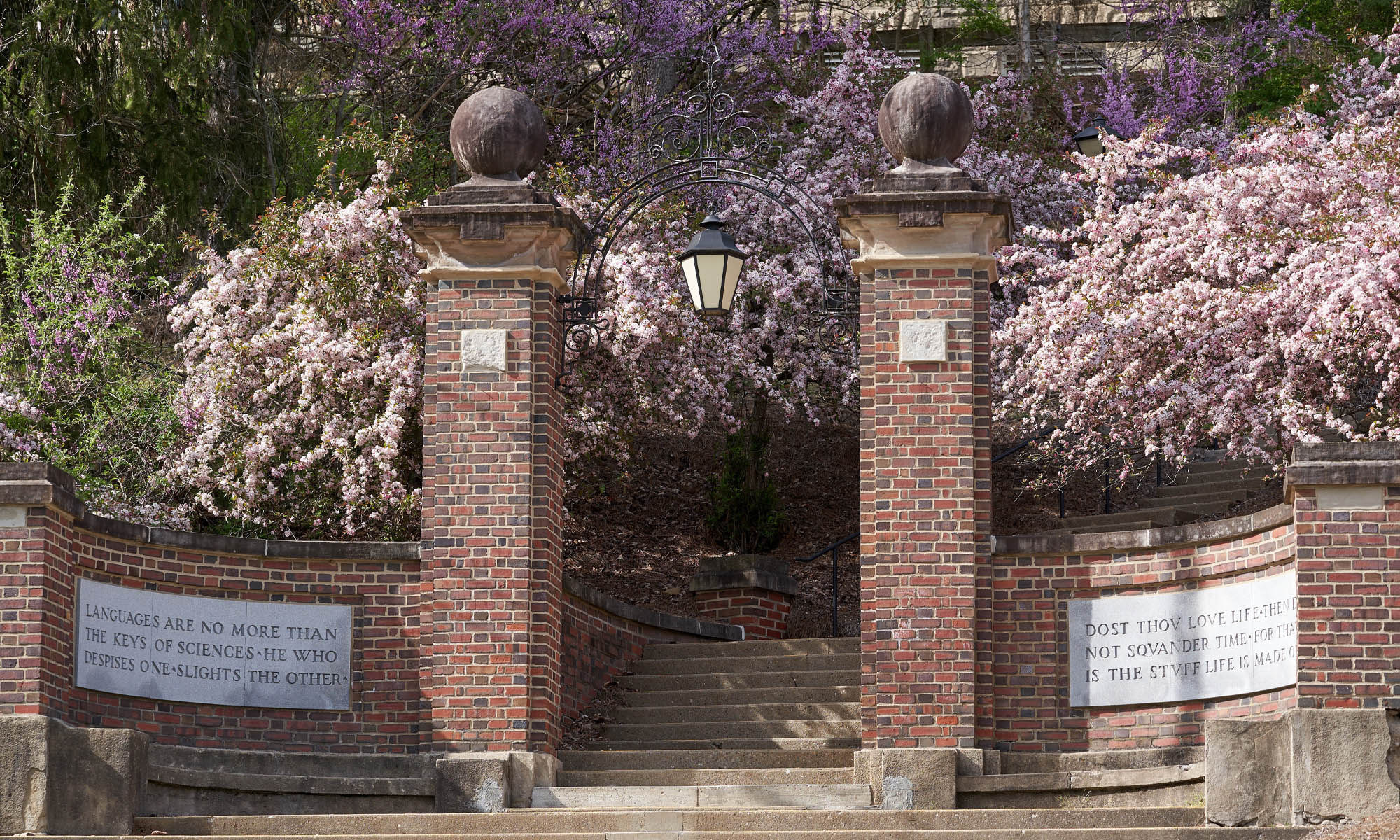
Burg Street Entrance
• Languages are no more than the keys of sciences • He who despises one • slights the other •
Attributed to the French philosopher Jean De La Bruyere
• Dost thou love life • Then do not squander time • for that is the stuff life is made of •
This aphorism is attributed to Benjamin Franklin and first appeared in Poor Richard’s Almanack.
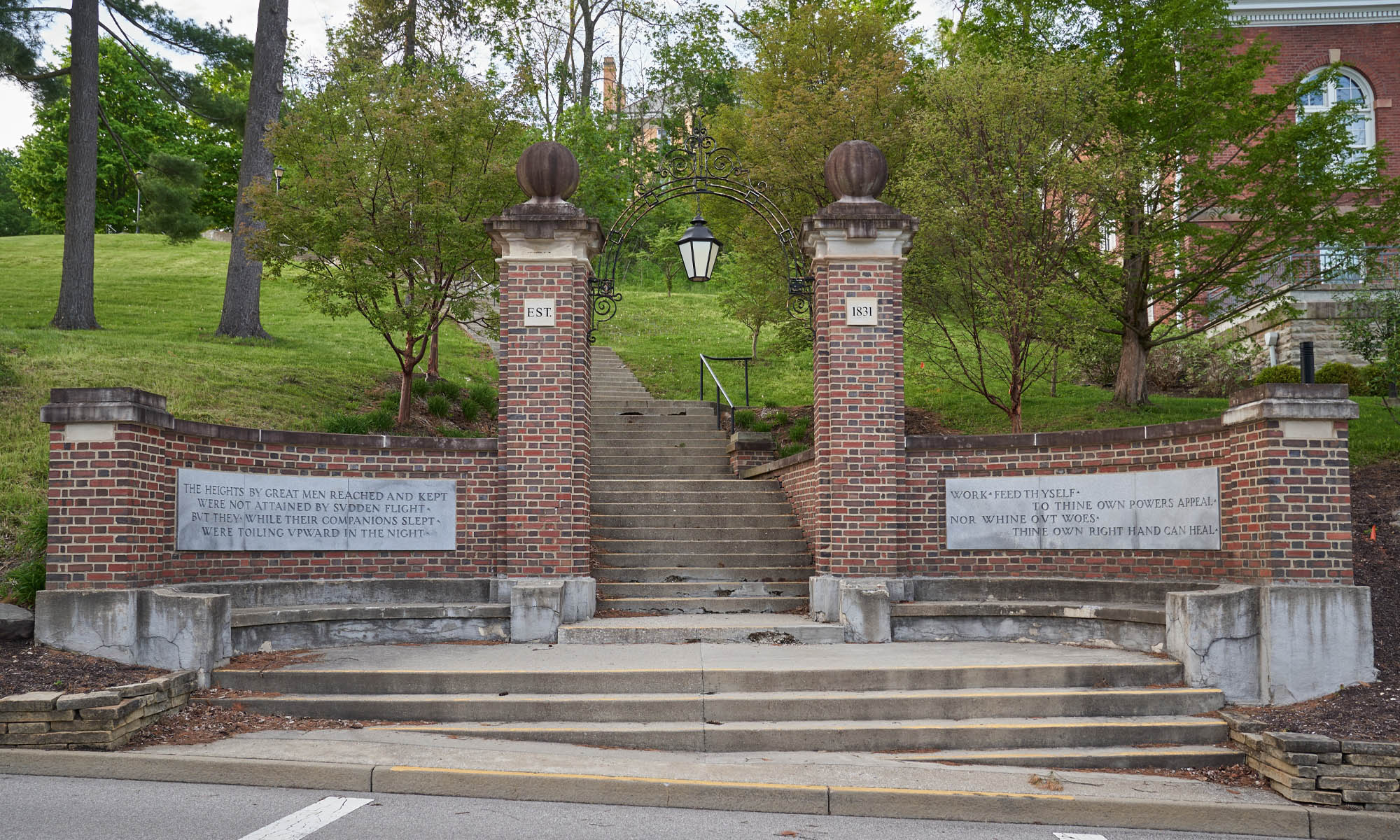
Bryant Hall Entrance
• The Heights by great men reached and kept were not attained by sudden flight • But they while their companions slept • were toiling upward in the night •
From Henry Wadsworth Longfellow’s poem The Ladder of St. Augustine
• Work • Feed thyself • to thine own powers appeal • nor whine out woes • thine own right hand can heal •
From a poem titled The Parish Register written by George Crabb