

As AI imposes a generational shift in how people live, learn, and work, Denison — informed by its vast network of alumni and employers, as well as several years of preparation to its advantage — is embracing the technology as a valuable tool for teaching and preparing students for careers.
“AI is reshaping how students arrive prepared to learn, how they expect to be taught, and what they need to know, including the need to develop new forms of digital fluency,” said President Adam Weinberg.
Having spent years focused on the intersection of academic innovation and workforce readiness, Denison, he said, is uniquely suited for this moment.
Technologists predict thriving in the age of AI is less about mastering a single technology and more about cultivating the intellectual agility, ethical grounding, and creative confidence to connect ideas across disciplines and adapt as technology evolves. That’s the essence of a liberal arts education.
Still, the moment demands an evolved approach for higher education. Every student, regardless of major, should graduate fully competent in analyzing and presenting data.
This is Denison’s aim, which is supported by the fall 2026 opening of the Emily Hauser King and Robert E. King Center for Data and Innovation, through routine faculty engagement and pedagogical experimentation, as well as leading broader conversations with its higher education peers.
“We are teaching students how to think critically about AI, use it ethically, and apply it creatively and strategically,” Provost Kim Coplin ’85 said.
Ahead of the curve
At Denison, faculty members are embracing AI with equal parts innovation and careful deliberation, continually experimenting and discovering new opportunities. “We’ve been working on this for a couple of years, and we are way ahead of the curve,” said Dean of the Faculty and Professor of Biology Jeff Thompson.
At a recent higher education leadership conference, Thompson was both “heartened and dismayed” to find that most of his peers at other colleges were just beginning to think about AI or “bogged down in ‘how we police it.’”
Denison, he said, has progressed to a deeper and more nuanced — as well as practical — level of discussion.
This fall, the faculty held a symposium to share their collective insights and approaches to teaching and learning using new AI tools and technology.
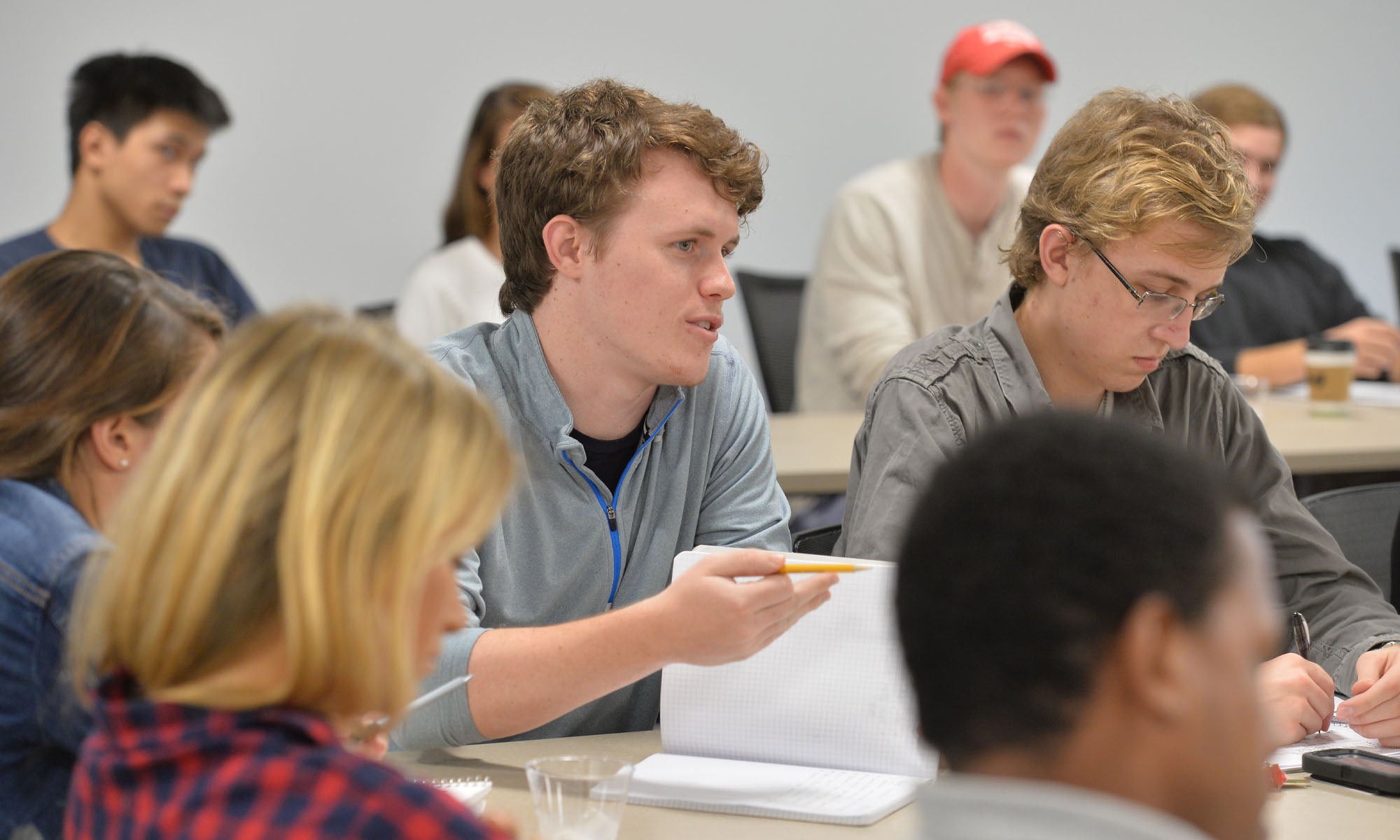
AI Futures Summit attendees discussed how to structure secure AI platforms, AI strategies for higher education, and AI certification programs for their campuses
Symposium presentations offered a window into some of the many ways professors innovate their classes through AI. They ranged across natural and social sciences, humanities, and the arts, from prompt engineer-ing to using AI for data analysis and visualizing literary text. The AI strategies are compiled in a new online faculty resource, Denison’s Faculty Handbook: Integrating AI in Teaching and Learning.
In her session, titled “Steal My Idea: How to reinvent the traditional essay with AI,” Malliga Och, associate professor of politics and public affairs, offered a new way to engage students in writing assignments.
She says that by asking students to evaluate an AI definition of a key concept, they can “demonstrate their knowledge of key concepts while learning about AI weaknesses.”
Och suggested using large language models (LLMs) such as ChatGPT and shared an AI analysis rubric and a list of questions for students to ask when read-ing AI-created content, such as “Is the information comprehensive and nuanced, rather than just complete?” and, “Is it objective?”
Denison faculty have the freedom to decide if and how they use AI. “We’re not telling our faculty to use AI in every class,” Thompson said. “We have to experiment, to be brave, try different things, and share with each other.” “We have to put it all out there.”
Leadership in higher education
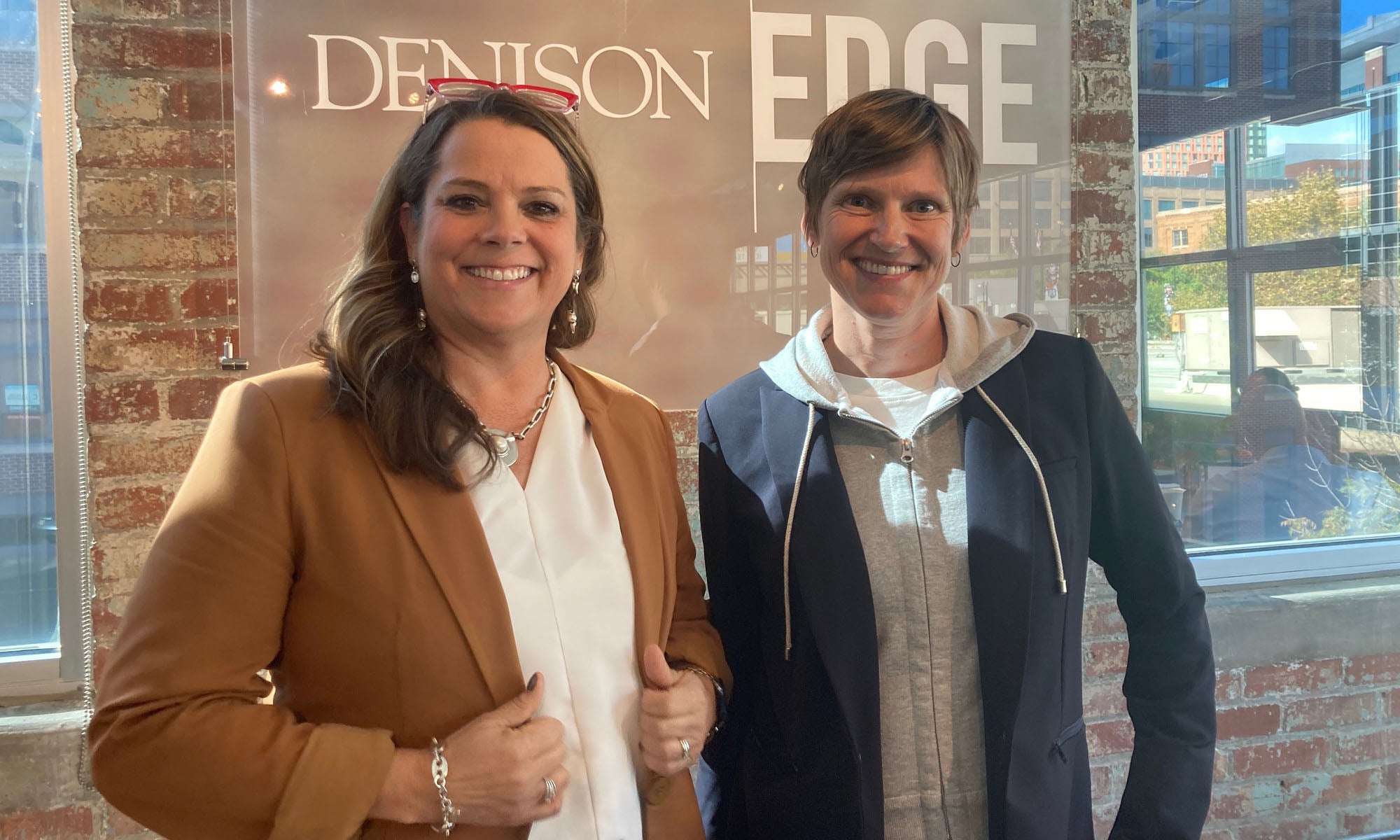
Kristi Wellington-Baker, Amazon Web Services Higher Education Strategy (left) with Denison Vice President and Chief Information Officer Liv Gjestvang.
As Denison continues to experiment with various AI approaches on campus, it’s also leading conversations, alongside its industry partners, for its higher education peers.
Partnering with Amazon Web Services (AWS), Denison invited a select group of higher education institutions to participate in an AI Certified Futures Summit in October.
Representatives from Bates, Bowdoin, Davidson, Penn State, Williams, as well as other colleges and universities attended the three-day event, where they discussed how to structure secure AI platforms, AI strategies for higher education, and AI certification programs for their campuses.
“The higher education mission is even more important with the advent of AI,” said Liv Gjestvang, Denison vice president and chief information officer. “Used well, AI can complement critical thinking and intellectual curiosity, and support the growth of our own workforce.”
Keynote speaker Kristi Wellington-Baker, who leads AWS’ Higher Education Strategy, discussed the many ways leaders in higher education and AI can partner on campus innovation.
“AI strategies can be integrated to increase digital literacy and experiential learning, to help students access financial aid, prepare them for careers, and more,” Wellington-Baker said.
Denison is partnering with AWS to create a custom AI platform, DenAI. Faculty and students are testing a pilot model that gives them secure access to generative AI tools such as ChatGPT and Claude through a single interface.
“The pilot allows us to develop some guide rails and expectations when using AI,” said Heath Hase, Denison’s senior director of innovation and technology. “We can learn what works, and our community can access higher models at a significant cost savings.”
Other ways Denison is powering forward include student and staff certification programs in AI and a partnership with the Ohio Supercomputer Center that supports faculty research with high-performance computing resources.
“AI is not just a technical tool,” Gjestvang said. “It’s challenging us to ask deeper human questions and foster new creativity. We are preparing our students for meaningful lives and careers in a future with very fast-paced technology innovation.”
AI's impact on career services
Denison’s employers and alumni, who have helped inform and calibrate its career services approach for years, are communicating their needs clearly. “Employers are saying they don’t want robots,” Melanie Murphy, executive director of the Knowlton Center for Career Exploration, said. “They want to know employees can be trusted with sensitive information and can use AI ethically.”
The Knowlton Center team is using AI to help students explore careers based on what they discover about them-selves, Murphy said. “It’s igniting them, not telling them what to do, by giving them ideas they never thought about before.”
Denison Edge, the college’s Columbus-based hub for learning workplace skills, offers certifications in AI. Red Frame Lab teaches design-thinking skills used by AI industry leaders to student entrepreneurs and student business consultants.
In a new AI student ambassador program offered by Lori Robbins, who leads Denison’s AI strategies, students learn AI skills they can teach their peers and take into local workplaces, helping those businesses advance in the technology.
She is also planning an AI summer camp for area students and their parents.
Integrating data literacy
The historic Doane Administration Building is being renovated and expanded to create a center that will create a state-of-the-art home for data, technology, and innovation on Denison’s campus.
The building is being renamed Dale and Tina Knobel Hall, in recognition of a lead gift from the Sherman Fairchild Foundation to support the building’s renovation, made in honor of President Emeritus Dale Knobel and his wife, Tina.
The Emily Hauser King and Robert E. King Center for Data and Innovation is a new addition that will anchor the expanded facility. The building will house Denison’s computer science and data analytics departments and serve as a campuswide resource for courses in applied mathematics, digital humanities, financial economics, and data for political research.
Matt Kretchmar, professor of computer science, is eager to partner with the King Center for a variety of supplementary skills on data, computation, coding, mathematics, and AI to help prepare students for more advanced classroom pedagogy, citing this example. “Students in my statistics course could receive supplementary training in the King Center on using AI as a technical assistant to program spreadsheets,” he said. “This would allow them to go deeper into statistical concepts.”
Kretchmar is looking forward to ways the King Center can provide immediate advantages for student/faculty research projects, which often require technological skills beyond classroom learning. “Students can receive technical assistance on analyzing their datasets. For example, a student could partner with the Center to perform clustering analysis on their data to look for patterns,” he said. “The King Center will be a great resource for this.”
“The life-changing benefits students will reap from the technological innovations made possible by Knobel Hall and the King Center will help propel Denison graduates into successful lives and careers,” said Weinberg. “Every single profession that our students will go into will be impacted by technology,